

Processes 2018, 6,38
After initial testing, standards were not subjected to the lysis steps along with samples but were
subjected only to the Hoechst treatment.
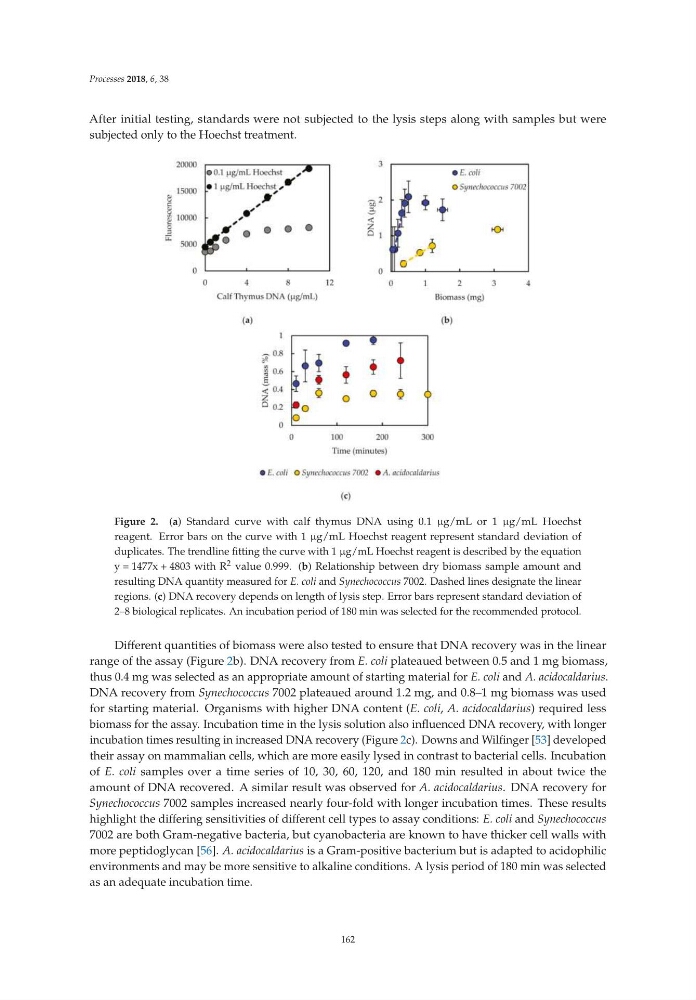
Figure 2. (a) Standard curve with calf thymus DNA using 0.1 µg/mL or 1 µg/mL Hoechst
reagent. Error bars on the curve with 1 µg/mL Hoechst reagent represent standard deviation of
duplicates. The trendline fitting the curve with 1 µg/mL Hoechst reagent is described by the equation
y = 1477x + 4803 with R 2 value 0.999. (b) Relationship between dry biomass sample amount and
resulting DNA quantity measured for E. coli and Synechococcus 7002. Dashed lines designate the linear
regions. (c) DNA recovery depends on length of lysis step. Error bars represent standard deviation of
2–8 biological replicates. An incubation period of 180 min was selected for the recommended protocol.
Different quantities of biomass were also tested to ensure that DNA recovery was in the linear
range of the assay (Figure 2b). DNA recovery from E. coli plateaued between 0.5 and 1 mg biomass,
thus 0.4 mg was selected as an appropriate amount of starting material for E. coli and A. acidocaldarius.
DNA recovery from Synechococcus 7002 plateaued around 1.2 mg, and 0.8–1 mg biomass was used
for starting material. Organisms with higher DNA content (E. coli, A. acidocaldarius) required less
biomass for the assay. Incubation time in the lysis solution also influenced DNA recovery, with longer
incubation times resulting in increased DNA recovery (Figure 2c). Downs and Wilfinger [53] developed
their assay on mammalian cells, which are more easily lysed in contrast to bacterial cells. Incubation
of E. coli samples over a time series of 10, 30, 60, 120, and 180 min resulted in about twice the
amount of DNA recovered. A similar result was observed for A. acidocaldarius. DNA recovery for
Synechococcus 7002 samples increased nearly four-fold with longer incubation times. These results
highlight the differing sensitivities of different cell types to assay conditions: E. coli and Synechococcus
7002 are both Gram-negative bacteria, but cyanobacteria are known to have thicker cell walls with
more peptidoglycan [56]. A. acidocaldarius is a Gram-positive bacterium but is adapted to acidophilic
environments and may be more sensitive to alkaline conditions. A lysis period of 180 min was selected
as an adequate incubation time.
162
After initial testing, standards were not subjected to the lysis steps along with samples but were
subjected only to the Hoechst treatment.
Figure 2. (a) Standard curve with calf thymus DNA using 0.1 µg/mL or 1 µg/mL Hoechst
reagent. Error bars on the curve with 1 µg/mL Hoechst reagent represent standard deviation of
duplicates. The trendline fitting the curve with 1 µg/mL Hoechst reagent is described by the equation
y = 1477x + 4803 with R 2 value 0.999. (b) Relationship between dry biomass sample amount and
resulting DNA quantity measured for E. coli and Synechococcus 7002. Dashed lines designate the linear
regions. (c) DNA recovery depends on length of lysis step. Error bars represent standard deviation of
2–8 biological replicates. An incubation period of 180 min was selected for the recommended protocol.
Different quantities of biomass were also tested to ensure that DNA recovery was in the linear
range of the assay (Figure 2b). DNA recovery from E. coli plateaued between 0.5 and 1 mg biomass,
thus 0.4 mg was selected as an appropriate amount of starting material for E. coli and A. acidocaldarius.
DNA recovery from Synechococcus 7002 plateaued around 1.2 mg, and 0.8–1 mg biomass was used
for starting material. Organisms with higher DNA content (E. coli, A. acidocaldarius) required less
biomass for the assay. Incubation time in the lysis solution also influenced DNA recovery, with longer
incubation times resulting in increased DNA recovery (Figure 2c). Downs and Wilfinger [53] developed
their assay on mammalian cells, which are more easily lysed in contrast to bacterial cells. Incubation
of E. coli samples over a time series of 10, 30, 60, 120, and 180 min resulted in about twice the
amount of DNA recovered. A similar result was observed for A. acidocaldarius. DNA recovery for
Synechococcus 7002 samples increased nearly four-fold with longer incubation times. These results
highlight the differing sensitivities of different cell types to assay conditions: E. coli and Synechococcus
7002 are both Gram-negative bacteria, but cyanobacteria are known to have thicker cell walls with
more peptidoglycan [56]. A. acidocaldarius is a Gram-positive bacterium but is adapted to acidophilic
environments and may be more sensitive to alkaline conditions. A lysis period of 180 min was selected
as an adequate incubation time.
162