

Processes 2018, 6,82
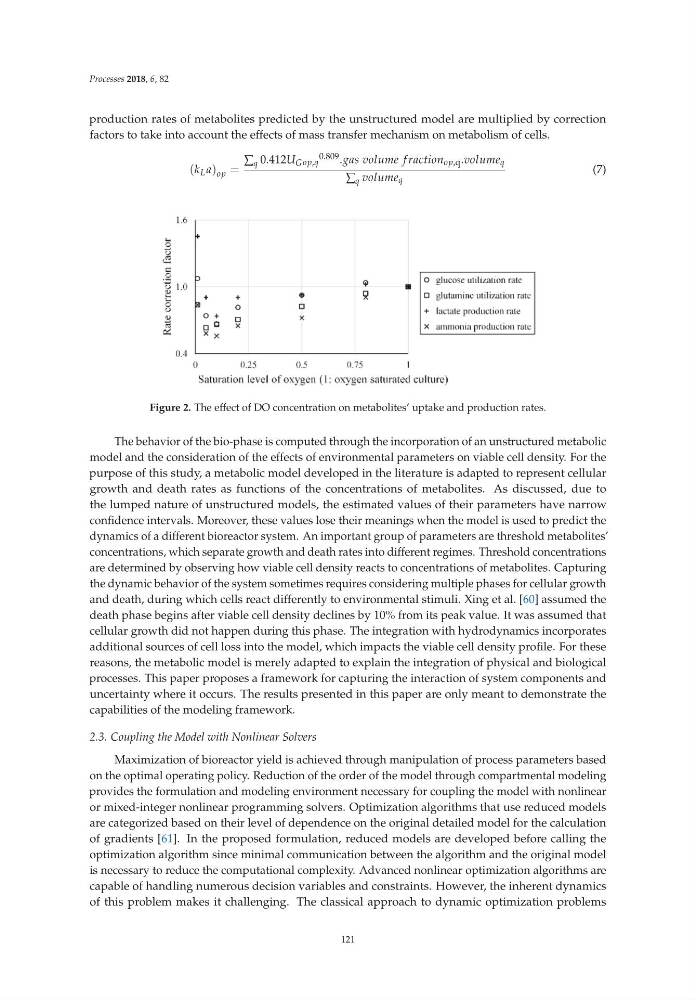
production rates of metabolites predicted by the unstructured model are multiplied by correction
factors to take into account the effects of mass transfer mechanism on metabolism of cells.
(k L a) op =
∑ q 0.412U G op,q
0.809 .gas volume f raction op,q .volume q
∑ q volume q
(7)
Figure 2. The effect of DO concentration on metabolites’ uptake and production rates.
The behavior of the bio-phase is computed through the incorporation of an unstructured metabolic
model and the consideration of the effects of environmental parameters on viable cell density. For the
purpose of this study, a metabolic model developed in the literature is adapted to represent cellular
growth and death rates as functions of the concentrations of metabolites. As discussed, due to
the lumped nature of unstructured models, the estimated values of their parameters have narrow
confidence intervals. Moreover, these values lose their meanings when the model is used to predict the
dynamics of a different bioreactor system. An important group of parameters are threshold metabolites’
concentrations, which separate growth and death rates into different regimes. Threshold concentrations
are determined by observing how viable cell density reacts to concentrations of metabolites. Capturing
the dynamic behavior of the system sometimes requires considering multiple phases for cellular growth
and death, during which cells react differently to environmental stimuli. Xing et al. [60] assumed the
death phase begins after viable cell density declines by 10% from its peak value. It was assumed that
cellular growth did not happen during this phase. The integration with hydrodynamics incorporates
additional sources of cell loss into the model, which impacts the viable cell density profile. For these
reasons, the metabolic model is merely adapted to explain the integration of physical and biological
processes. This paper proposes a framework for capturing the interaction of system components and
uncertainty where it occurs. The results presented in this paper are only meant to demonstrate the
capabilities of the modeling framework.
2.3. Coupling the Model with Nonlinear Solvers
Maximization of bioreactor yield is achieved through manipulation of process parameters based
on the optimal operating policy. Reduction of the order of the model through compartmental modeling
provides the formulation and modeling environment necessary for coupling the model with nonlinear
or mixed-integer nonlinear programming solvers. Optimization algorithms that use reduced models
are categorized based on their level of dependence on the original detailed model for the calculation
of gradients [61]. In the proposed formulation, reduced models are developed before calling the
optimization algorithm since minimal communication between the algorithm and the original model
is necessary to reduce the computational complexity. Advanced nonlinear optimization algorithms are
capable of handling numerous decision variables and constraints. However, the inherent dynamics
of this problem makes it challenging. The classical approach to dynamic optimization problems
121
production rates of metabolites predicted by the unstructured model are multiplied by correction
factors to take into account the effects of mass transfer mechanism on metabolism of cells.
(k L a) op =
∑ q 0.412U G op,q
0.809 .gas volume f raction op,q .volume q
∑ q volume q
(7)
Figure 2. The effect of DO concentration on metabolites’ uptake and production rates.
The behavior of the bio-phase is computed through the incorporation of an unstructured metabolic
model and the consideration of the effects of environmental parameters on viable cell density. For the
purpose of this study, a metabolic model developed in the literature is adapted to represent cellular
growth and death rates as functions of the concentrations of metabolites. As discussed, due to
the lumped nature of unstructured models, the estimated values of their parameters have narrow
confidence intervals. Moreover, these values lose their meanings when the model is used to predict the
dynamics of a different bioreactor system. An important group of parameters are threshold metabolites’
concentrations, which separate growth and death rates into different regimes. Threshold concentrations
are determined by observing how viable cell density reacts to concentrations of metabolites. Capturing
the dynamic behavior of the system sometimes requires considering multiple phases for cellular growth
and death, during which cells react differently to environmental stimuli. Xing et al. [60] assumed the
death phase begins after viable cell density declines by 10% from its peak value. It was assumed that
cellular growth did not happen during this phase. The integration with hydrodynamics incorporates
additional sources of cell loss into the model, which impacts the viable cell density profile. For these
reasons, the metabolic model is merely adapted to explain the integration of physical and biological
processes. This paper proposes a framework for capturing the interaction of system components and
uncertainty where it occurs. The results presented in this paper are only meant to demonstrate the
capabilities of the modeling framework.
2.3. Coupling the Model with Nonlinear Solvers
Maximization of bioreactor yield is achieved through manipulation of process parameters based
on the optimal operating policy. Reduction of the order of the model through compartmental modeling
provides the formulation and modeling environment necessary for coupling the model with nonlinear
or mixed-integer nonlinear programming solvers. Optimization algorithms that use reduced models
are categorized based on their level of dependence on the original detailed model for the calculation
of gradients [61]. In the proposed formulation, reduced models are developed before calling the
optimization algorithm since minimal communication between the algorithm and the original model
is necessary to reduce the computational complexity. Advanced nonlinear optimization algorithms are
capable of handling numerous decision variables and constraints. However, the inherent dynamics
of this problem makes it challenging. The classical approach to dynamic optimization problems
121