

Processes 2018, 6, 134
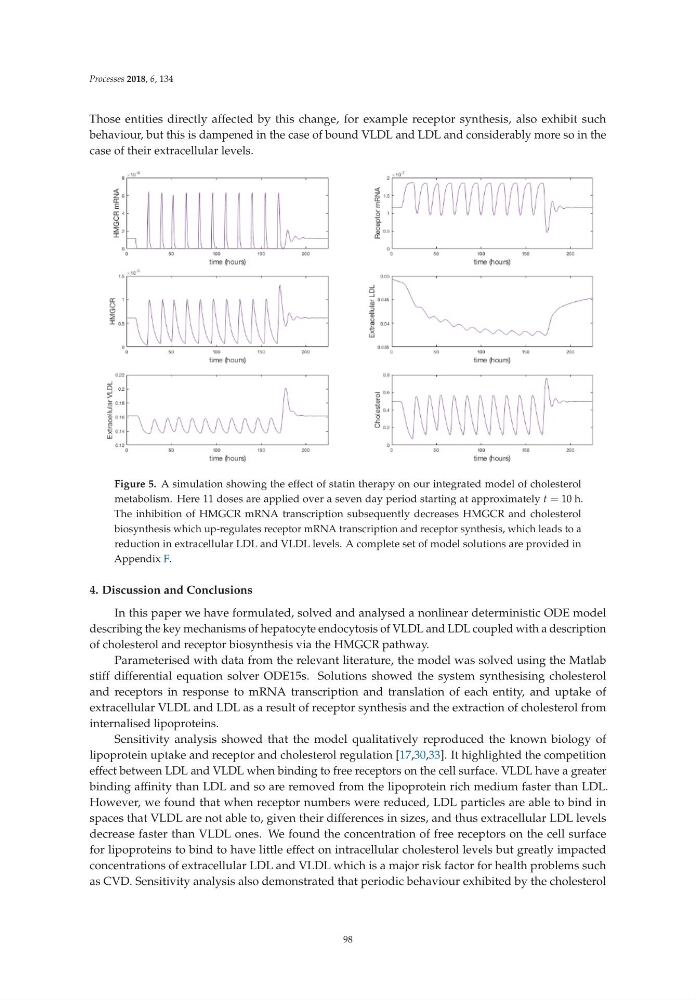
Those entities directly affected by this change, for example receptor synthesis, also exhibit such
behaviour, but this is dampened in the case of bound VLDL and LDL and considerably more so in the
case of their extracellular levels.
Figure 5. A simulation showing the effect of statin therapy on our integrated model of cholesterol
metabolism. Here 11 doses are applied over a seven day period starting at approximately t = 10 h.
The inhibition of HMGCR mRNA transcription subsequently decreases HMGCR and cholesterol
biosynthesis which up-regulates receptor mRNA transcription and receptor synthesis, which leads to a
reduction in extracellular LDL and VLDL levels. A complete set of model solutions are provided in
Appendix F.
4. Discussion and Conclusions
In this paper we have formulated, solved and analysed a nonlinear deterministic ODE model
describing the key mechanisms of hepatocyte endocytosis of VLDL and LDL coupled with a description
of cholesterol and receptor biosynthesis via the HMGCR pathway.
Parameterised with data from the relevant literature, the model was solved using the Matlab
stiff differential equation solver ODE15s. Solutions showed the system synthesising cholesterol
and receptors in response to mRNA transcription and translation of each entity, and uptake of
extracellular VLDL and LDL as a result of receptor synthesis and the extraction of cholesterol from
internalised lipoproteins.
Sensitivity analysis showed that the model qualitatively reproduced the known biology of
lipoprotein uptake and receptor and cholesterol regulation [17,30,33]. It highlighted the competition
effect between LDL and VLDL when binding to free receptors on the cell surface. VLDL have a greater
binding affinity than LDL and so are removed from the lipoprotein rich medium faster than LDL.
However, we found that when receptor numbers were reduced, LDL particles are able to bind in
spaces that VLDL are not able to, given their differences in sizes, and thus extracellular LDL levels
decrease faster than VLDL ones. We found the concentration of free receptors on the cell surface
for lipoproteins to bind to have little effect on intracellular cholesterol levels but greatly impacted
concentrations of extracellular LDL and VLDL which is a major risk factor for health problems such
as CVD. Sensitivity analysis also demonstrated that periodic behaviour exhibited by the cholesterol
98
Those entities directly affected by this change, for example receptor synthesis, also exhibit such
behaviour, but this is dampened in the case of bound VLDL and LDL and considerably more so in the
case of their extracellular levels.
Figure 5. A simulation showing the effect of statin therapy on our integrated model of cholesterol
metabolism. Here 11 doses are applied over a seven day period starting at approximately t = 10 h.
The inhibition of HMGCR mRNA transcription subsequently decreases HMGCR and cholesterol
biosynthesis which up-regulates receptor mRNA transcription and receptor synthesis, which leads to a
reduction in extracellular LDL and VLDL levels. A complete set of model solutions are provided in
Appendix F.
4. Discussion and Conclusions
In this paper we have formulated, solved and analysed a nonlinear deterministic ODE model
describing the key mechanisms of hepatocyte endocytosis of VLDL and LDL coupled with a description
of cholesterol and receptor biosynthesis via the HMGCR pathway.
Parameterised with data from the relevant literature, the model was solved using the Matlab
stiff differential equation solver ODE15s. Solutions showed the system synthesising cholesterol
and receptors in response to mRNA transcription and translation of each entity, and uptake of
extracellular VLDL and LDL as a result of receptor synthesis and the extraction of cholesterol from
internalised lipoproteins.
Sensitivity analysis showed that the model qualitatively reproduced the known biology of
lipoprotein uptake and receptor and cholesterol regulation [17,30,33]. It highlighted the competition
effect between LDL and VLDL when binding to free receptors on the cell surface. VLDL have a greater
binding affinity than LDL and so are removed from the lipoprotein rich medium faster than LDL.
However, we found that when receptor numbers were reduced, LDL particles are able to bind in
spaces that VLDL are not able to, given their differences in sizes, and thus extracellular LDL levels
decrease faster than VLDL ones. We found the concentration of free receptors on the cell surface
for lipoproteins to bind to have little effect on intracellular cholesterol levels but greatly impacted
concentrations of extracellular LDL and VLDL which is a major risk factor for health problems such
as CVD. Sensitivity analysis also demonstrated that periodic behaviour exhibited by the cholesterol
98