

209
Miscanthus for Bio-based Products
Cooking of the leaf-fraction results in much lower yield, brightness, and pulp
viscosity in comparison with stalks (Kordsachia et al., 1993). However, when
whole plant material is cooked, the adverse effect of leaves is hardly evident.
Miscanthus sinensis has some outstanding features in comparison with other
nonwood pulping raw materials, i.e., high delignification rate obtained with
a low chemical change. The high yield, good bleaching ability, and excellent
strength properties nearly match those of pulps prepared from poplar.
Organosolvent delignification has been suggested as an environmentally
friendly process and an alternative way for obtaining pulp. Organic reagents
have the potential to remove lignin and hemicelluloses at boiling temperatures. A variety of organic solvents such as esters, alcohols, ketones, and
organic acids have been offered for cooking (Barbash et al., 2011). Among
organic solvents, acetic acid is regarded as a potential agent to achieve extensive delignification due to its relatively low cost. The application of hydrogen
peroxide during cooking promotes delignification of raw materials; increased
brightness can also be achieved by delignification with peroxyl compounds.
At the same time, less pronounced degradation of the cellulose is observed
during cooking with such compounds. The cooking process is carried out at
low temperature which helps to reduce energy consumption.
11.4 Production of Pulp from M. × giganteus Biomass
Produced on Pb-Contaminated Soil
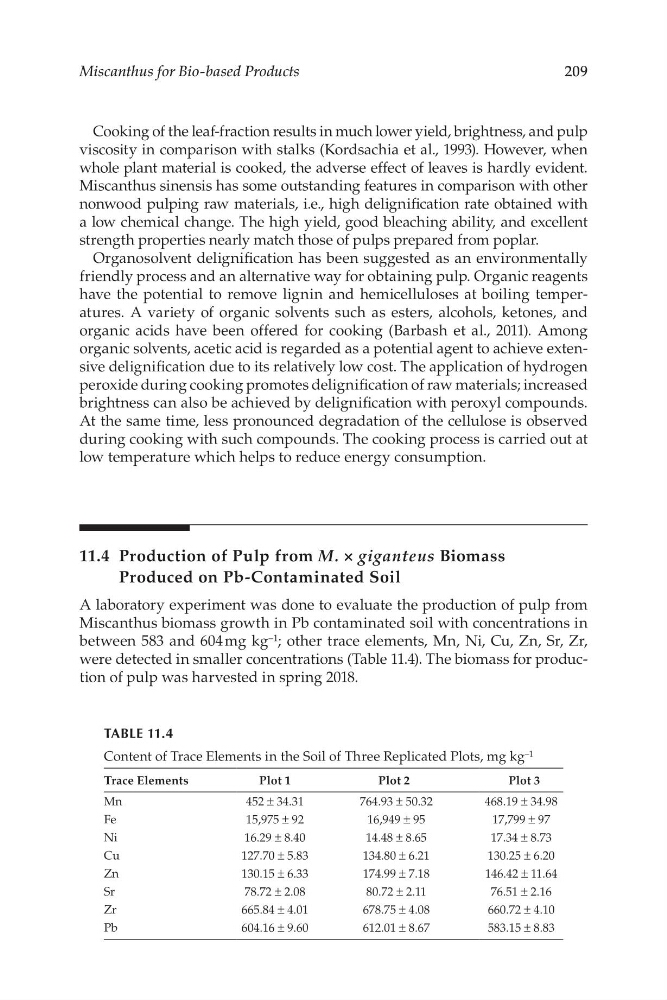
A laboratory experiment was done to evaluate the production of pulp from
Miscanthus biomass growth in Pb contaminated soil with concentrations in
between 583 and 604 mg kg −1 ; other trace elements, Mn, Ni, Cu, Zn, Sr, Zr,
were detected in smaller concentrations (Table 11.4). The biomass for production of pulp was harvested in spring 2018.
TABLE 11.4
Content of Trace Elements in the Soil of Three Replicated Plots, mg kg −1
Trace Elements
Plot 1
Plot 2
Plot 3
Mn
452 ± 34.31
764.93 ± 50.32
468.19 ± 34.98
Fe
15,975 ± 92
16,949 ± 95
17,799 ± 97
Ni
16.29 ± 8.40
14.48 ± 8.65
17.34 ± 8.73
Cu
127.70 ± 5.83
134.80 ± 6.21
130.25 ± 6.20
Zn
130.15 ± 6.33
174.99 ± 7.18
146.42 ± 11.64
Sr
78.72 ± 2.08
80.72 ± 2.11
76.51 ± 2.16
Zr
665.84 ± 4.01
678.75 ± 4.08
660.72 ± 4.10
Pb
604.16 ± 9.60
612.01 ± 8.67
583.15 ± 8.83
Miscanthus for Bio-based Products
Cooking of the leaf-fraction results in much lower yield, brightness, and pulp
viscosity in comparison with stalks (Kordsachia et al., 1993). However, when
whole plant material is cooked, the adverse effect of leaves is hardly evident.
Miscanthus sinensis has some outstanding features in comparison with other
nonwood pulping raw materials, i.e., high delignification rate obtained with
a low chemical change. The high yield, good bleaching ability, and excellent
strength properties nearly match those of pulps prepared from poplar.
Organosolvent delignification has been suggested as an environmentally
friendly process and an alternative way for obtaining pulp. Organic reagents
have the potential to remove lignin and hemicelluloses at boiling temperatures. A variety of organic solvents such as esters, alcohols, ketones, and
organic acids have been offered for cooking (Barbash et al., 2011). Among
organic solvents, acetic acid is regarded as a potential agent to achieve extensive delignification due to its relatively low cost. The application of hydrogen
peroxide during cooking promotes delignification of raw materials; increased
brightness can also be achieved by delignification with peroxyl compounds.
At the same time, less pronounced degradation of the cellulose is observed
during cooking with such compounds. The cooking process is carried out at
low temperature which helps to reduce energy consumption.
11.4 Production of Pulp from M. × giganteus Biomass
Produced on Pb-Contaminated Soil
A laboratory experiment was done to evaluate the production of pulp from
Miscanthus biomass growth in Pb contaminated soil with concentrations in
between 583 and 604 mg kg −1 ; other trace elements, Mn, Ni, Cu, Zn, Sr, Zr,
were detected in smaller concentrations (Table 11.4). The biomass for production of pulp was harvested in spring 2018.
TABLE 11.4
Content of Trace Elements in the Soil of Three Replicated Plots, mg kg −1
Trace Elements
Plot 1
Plot 2
Plot 3
Mn
452 ± 34.31
764.93 ± 50.32
468.19 ± 34.98
Fe
15,975 ± 92
16,949 ± 95
17,799 ± 97
Ni
16.29 ± 8.40
14.48 ± 8.65
17.34 ± 8.73
Cu
127.70 ± 5.83
134.80 ± 6.21
130.25 ± 6.20
Zn
130.15 ± 6.33
174.99 ± 7.18
146.42 ± 11.64
Sr
78.72 ± 2.08
80.72 ± 2.11
76.51 ± 2.16
Zr
665.84 ± 4.01
678.75 ± 4.08
660.72 ± 4.10
Pb
604.16 ± 9.60
612.01 ± 8.67
583.15 ± 8.83