

208
Phytotechnology with Biomass Production
For papermaking, the internodes of Miscanthus stalks have better cellular
composition than the nodes and pith. The stalks require less alkali for Kraft
pulping compared to birch (Danielewicz et al., 2018; Kordsachia & Patt, 1991).
The technique used for the pulping operations consists of three procedures:
preliminary dry-mechanical treatment which initially compresses the crop’s
stems, a high yield pulping process, followed by a peroxide bleach sequence.
Cappelletto et al. (2000) argued that cells found in biomass, i.e., epithelial, sclerenchyma, parenchyma, and medullar rays do not possess the correct dimensions for papermaking. Hence, it is necessary to reduce the number of these
cells prior to the pulping process by dry-mechanical treatment. This divides
the raw material into uniform segments and to remove leaves and pith. In
turn, this pretreatment decreases the chemical consumption during pulping,
thus reducing pollution of wastewater. To generate papermaking pulps from
fibrous fractions of Miscanthus, a four-stage mechanical pretreatment operation was designed (Cappelletto & Mongardini, 1997). The first stage compacted the Miscanthus stalks by cutting the raw material using a blade mill.
The second step used fans to transport the cut material, and the third stage
contained a cyclone that was utilized to divide light fractions. Finally, the last
stage separated hefty fines. These operations help to obtain a higher number
of fibers because foreign matter like dust, sand, and pebbles are removed; it
eliminates useless material such as leaves, pith, epithelial, and parenchyma
cells of stems. The resulting material will contain a higher percentage of fibers.
There are few standard methods for obtaining pulp from wood and nonwood raw materials, i.e., the sulfate, sulfite, and neutral-sulfite methods.
These negatively influence the environment because of the application of
sulfur-containing reagents for lignin removal from plant materials. Most of
the lignin is removed during cooking, but there is some residual lignin that
can be removed in an additional stage by bleaching, using chlorine-based
and oxygen-based chemicals (Smook, 2002).
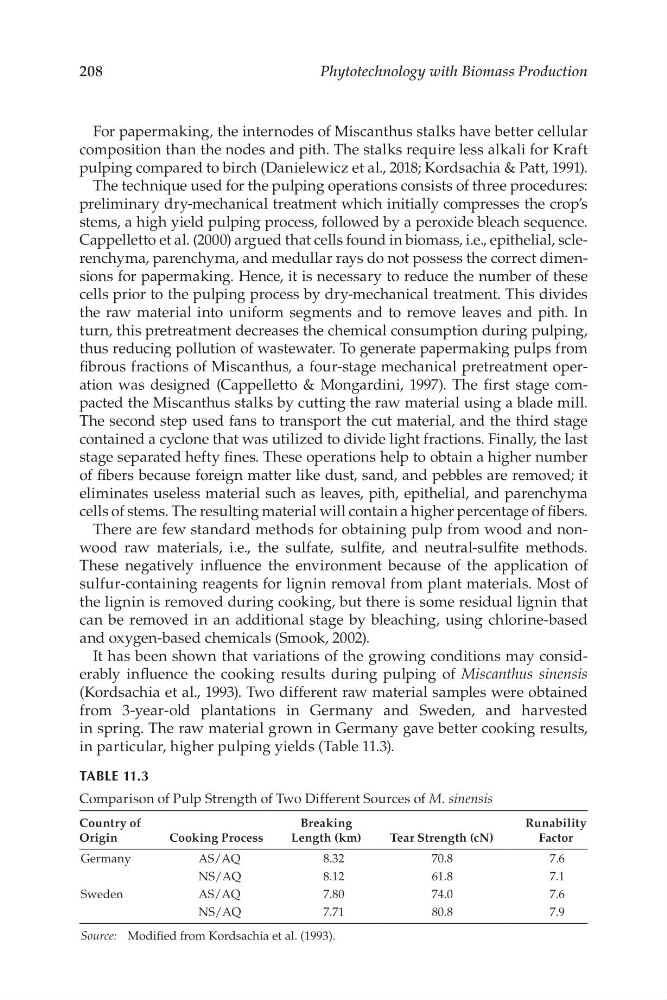
It has been shown that variations of the growing conditions may considerably influence the cooking results during pulping of Miscanthus sinensis
(Kordsachia et al., 1993). Two different raw material samples were obtained
from 3-year-old plantations in Germany and Sweden, and harvested
in spring. The raw material grown in Germany gave better cooking results,
in particular, higher pulping yields (Table 11.3).
TABLE 11.3
Comparison of Pulp Strength of Two Different Sources of M. sinensis
Country of
Breaking
Runability
Origin
Cooking Process
Length (km)
Tear Strength (cN)
Factor
Germany
AS/AQ
8.32
70.8
7.6
NS/AQ
8.12
61.8
7.1
Sweden
AS/AQ
7.80
74.0
7.6
NS/AQ
7.71
80.8
7.9
Source: Modified from Kordsachia et al. (1993).