

181
Miscanthus Biomass for Energy
conversion (combustion, pyrolysis, and gasification) of Miscanthus biomass
to heat, power, bio-oil, and syngas is also presented. In addition, the internal
and external factors that have significant influences on anaerobic digestion
and thermochemical conversion performances of Miscanthus biomass are
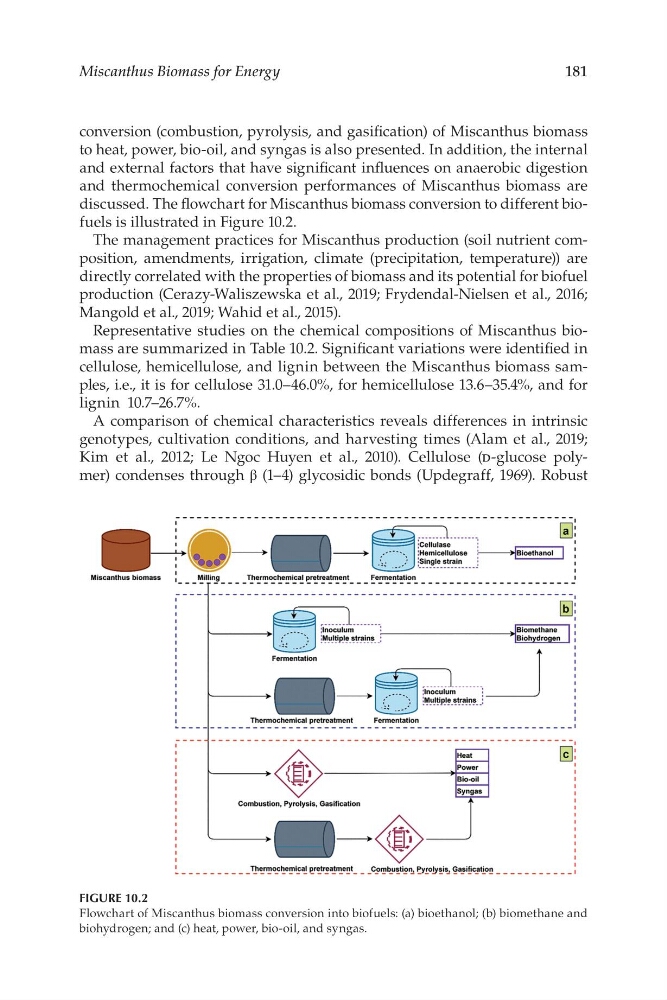
discussed. The flowchart for Miscanthus biomass conversion to different biofuels is illustrated in Figure 10.2.
The management practices for Miscanthus production (soil nutrient composition, amendments, irrigation, climate (precipitation, temperature)) are
directly correlated with the properties of biomass and its potential for biofuel
production (Cerazy-Waliszewska et al., 2019; Frydendal-Nielsen et al., 2016;
Mangold et al., 2019; Wahid et al., 2015).
Representative studies on the chemical compositions of Miscanthus biomass are summarized in Table 10.2. Significant variations were identified in
cellulose, hemicellulose, and lignin between the Miscanthus biomass samples, i.e., it is for cellulose 31.0–46.0%, for hemicellulose 13.6–35.4%, and for
lignin 10.7–26.7%.
A comparison of chemical characteristics reveals differences in intrinsic
genotypes, cultivation conditions, and harvesting times (Alam et al., 2019;
Kim et al., 2012; Le Ngoc Huyen et al., 2010). Cellulose (d-glucose polymer) condenses through β (1–4) glycosidic bonds (Updegraff, 1969). Robust
FIGURE 10.2
Flowchart of Miscanthus biomass conversion into biofuels: (a) bioethanol; (b) biomethane and
biohydrogen; and (c) heat, power, bio-oil, and syngas.
Miscanthus Biomass for Energy
conversion (combustion, pyrolysis, and gasification) of Miscanthus biomass
to heat, power, bio-oil, and syngas is also presented. In addition, the internal
and external factors that have significant influences on anaerobic digestion
and thermochemical conversion performances of Miscanthus biomass are
discussed. The flowchart for Miscanthus biomass conversion to different biofuels is illustrated in Figure 10.2.
The management practices for Miscanthus production (soil nutrient composition, amendments, irrigation, climate (precipitation, temperature)) are
directly correlated with the properties of biomass and its potential for biofuel
production (Cerazy-Waliszewska et al., 2019; Frydendal-Nielsen et al., 2016;
Mangold et al., 2019; Wahid et al., 2015).
Representative studies on the chemical compositions of Miscanthus biomass are summarized in Table 10.2. Significant variations were identified in
cellulose, hemicellulose, and lignin between the Miscanthus biomass samples, i.e., it is for cellulose 31.0–46.0%, for hemicellulose 13.6–35.4%, and for
lignin 10.7–26.7%.
A comparison of chemical characteristics reveals differences in intrinsic
genotypes, cultivation conditions, and harvesting times (Alam et al., 2019;
Kim et al., 2012; Le Ngoc Huyen et al., 2010). Cellulose (d-glucose polymer) condenses through β (1–4) glycosidic bonds (Updegraff, 1969). Robust
FIGURE 10.2
Flowchart of Miscanthus biomass conversion into biofuels: (a) bioethanol; (b) biomethane and
biohydrogen; and (c) heat, power, bio-oil, and syngas.