

180
Phytotechnology with Biomass Production
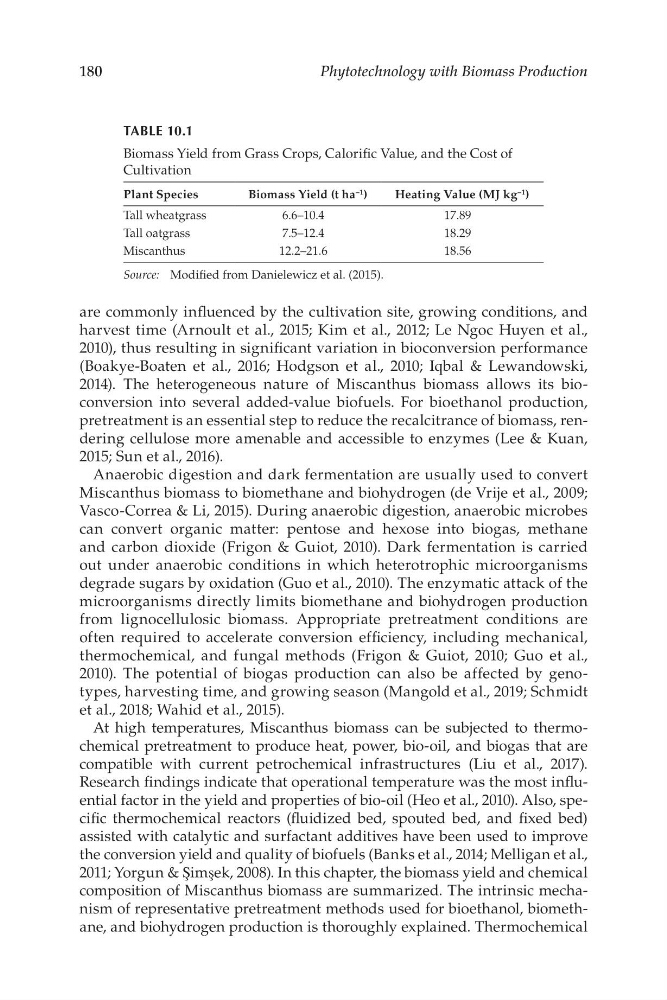
TABLE 10.1
Biomass Yield from Grass Crops, Calorific Value, and the Cost of
Cultivation
Plant Species
Biomass Yield (t ha −1 )
Heating Value (MJ kg −1 )
Tall wheatgrass
6.6–10.4
17.89
Tall oatgrass
7.5–12.4
18.29
Miscanthus
12.2–21.6
18.56
Source: Modified from Danielewicz et al. (2015).
are commonly influenced by the cultivation site, growing conditions, and
harvest time (Arnoult et al., 2015; Kim et al., 2012; Le Ngoc Huyen et al.,
2010), thus resulting in significant variation in bioconversion performance
(Boakye-Boaten et al., 2016; Hodgson et al., 2010; Iqbal & Lewandowski,
2014). The heterogeneous nature of Miscanthus biomass allows its bioconversion into several added-value biofuels. For bioethanol production,
pretreatment is an essential step to reduce the recalcitrance of biomass, rendering cellulose more amenable and accessible to enzymes (Lee & Kuan,
2015; Sun et al., 2016).
Anaerobic digestion and dark fermentation are usually used to convert
Miscanthus biomass to biomethane and biohydrogen (de Vrije et al., 2009;
Vasco-Correa & Li, 2015). During anaerobic digestion, anaerobic microbes
can convert organic matter: pentose and hexose into biogas, methane
and carbon dioxide (Frigon & Guiot, 2010). Dark fermentation is carried
out under anaerobic conditions in which heterotrophic microorganisms
degrade sugars by oxidation (Guo et al., 2010). The enzymatic attack of the
microorganisms directly limits biomethane and biohydrogen production
from lignocellulosic biomass. Appropriate pretreatment conditions are
often required to accelerate conversion efficiency, including mechanical,
thermochemical, and fungal methods (Frigon & Guiot, 2010; Guo et al.,
2010). The potential of biogas production can also be affected by genotypes, harvesting time, and growing season (Mangold et al., 2019; Schmidt
et al., 2018; Wahid et al., 2015).
At high temperatures, Miscanthus biomass can be subjected to thermochemical pretreatment to produce heat, power, bio-oil, and biogas that are
compatible with current petrochemical infrastructures (Liu et al., 2017).
Research findings indicate that operational temperature was the most influential factor in the yield and properties of bio-oil (Heo et al., 2010). Also, specific thermochemical reactors (fluidized bed, spouted bed, and fixed bed)
assisted with catalytic and surfactant additives have been used to improve
the conversion yield and quality of biofuels (Banks et al., 2014; Melligan et al.,
2011; Yorgun & Şimşek, 2008). In this chapter, the biomass yield and chemical
composition of Miscanthus biomass are summarized. The intrinsic mechanism of representative pretreatment methods used for bioethanol, biomethane, and biohydrogen production is thoroughly explained. Thermochemical
Phytotechnology with Biomass Production
TABLE 10.1
Biomass Yield from Grass Crops, Calorific Value, and the Cost of
Cultivation
Plant Species
Biomass Yield (t ha −1 )
Heating Value (MJ kg −1 )
Tall wheatgrass
6.6–10.4
17.89
Tall oatgrass
7.5–12.4
18.29
Miscanthus
12.2–21.6
18.56
Source: Modified from Danielewicz et al. (2015).
are commonly influenced by the cultivation site, growing conditions, and
harvest time (Arnoult et al., 2015; Kim et al., 2012; Le Ngoc Huyen et al.,
2010), thus resulting in significant variation in bioconversion performance
(Boakye-Boaten et al., 2016; Hodgson et al., 2010; Iqbal & Lewandowski,
2014). The heterogeneous nature of Miscanthus biomass allows its bioconversion into several added-value biofuels. For bioethanol production,
pretreatment is an essential step to reduce the recalcitrance of biomass, rendering cellulose more amenable and accessible to enzymes (Lee & Kuan,
2015; Sun et al., 2016).
Anaerobic digestion and dark fermentation are usually used to convert
Miscanthus biomass to biomethane and biohydrogen (de Vrije et al., 2009;
Vasco-Correa & Li, 2015). During anaerobic digestion, anaerobic microbes
can convert organic matter: pentose and hexose into biogas, methane
and carbon dioxide (Frigon & Guiot, 2010). Dark fermentation is carried
out under anaerobic conditions in which heterotrophic microorganisms
degrade sugars by oxidation (Guo et al., 2010). The enzymatic attack of the
microorganisms directly limits biomethane and biohydrogen production
from lignocellulosic biomass. Appropriate pretreatment conditions are
often required to accelerate conversion efficiency, including mechanical,
thermochemical, and fungal methods (Frigon & Guiot, 2010; Guo et al.,
2010). The potential of biogas production can also be affected by genotypes, harvesting time, and growing season (Mangold et al., 2019; Schmidt
et al., 2018; Wahid et al., 2015).
At high temperatures, Miscanthus biomass can be subjected to thermochemical pretreatment to produce heat, power, bio-oil, and biogas that are
compatible with current petrochemical infrastructures (Liu et al., 2017).
Research findings indicate that operational temperature was the most influential factor in the yield and properties of bio-oil (Heo et al., 2010). Also, specific thermochemical reactors (fluidized bed, spouted bed, and fixed bed)
assisted with catalytic and surfactant additives have been used to improve
the conversion yield and quality of biofuels (Banks et al., 2014; Melligan et al.,
2011; Yorgun & Şimşek, 2008). In this chapter, the biomass yield and chemical
composition of Miscanthus biomass are summarized. The intrinsic mechanism of representative pretreatment methods used for bioethanol, biomethane, and biohydrogen production is thoroughly explained. Thermochemical