

182
Phytotechnology with Biomass Production
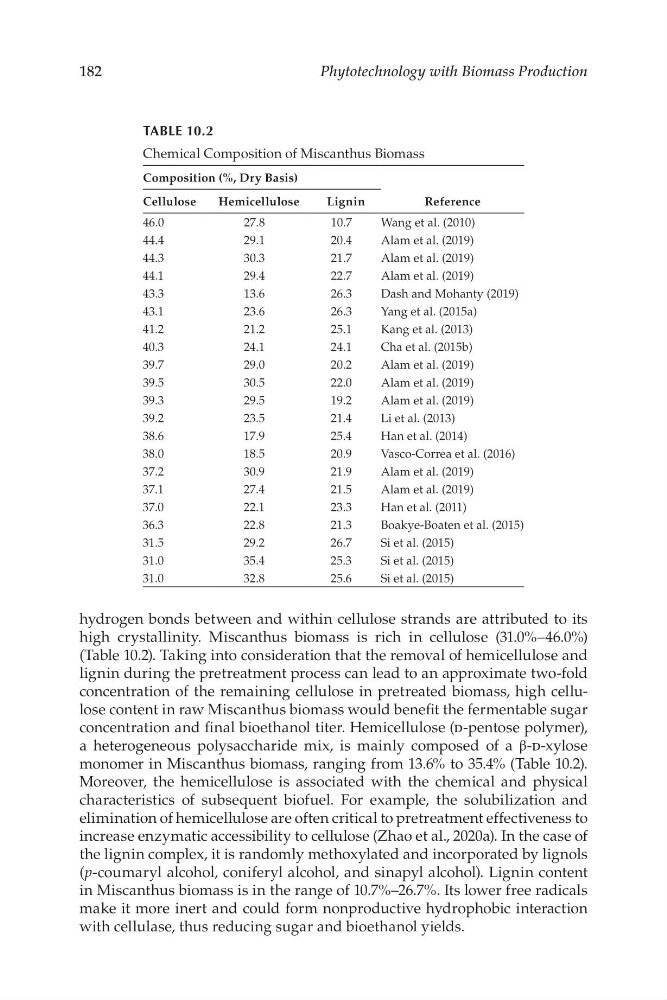
TABLE 10.2
Chemical Composition of Miscanthus Biomass
Composition (%, Dry Basis)
Cellulose
Hemicellulose
Lignin
Reference
46.0
27.8
10.7
Wang et al. (2010)
44.4
29.1
20.4
Alam et al. (2019)
44.3
30.3
21.7
Alam et al. (2019)
44.1
29.4
22.7
Alam et al. (2019)
43.3
13.6
26.3
Dash and Mohanty (2019)
43.1
23.6
26.3
Yang et al. (2015a)
41.2
21.2
25.1
Kang et al. (2013)
40.3
24.1
24.1
Cha et al. (2015b)
39.7
29.0
20.2
Alam et al. (2019)
39.5
30.5
22.0
Alam et al. (2019)
39.3
29.5
19.2
Alam et al. (2019)
39.2
23.5
21.4
Li et al. (2013)
38.6
17.9
25.4
Han et al. (2014)
38.0
18.5
20.9
Vasco-Correa et al. (2016)
37.2
30.9
21.9
Alam et al. (2019)
37.1
27.4
21.5
Alam et al. (2019)
37.0
22.1
23.3
Han et al. (2011)
36.3
22.8
21.3
Boakye-Boaten et al. (2015)
31.5
29.2
26.7
Si et al. (2015)
31.0
35.4
25.3
Si et al. (2015)
31.0
32.8
25.6
Si et al. (2015)
hydrogen bonds between and within cellulose strands are attributed to its
high crystallinity. Miscanthus biomass is rich in cellulose (31.0%–46.0%)
(Table 10.2). Taking into consideration that the removal of hemicellulose and
lignin during the pretreatment process can lead to an approximate two-fold
concentration of the remaining cellulose in pretreated biomass, high cellulose content in raw Miscanthus biomass would benefit the fermentable sugar
concentration and final bioethanol titer. Hemicellulose (d-pentose polymer),
a heterogeneous polysaccharide mix, is mainly composed of a β-d-xylose
monomer in Miscanthus biomass, ranging from 13.6% to 35.4% (Table 10.2).
Moreover, the hemicellulose is associated with the chemical and physical
characteristics of subsequent biofuel. For example, the solubilization and
elimination of hemicellulose are often critical to pretreatment effectiveness to
increase enzymatic accessibility to cellulose (Zhao et al., 2020a). In the case of
the lignin complex, it is randomly methoxylated and incorporated by lignols
(p-coumaryl alcohol, coniferyl alcohol, and sinapyl alcohol). Lignin content
in Miscanthus biomass is in the range of 10.7%–26.7%. Its lower free radicals
make it more inert and could form nonproductive hydrophobic interaction
with cellulase, thus reducing sugar and bioethanol yields.