

104
Phytotechnology with Biomass Production
the effect of PGRs treatment was (case of Dolyna soil). Conversely, the effect
was almost negligible in soils poor in nutrients and organic matter (case of
Mimon soil). Between the two tested PGRs the effect of Regoplant was more
obvious. The best results were obtained with combined treatment of application to rhizomes before planting and spraying of biomass during the vegetation season (Nebeská et al., 2019).
The impact of PGR treatment on phytoremediation parameters was evaluated as well. When M. × giganteus was growing in soil richer in nutrients
the process of metals uptake was in accordance with the general trend for
Miscanthus (Pidlisnyuk et al., 2014) and recognized as phytostabilization. That
is, the majority of the metals accumulated in the roots. The bioaccumulation
behavior of the monitored metals was different when a crop was grown in
sandy soil with poor nutrient content. While the nonessential elements Cr and
Pb were as expected dominantly accumulated in roots, Ni was not detected
and biogenic elements (Mn, Cu, Zn) were more intensively taken up into shoots
in comparison with roots. This was attributed to stress caused by deficient soil
characteristics (Kabata-Pendias & Pendias, 2001; Nebeská et al., 2019).
5.7.2 Field Research on Impact of PGRs on Biomass
Parameters of M. × giganteus during Field Production
on the Marginal and Slightly Contaminated Lands
Two PGRs, Stimpo and Charkor, were evaluated in the field conditions and
tested for production of Miscanthus on marginal agricultural land in the
Central Ukraine (Pidlisnyuk & Stefanovska, 2018). The dose for the treatment
was the same as in the Lab experiment (Nebeská et al., 2019). The results
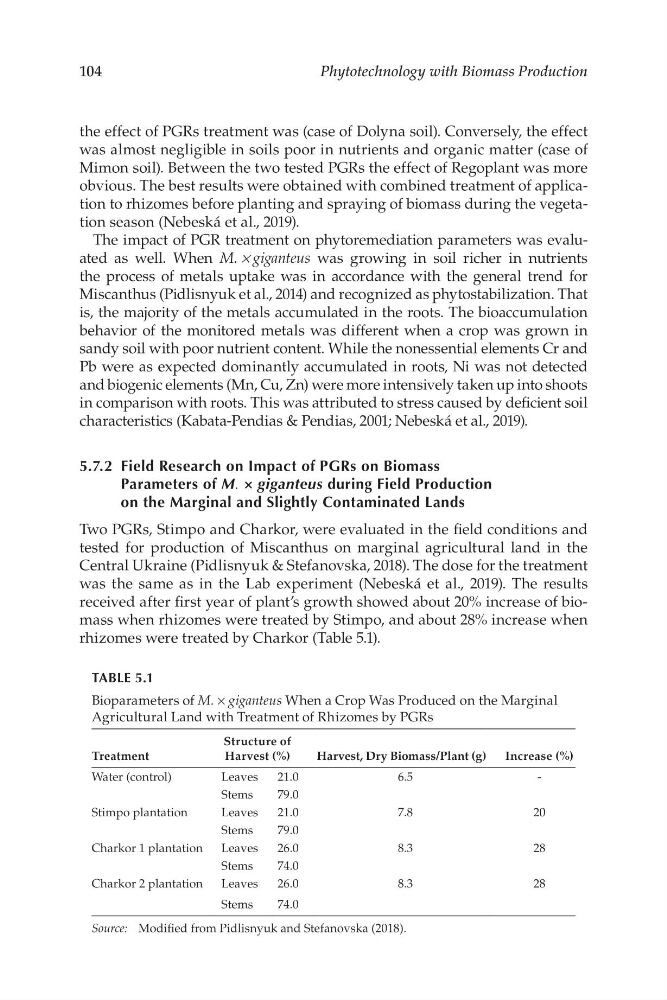
received after first year of plant’s growth showed about 20% increase of biomass when rhizomes were treated by Stimpo, and about 28% increase when
rhizomes were treated by Charkor (Table 5.1).
TABLE 5.1
Bioparameters of M. × giganteus When a Crop Was Produced on the Marginal
Agricultural Land with Treatment of Rhizomes by PGRs
Treatment
Structure of
Harvest (%)
Harvest, Dry Biomass/Plant (g)
Increase (%)
Water (control)
Leaves
21.0
6.5
-
Stems
79.0
Stimpo plantation
Leaves
21.0
7.8
20
Stems
79.0
Charkor 1 plantation
Leaves
26.0
8.3
28
Stems
74.0
Charkor 2 plantation
Leaves
26.0
8.3
28
Stems
74.0
Source: Modified from Pidlisnyuk and Stefanovska (2018).
Phytotechnology with Biomass Production
the effect of PGRs treatment was (case of Dolyna soil). Conversely, the effect
was almost negligible in soils poor in nutrients and organic matter (case of
Mimon soil). Between the two tested PGRs the effect of Regoplant was more
obvious. The best results were obtained with combined treatment of application to rhizomes before planting and spraying of biomass during the vegetation season (Nebeská et al., 2019).
The impact of PGR treatment on phytoremediation parameters was evaluated as well. When M. × giganteus was growing in soil richer in nutrients
the process of metals uptake was in accordance with the general trend for
Miscanthus (Pidlisnyuk et al., 2014) and recognized as phytostabilization. That
is, the majority of the metals accumulated in the roots. The bioaccumulation
behavior of the monitored metals was different when a crop was grown in
sandy soil with poor nutrient content. While the nonessential elements Cr and
Pb were as expected dominantly accumulated in roots, Ni was not detected
and biogenic elements (Mn, Cu, Zn) were more intensively taken up into shoots
in comparison with roots. This was attributed to stress caused by deficient soil
characteristics (Kabata-Pendias & Pendias, 2001; Nebeská et al., 2019).
5.7.2 Field Research on Impact of PGRs on Biomass
Parameters of M. × giganteus during Field Production
on the Marginal and Slightly Contaminated Lands
Two PGRs, Stimpo and Charkor, were evaluated in the field conditions and
tested for production of Miscanthus on marginal agricultural land in the
Central Ukraine (Pidlisnyuk & Stefanovska, 2018). The dose for the treatment
was the same as in the Lab experiment (Nebeská et al., 2019). The results
received after first year of plant’s growth showed about 20% increase of biomass when rhizomes were treated by Stimpo, and about 28% increase when
rhizomes were treated by Charkor (Table 5.1).
TABLE 5.1
Bioparameters of M. × giganteus When a Crop Was Produced on the Marginal
Agricultural Land with Treatment of Rhizomes by PGRs
Treatment
Structure of
Harvest (%)
Harvest, Dry Biomass/Plant (g)
Increase (%)
Water (control)
Leaves
21.0
6.5
-
Stems
79.0
Stimpo plantation
Leaves
21.0
7.8
20
Stems
79.0
Charkor 1 plantation
Leaves
26.0
8.3
28
Stems
74.0
Charkor 2 plantation
Leaves
26.0
8.3
28
Stems
74.0
Source: Modified from Pidlisnyuk and Stefanovska (2018).