

292
Trace Elements in Abiotic and Biotic Environments
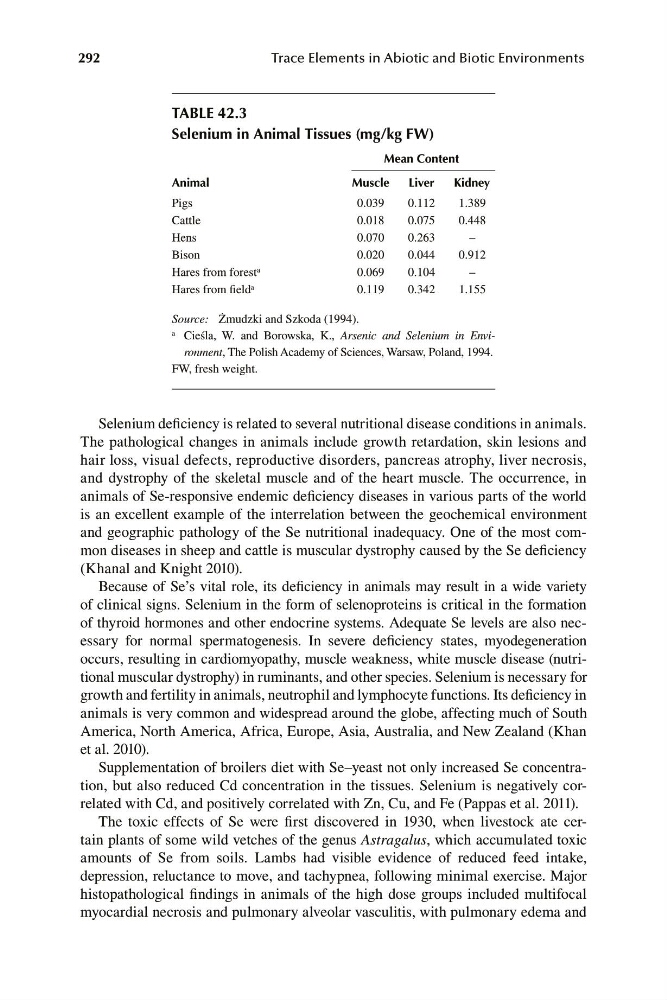
TABLE 42.3
Selenium in Animal Tissues (mg/kg FW)
Animal
Mean Content
Muscle
Liver
Kidney
Pigs
0.039
0.112
1.389
Cattle
0.018
0.075
0.448
Hens
0.070
0.263
–
Bison
0.020
0.044
0.912
Hares from forest a
0.069
0.104
–
Hares from field a
0.119
0.342
1.155
Source: Żmudzki and Szkoda (1994).
a Cieśla, W. and Borowska, K., Arsenic and Selenium in Environment, The Polish Academy of Sciences, Warsaw, Poland, 1994.
FW, fresh weight.
Selenium deficiency is related to several nutritional disease conditions in animals.
The pathological changes in animals include growth retardation, skin lesions and
hair loss, visual defects, reproductive disorders, pancreas atrophy, liver necrosis,
and dystrophy of the skeletal muscle and of the heart muscle. The occurrence, in
animals of Se-responsive endemic deficiency diseases in various parts of the world
is an excellent example of the interrelation between the geochemical environment
and geographic pathology of the Se nutritional inadequacy. One of the most common diseases in sheep and cattle is muscular dystrophy caused by the Se deficiency
(Khanal and Knight 2010).
Because of Se’s vital role, its deficiency in animals may result in a wide variety
of clinical signs. Selenium in the form of selenoproteins is critical in the formation
of thyroid hormones and other endocrine systems. Adequate Se levels are also necessary for normal spermatogenesis. In severe deficiency states, myodegeneration
occurs, resulting in cardiomyopathy, muscle weakness, white muscle disease (nutritional muscular dystrophy) in ruminants, and other species. Selenium is necessary for
growth and fertility in animals, neutrophil and lymphocyte functions. Its deficiency in
animals is very common and widespread around the globe, affecting much of South
America, North America, Africa, Europe, Asia, Australia, and New Zealand (Khan
et al. 2010).
Supplementation of broilers diet with Se–yeast not only increased Se concentration, but also reduced Cd concentration in the tissues. Selenium is negatively correlated with Cd, and positively correlated with Zn, Cu, and Fe (Pappas et al. 2011).
The toxic effects of Se were first discovered in 1930, when livestock ate certain plants of some wild vetches of the genus Astragalus, which accumulated toxic
amounts of Se from soils. Lambs had visible evidence of reduced feed intake,
depression, reluctance to move, and tachypnea, following minimal exercise. Major
histopathological findings in animals of the high dose groups included multifocal
myocardial necrosis and pulmonary alveolar vasculitis, with pulmonary edema and
Trace Elements in Abiotic and Biotic Environments
TABLE 42.3
Selenium in Animal Tissues (mg/kg FW)
Animal
Mean Content
Muscle
Liver
Kidney
Pigs
0.039
0.112
1.389
Cattle
0.018
0.075
0.448
Hens
0.070
0.263
–
Bison
0.020
0.044
0.912
Hares from forest a
0.069
0.104
–
Hares from field a
0.119
0.342
1.155
Source: Żmudzki and Szkoda (1994).
a Cieśla, W. and Borowska, K., Arsenic and Selenium in Environment, The Polish Academy of Sciences, Warsaw, Poland, 1994.
FW, fresh weight.
Selenium deficiency is related to several nutritional disease conditions in animals.
The pathological changes in animals include growth retardation, skin lesions and
hair loss, visual defects, reproductive disorders, pancreas atrophy, liver necrosis,
and dystrophy of the skeletal muscle and of the heart muscle. The occurrence, in
animals of Se-responsive endemic deficiency diseases in various parts of the world
is an excellent example of the interrelation between the geochemical environment
and geographic pathology of the Se nutritional inadequacy. One of the most common diseases in sheep and cattle is muscular dystrophy caused by the Se deficiency
(Khanal and Knight 2010).
Because of Se’s vital role, its deficiency in animals may result in a wide variety
of clinical signs. Selenium in the form of selenoproteins is critical in the formation
of thyroid hormones and other endocrine systems. Adequate Se levels are also necessary for normal spermatogenesis. In severe deficiency states, myodegeneration
occurs, resulting in cardiomyopathy, muscle weakness, white muscle disease (nutritional muscular dystrophy) in ruminants, and other species. Selenium is necessary for
growth and fertility in animals, neutrophil and lymphocyte functions. Its deficiency in
animals is very common and widespread around the globe, affecting much of South
America, North America, Africa, Europe, Asia, Australia, and New Zealand (Khan
et al. 2010).
Supplementation of broilers diet with Se–yeast not only increased Se concentration, but also reduced Cd concentration in the tissues. Selenium is negatively correlated with Cd, and positively correlated with Zn, Cu, and Fe (Pappas et al. 2011).
The toxic effects of Se were first discovered in 1930, when livestock ate certain plants of some wild vetches of the genus Astragalus, which accumulated toxic
amounts of Se from soils. Lambs had visible evidence of reduced feed intake,
depression, reluctance to move, and tachypnea, following minimal exercise. Major
histopathological findings in animals of the high dose groups included multifocal
myocardial necrosis and pulmonary alveolar vasculitis, with pulmonary edema and