

164
Trace Elements in Abiotic and Biotic Environments
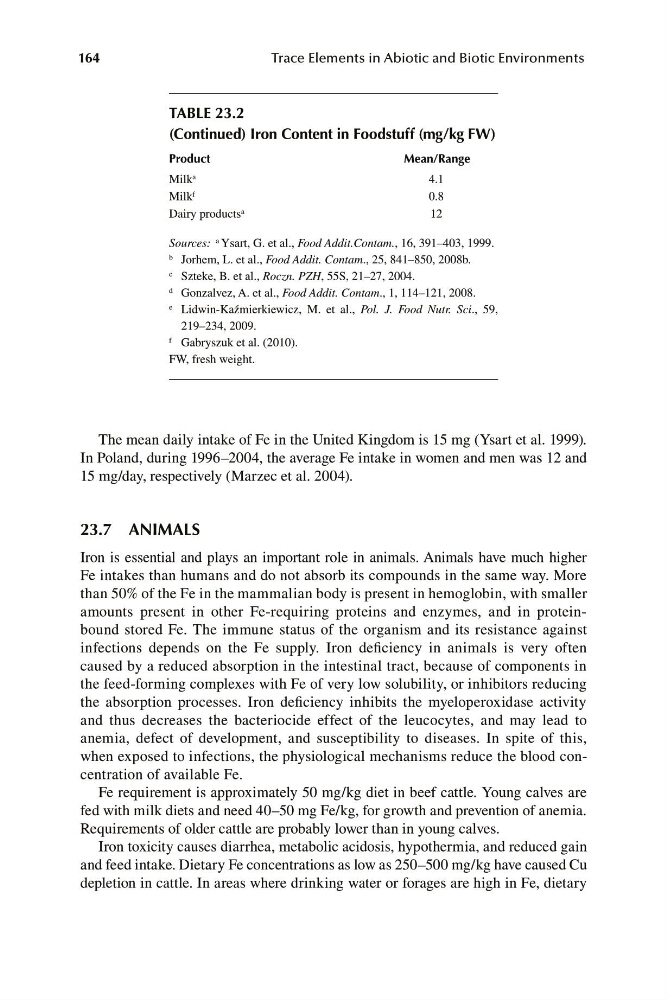
TABLE 23.2
(Continued) Iron Content in Foodstuff (mg/kg FW)
Product
Mean/Range
Milk a
4.1
Milk f
0.8
Dairy products a
12
Sources: a Ysart, G. et al., Food Addit.Contam., 16, 391–403, 1999.
b Jorhem, L. et al., Food Addit. Contam., 25, 841–850, 2008b.
c Szteke, B. et al., Roczn. PZH, 55S, 21–27, 2004.
d Gonzalvez, A. et al., Food Addit. Contam., 1, 114–121, 2008.
e Lidwin-Kaźmierkiewicz, M. et al., Pol. J. Food Nutr. Sci., 59,
219–234, 2009.
f Gabryszuk et al. (2010).
FW, fresh weight.
The mean daily intake of Fe in the United Kingdom is 15 mg (Ysart et al. 1999).
In Poland, during 1996–2004, the average Fe intake in women and men was 12 and
15 mg/day, respectively (Marzec et al. 2004).
23.7 ANIMALS
Iron is essential and plays an important role in animals. Animals have much higher
Fe intakes than humans and do not absorb its compounds in the same way. More
than 50% of the Fe in the mammalian body is present in hemoglobin, with smaller
amounts present in other Fe-requiring proteins and enzymes, and in proteinbound stored Fe. The immune status of the organism and its resistance against
infections depends on the Fe supply. Iron deficiency in animals is very often
caused by a reduced absorption in the intestinal tract, because of components in
the feed-forming complexes with Fe of very low solubility, or inhibitors reducing
the absorption processes. Iron deficiency inhibits the myeloperoxidase activity
and thus decreases the bacteriocide effect of the leucocytes, and may lead to
anemia, defect of development, and susceptibility to diseases. In spite of this,
when exposed to infections, the physiological mechanisms reduce the blood concentration of available Fe.
Fe requirement is approximately 50 mg/kg diet in beef cattle. Young calves are
fed with milk diets and need 40–50 mg Fe/kg, for growth and prevention of anemia.
Requirements of older cattle are probably lower than in young calves.
Iron toxicity causes diarrhea, metabolic acidosis, hypothermia, and reduced gain
and feed intake. Dietary Fe concentrations as low as 250–500 mg/kg have caused Cu
depletion in cattle. In areas where drinking water or forages are high in Fe, dietary
Trace Elements in Abiotic and Biotic Environments
TABLE 23.2
(Continued) Iron Content in Foodstuff (mg/kg FW)
Product
Mean/Range
Milk a
4.1
Milk f
0.8
Dairy products a
12
Sources: a Ysart, G. et al., Food Addit.Contam., 16, 391–403, 1999.
b Jorhem, L. et al., Food Addit. Contam., 25, 841–850, 2008b.
c Szteke, B. et al., Roczn. PZH, 55S, 21–27, 2004.
d Gonzalvez, A. et al., Food Addit. Contam., 1, 114–121, 2008.
e Lidwin-Kaźmierkiewicz, M. et al., Pol. J. Food Nutr. Sci., 59,
219–234, 2009.
f Gabryszuk et al. (2010).
FW, fresh weight.
The mean daily intake of Fe in the United Kingdom is 15 mg (Ysart et al. 1999).
In Poland, during 1996–2004, the average Fe intake in women and men was 12 and
15 mg/day, respectively (Marzec et al. 2004).
23.7 ANIMALS
Iron is essential and plays an important role in animals. Animals have much higher
Fe intakes than humans and do not absorb its compounds in the same way. More
than 50% of the Fe in the mammalian body is present in hemoglobin, with smaller
amounts present in other Fe-requiring proteins and enzymes, and in proteinbound stored Fe. The immune status of the organism and its resistance against
infections depends on the Fe supply. Iron deficiency in animals is very often
caused by a reduced absorption in the intestinal tract, because of components in
the feed-forming complexes with Fe of very low solubility, or inhibitors reducing
the absorption processes. Iron deficiency inhibits the myeloperoxidase activity
and thus decreases the bacteriocide effect of the leucocytes, and may lead to
anemia, defect of development, and susceptibility to diseases. In spite of this,
when exposed to infections, the physiological mechanisms reduce the blood concentration of available Fe.
Fe requirement is approximately 50 mg/kg diet in beef cattle. Young calves are
fed with milk diets and need 40–50 mg Fe/kg, for growth and prevention of anemia.
Requirements of older cattle are probably lower than in young calves.
Iron toxicity causes diarrhea, metabolic acidosis, hypothermia, and reduced gain
and feed intake. Dietary Fe concentrations as low as 250–500 mg/kg have caused Cu
depletion in cattle. In areas where drinking water or forages are high in Fe, dietary