

Iron [Fe, 26]
163
or mental function (normal thinking and processing skills). Iron-deficiency anemia
during pregnancy can increase risk for small or early (preterm) babies. Iron deficiency can cause fatigue that impairs the ability to do physical work in adults and
may also affect memory or other mental function in teens.
Recommended dietary allowances for Fe depend on age, sex, and conditions; for
example, Fe (mg/day) intakes for males and females aged between 25 and 50 are as
follows: 10 (male) and 15 (female) (WHO 2004). As a precaution against storage
in the body of excessive Fe, in 1983, Joint FAO/WHO Expert Committee on Food
Additives established a provisional maximum tolerable daily intake of 0.8 mg/kg bw
(WHO 2011a).
Iron overload may also happen: it is the accumulation of excess Fe in body tissues.
Excess of pharmaceutical Fe may cause toxicity and therapeutic doses may cause
gastrointestinal side effects. Chronic Fe excess, for example, in primary and secondary hemochromatosis, may lead to hepatic fibrosis, diabetes mellitus, and cardiac
failure. Iron stores may also be related to cardiovascular risk. Fe-amplified oxidative
stress may also increase DNA damage, oxidative activation of precancerogens, and
support tumor cell growth. Due to these mechanisms, high Fe stores may present a
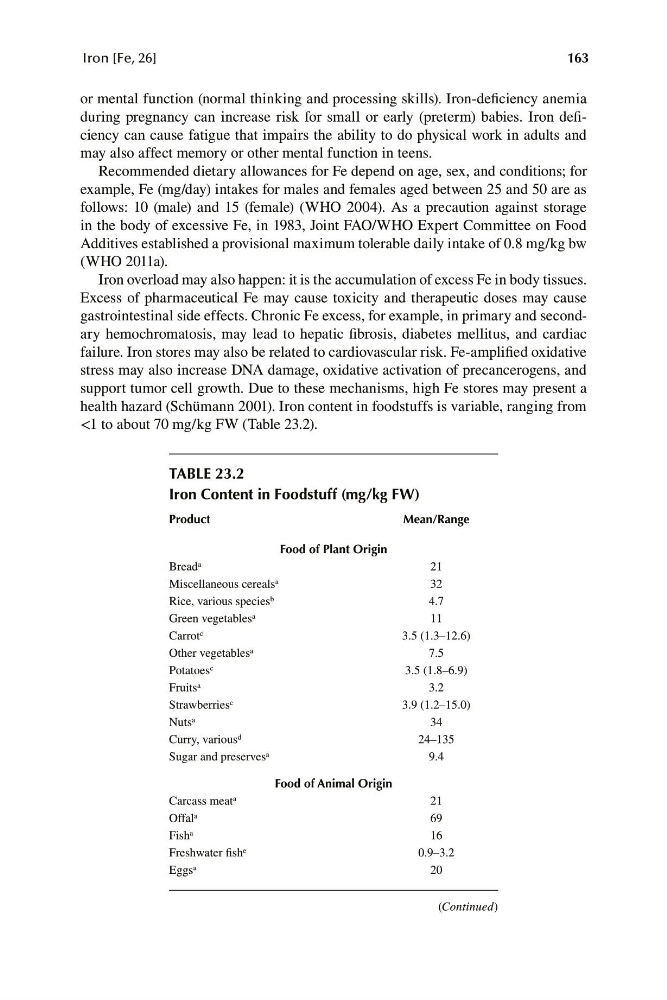
health hazard (Schümann 2001). Iron content in foodstuffs is variable, ranging from
<1 to about 70 mg/kg FW (Table 23.2).
TABLE 23.2
Iron Content in Foodstuff (mg/kg FW)
Product
Mean/Range
Food of Plant Origin
Bread a
21
Miscellaneous cereals a
32
Rice, various species b
Green vegetables a
Carrot c
Other vegetables a
Potatoes c
Fruits a
4.7
11
3.5 (1.3–12.6)
7.5
3.5 (1.8–6.9)
3.2
Strawberries c
Nuts a
3.9 (1.2–15.0)
34
Curry, various d
Sugar and preserves a
24–135
9.4
Food of Animal Origin
Carcass meat a
21
Offal a
69
Fish a
16
Freshwater fish e
0.9–3.2
Eggs a
20
(Continued)
163
or mental function (normal thinking and processing skills). Iron-deficiency anemia
during pregnancy can increase risk for small or early (preterm) babies. Iron deficiency can cause fatigue that impairs the ability to do physical work in adults and
may also affect memory or other mental function in teens.
Recommended dietary allowances for Fe depend on age, sex, and conditions; for
example, Fe (mg/day) intakes for males and females aged between 25 and 50 are as
follows: 10 (male) and 15 (female) (WHO 2004). As a precaution against storage
in the body of excessive Fe, in 1983, Joint FAO/WHO Expert Committee on Food
Additives established a provisional maximum tolerable daily intake of 0.8 mg/kg bw
(WHO 2011a).
Iron overload may also happen: it is the accumulation of excess Fe in body tissues.
Excess of pharmaceutical Fe may cause toxicity and therapeutic doses may cause
gastrointestinal side effects. Chronic Fe excess, for example, in primary and secondary hemochromatosis, may lead to hepatic fibrosis, diabetes mellitus, and cardiac
failure. Iron stores may also be related to cardiovascular risk. Fe-amplified oxidative
stress may also increase DNA damage, oxidative activation of precancerogens, and
support tumor cell growth. Due to these mechanisms, high Fe stores may present a
health hazard (Schümann 2001). Iron content in foodstuffs is variable, ranging from
<1 to about 70 mg/kg FW (Table 23.2).
TABLE 23.2
Iron Content in Foodstuff (mg/kg FW)
Product
Mean/Range
Food of Plant Origin
Bread a
21
Miscellaneous cereals a
32
Rice, various species b
Green vegetables a
Carrot c
Other vegetables a
Potatoes c
Fruits a
4.7
11
3.5 (1.3–12.6)
7.5
3.5 (1.8–6.9)
3.2
Strawberries c
Nuts a
3.9 (1.2–15.0)
34
Curry, various d
Sugar and preserves a
24–135
9.4
Food of Animal Origin
Carcass meat a
21
Offal a
69
Fish a
16
Freshwater fish e
0.9–3.2
Eggs a
20
(Continued)