

81
Notch Signaling in Early Embryogenesis
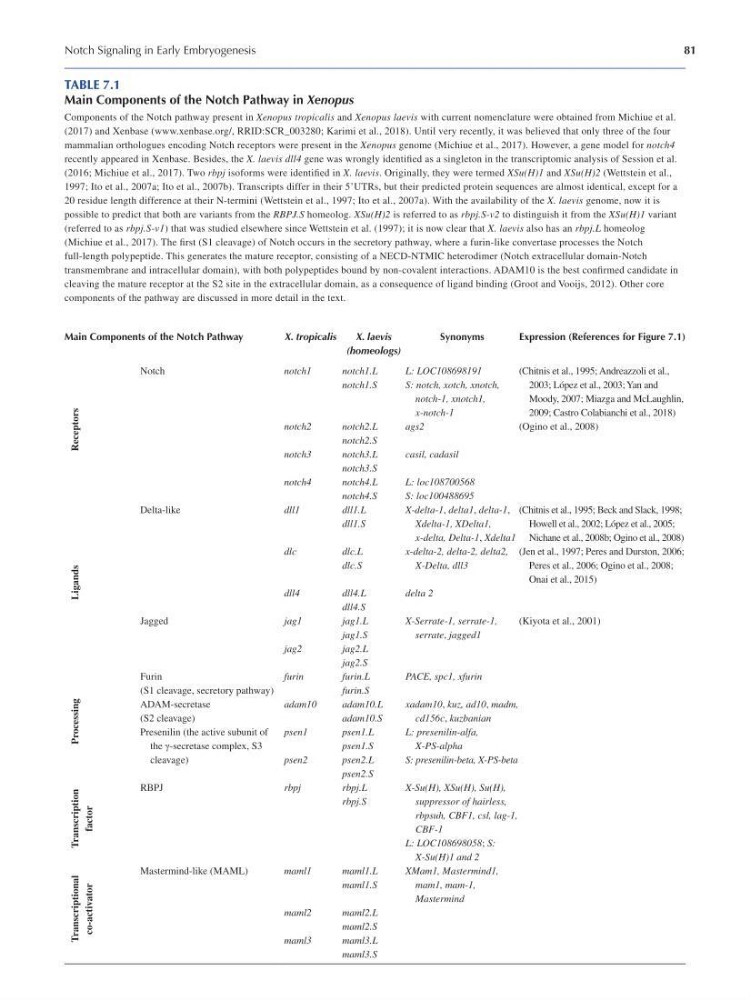
TABLE 7.1
Main Components of the Notch Pathway in Xenopus
Components of the Notch pathway present in Xenopus tropicalis and Xenopus laevis with current nomenclature were obtained from Michiue et al.
(2017 ) and Xenbase ( www.xenbase.org/ , RRID:SCR_003280; Karimi et al., 2018 ). Until very recently, it was believed that only three of the four
mammalian orthologues encoding Notch receptors were present in the Xenopus genome ( Michiue et al., 2017 ). However, a gene model for notch4
recently appeared in Xenbase. Besides, the X. laevis dll4 gene was wrongly identifed as a singleton in the transcriptomic analysis of Session et al.
(2016 ; Michiue et al., 2017 ). Two rbpj isoforms were identifed in X. laevis. Originally, they were termed XSu(H)1 and XSu(H)2 ( Wettstein et al.,
1997 ; Ito et al., 2007a ; Ito et al., 2007b ). Transcripts differ in their 5’UTRs, but their predicted protein sequences are almost identical, except for a
20 residue length difference at their N-termini ( Wettstein et al., 1997 ; Ito et al., 2007a ). With the availability of the X. laevis genome, now it is
possible to predict that both are variants from the RBPJ.S homeolog. XSu(H)2 is referred to as rbpj.S-v2 to distinguish it from the XSu(H)1 variant
(referred to as rbpj.S-v1) that was studied elsewhere since Wettstein et al. (1997 ); it is now clear that X. laevis also has an rbpj.L homeolog
( Michiue et al., 2017 ). The frst (S1 cleavage) of Notch occurs in the secretory pathway, where a furin-like convertase processes the Notch
full-length polypeptide. This generates the mature receptor, consisting of a NECD-NTMIC heterodimer (Notch extracellular domain-Notch
transmembrane and intracellular domain), with both polypeptides bound by non-covalent interactions. ADAM10 is the best confrmed candidate in
cleaving the mature receptor at the S2 site in the extracellular domain, as a consequence of ligand binding ( Groot and Vooijs, 2012 ). Other core
components of the pathway are discussed in more detail in the text.
Main Components of the Notch Pathway
X. tropicalis
X. laevis
Synonyms
Expression (References for Figure 7.1 )
(homeologs)
Notch
notch1
notch1.L
L: LOC108698191
( Chitnis et al., 1995 ; Andreazzoli et al.,
notch1.S
S: notch, xotch, xnotch,
2003 ; López et al., 2003 ; Yan and
notch-1, xnotch1,
Moody, 2007 ; Miazga and McLaughlin,
ors
x-notch-1
2009 ; Castro Colabianchi et al., 2018 )
Recept
notch2
notch2.L
ags2
( Ogino et al., 2008 )
notch2.S
notch3
notch3.L
casil, cadasil
notch3.S
notch4
notch4.L
L: loc108700568
notch4.S
S: loc100488695
Delta-like
dll1
dll1.L
X-delta-1, delta1, delta-1, ( Chitnis et al., 1995 ; Beck and Slack, 1998 ;
dll1.S
Xdelta-1, XDelta1,
Howell et al., 2002 ; López et al., 2005 ;
x-delta, Delta-1, Xdelta1 Nichane et al., 2008b ; Ogino et al., 2008 )
dlc
dlc.L
x-delta-2, delta-2, delta2, ( Jen et al., 1997 ; Peres and Durston, 2006 ;
dlc.S
X-Delta, dll3
Peres et al., 2006 ; Ogino et al., 2008 ;
Ligands
Onai et al., 2015 )
dll4
dll4.L
delta 2
dll4.S
Jagged
jag1
jag1.L
X-Serrate-1, serrate-1,
( Kiyota et al., 2001 )
jag1.S
serrate, jagged1
jag2
jag2.L
jag2.S
Furin
furin
furin.L
PACE, spc1, xfurin
(S1 cleavage, secretory pathway)
furin.S
ADAM-secretase
adam10
adam10.L
xadam10, kuz, ad10, madm,
ing
ess
(S2 cleavage)
adam10.S
cd156c, kuzbanian
Proc
Presenilin (the active subunit of
psen1
psen1.L
L: presenilin-alfa,
the γ-secretase complex, S3
psen1.S
X-PS-alpha
cleavage)
psen2
psen2.L
S: presenilin-beta, X-PS-beta
psen2.S
n
RBPJ
rbpj
rbpj.L
X-Su(H), XSu(H), Su(H),
rbpj.S
suppressor of hairless,
ptio
cri
factor
rbpsuh, CBF1, csl, lag-1,
Trans
CBF-1
L: LOC108698058; S:
X-Su(H)1 and 2
l
Mastermind-like (MAML)
maml1
maml1.L
XMam1, Mastermind1,
ona
maml1.S
mam1, mam-1,
pti
or
vat
Mastermind
cri
maml2
maml2.L
Trans
co-acti
maml2.S
maml3
maml3.L
maml3.S
Notch Signaling in Early Embryogenesis
TABLE 7.1
Main Components of the Notch Pathway in Xenopus
Components of the Notch pathway present in Xenopus tropicalis and Xenopus laevis with current nomenclature were obtained from Michiue et al.
(2017 ) and Xenbase ( www.xenbase.org/ , RRID:SCR_003280; Karimi et al., 2018 ). Until very recently, it was believed that only three of the four
mammalian orthologues encoding Notch receptors were present in the Xenopus genome ( Michiue et al., 2017 ). However, a gene model for notch4
recently appeared in Xenbase. Besides, the X. laevis dll4 gene was wrongly identifed as a singleton in the transcriptomic analysis of Session et al.
(2016 ; Michiue et al., 2017 ). Two rbpj isoforms were identifed in X. laevis. Originally, they were termed XSu(H)1 and XSu(H)2 ( Wettstein et al.,
1997 ; Ito et al., 2007a ; Ito et al., 2007b ). Transcripts differ in their 5’UTRs, but their predicted protein sequences are almost identical, except for a
20 residue length difference at their N-termini ( Wettstein et al., 1997 ; Ito et al., 2007a ). With the availability of the X. laevis genome, now it is
possible to predict that both are variants from the RBPJ.S homeolog. XSu(H)2 is referred to as rbpj.S-v2 to distinguish it from the XSu(H)1 variant
(referred to as rbpj.S-v1) that was studied elsewhere since Wettstein et al. (1997 ); it is now clear that X. laevis also has an rbpj.L homeolog
( Michiue et al., 2017 ). The frst (S1 cleavage) of Notch occurs in the secretory pathway, where a furin-like convertase processes the Notch
full-length polypeptide. This generates the mature receptor, consisting of a NECD-NTMIC heterodimer (Notch extracellular domain-Notch
transmembrane and intracellular domain), with both polypeptides bound by non-covalent interactions. ADAM10 is the best confrmed candidate in
cleaving the mature receptor at the S2 site in the extracellular domain, as a consequence of ligand binding ( Groot and Vooijs, 2012 ). Other core
components of the pathway are discussed in more detail in the text.
Main Components of the Notch Pathway
X. tropicalis
X. laevis
Synonyms
Expression (References for Figure 7.1 )
(homeologs)
Notch
notch1
notch1.L
L: LOC108698191
( Chitnis et al., 1995 ; Andreazzoli et al.,
notch1.S
S: notch, xotch, xnotch,
2003 ; López et al., 2003 ; Yan and
notch-1, xnotch1,
Moody, 2007 ; Miazga and McLaughlin,
ors
x-notch-1
2009 ; Castro Colabianchi et al., 2018 )
Recept
notch2
notch2.L
ags2
( Ogino et al., 2008 )
notch2.S
notch3
notch3.L
casil, cadasil
notch3.S
notch4
notch4.L
L: loc108700568
notch4.S
S: loc100488695
Delta-like
dll1
dll1.L
X-delta-1, delta1, delta-1, ( Chitnis et al., 1995 ; Beck and Slack, 1998 ;
dll1.S
Xdelta-1, XDelta1,
Howell et al., 2002 ; López et al., 2005 ;
x-delta, Delta-1, Xdelta1 Nichane et al., 2008b ; Ogino et al., 2008 )
dlc
dlc.L
x-delta-2, delta-2, delta2, ( Jen et al., 1997 ; Peres and Durston, 2006 ;
dlc.S
X-Delta, dll3
Peres et al., 2006 ; Ogino et al., 2008 ;
Ligands
Onai et al., 2015 )
dll4
dll4.L
delta 2
dll4.S
Jagged
jag1
jag1.L
X-Serrate-1, serrate-1,
( Kiyota et al., 2001 )
jag1.S
serrate, jagged1
jag2
jag2.L
jag2.S
Furin
furin
furin.L
PACE, spc1, xfurin
(S1 cleavage, secretory pathway)
furin.S
ADAM-secretase
adam10
adam10.L
xadam10, kuz, ad10, madm,
ing
ess
(S2 cleavage)
adam10.S
cd156c, kuzbanian
Proc
Presenilin (the active subunit of
psen1
psen1.L
L: presenilin-alfa,
the γ-secretase complex, S3
psen1.S
X-PS-alpha
cleavage)
psen2
psen2.L
S: presenilin-beta, X-PS-beta
psen2.S
n
RBPJ
rbpj
rbpj.L
X-Su(H), XSu(H), Su(H),
rbpj.S
suppressor of hairless,
ptio
cri
factor
rbpsuh, CBF1, csl, lag-1,
Trans
CBF-1
L: LOC108698058; S:
X-Su(H)1 and 2
l
Mastermind-like (MAML)
maml1
maml1.L
XMam1, Mastermind1,
ona
maml1.S
mam1, mam-1,
pti
or
vat
Mastermind
cri
maml2
maml2.L
Trans
co-acti
maml2.S
maml3
maml3.L
maml3.S