

82
Xenopus
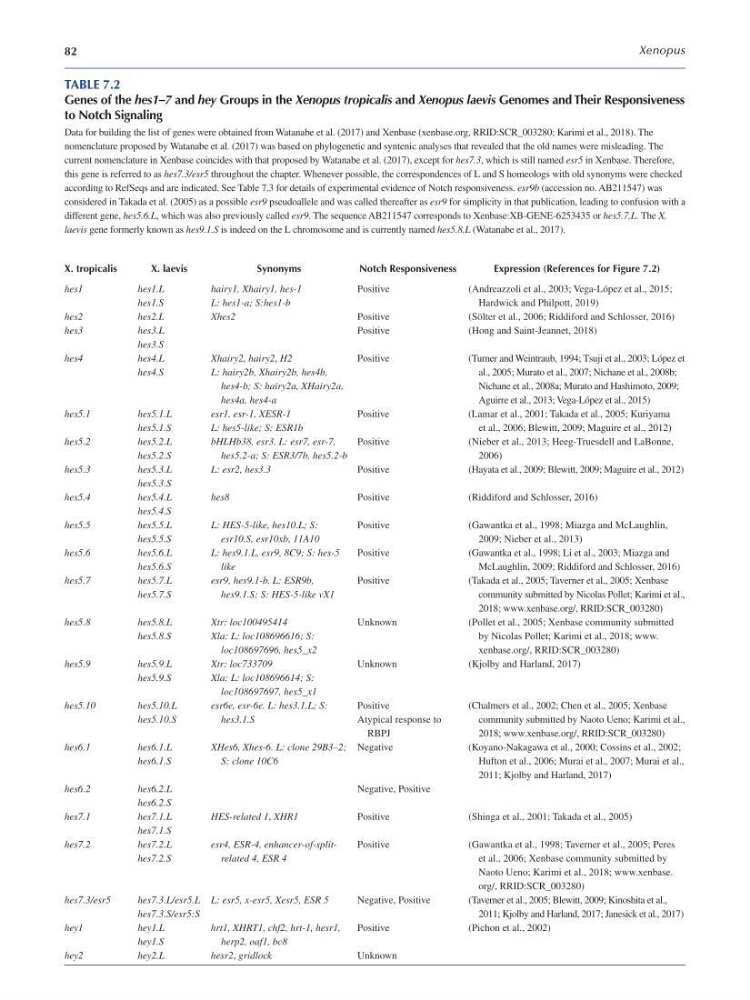
TABLE 7.2
Genes of the hes1–7 and hey Groups in the Xenopus tropicalis and Xenopus laevis Genomes and Their Responsiveness
to Notch Signaling
Data for building the list of genes were obtained from Watanabe et al. (2017) and Xenbase (xenbase.org, RRID:SCR_003280; Karimi et al., 2018). The
nomenclature proposed by Watanabe et al. (2017) was based on phylogenetic and syntenic analyses that revealed that the old names were misleading. The
current nomenclature in Xenbase coincides with that proposed by Watanabe et al. (2017), except for hes7.3, which is still named esr5 in Xenbase. Therefore,
this gene is referred to as hes7.3/esr5 throughout the chapter. Whenever possible, the correspondences of L and S homeologs with old synonyms were checked
according to RefSeqs and are indicated. See Table 7.3 for details of experimental evidence of Notch responsiveness. esr9b (accession no. AB211547) was
considered in Takada et al. (2005) as a possible esr9 pseudoallele and was called thereafter as esr9 for simplicity in that publication, leading to confusion with a
different gene, hes5.6.L, which was also previously called esr9. The sequence AB211547 corresponds to Xenbase:XB-GENE-6253435 or hes5.7.L. The X.
laevis gene formerly known as hes9.1.S is indeed on the L chromosome and is currently named hes5.8.L (Watanabe et al., 2017).
X. tropicalis
X. laevis
Synonyms
Notch Responsiveness
Expression (References for Figure 7.2)
hes1
hes1.L
hairy1, Xhairy1, hes-1
Positive
(Andreazzoli et al., 2003; Vega-López et al., 2015;
hes1.S
L: hes1-a; S:hes1-b
Hardwick and Philpott, 2019)
hes2
hes2.L
Xhes2
Positive
(Sölter et al., 2006; Riddiford and Schlosser, 2016)
hes3
hes3.L
Positive
(Hong and Saint-Jeannet, 2018)
hes3.S
hes4
hes4.L
Xhairy2, hairy2, H2
Positive
(Turner and Weintraub, 1994; Tsuji et al., 2003; López et
hes4.S
L: hairy2b, Xhairy2b, hes4b,
al., 2005; Murato et al., 2007; Nichane et al., 2008b;
hes4-b; S: hairy2a, XHairy2a,
Nichane et al., 2008a; Murato and Hashimoto, 2009;
hes4a, hes4-a
Aguirre et al., 2013; Vega-López et al., 2015)
hes5.1
hes5.1.L
esr1, esr-1, XESR-1
Positive
(Lamar et al., 2001; Takada et al., 2005; Kuriyama
hes5.1.S
L: hes5-like; S: ESR1b
et al., 2006; Blewitt, 2009; Maguire et al., 2012)
hes5.2
hes5.2.L
bHLHb38, esr3. L: esr7, esr-7,
Positive
(Nieber et al., 2013; Heeg-Truesdell and LaBonne,
hes5.2.S
hes5.2-a; S: ESR3/7b, hes5.2-b
2006)
hes5.3
hes5.3.L
L: esr2, hes3.3
Positive
(Hayata et al., 2009; Blewitt, 2009; Maguire et al., 2012)
hes5.3.S
hes5.4
hes5.4.L
hes8
Positive
(Riddiford and Schlosser, 2016)
hes5.4.S
hes5.5
hes5.5.L
L: HES-5-like, hes10.L; S:
Positive
(Gawantka et al., 1998; Miazga and McLaughlin,
hes5.5.S
esr10.S, esr10xb, 11A10
2009; Nieber et al., 2013)
hes5.6
hes5.6.L
L: hes9.1.L, esr9, 8C9; S: hes-5
Positive
(Gawantka et al., 1998; Li et al., 2003; Miazga and
hes5.6.S
like
McLaughlin, 2009; Riddiford and Schlosser, 2016)
hes5.7
hes5.7.L
esr9, hes9.1-b. L: ESR9b,
Positive
(Takada et al., 2005; Taverner et al., 2005; Xenbase
hes5.7.S
hes9.1.S; S: HES-5-like vX1
community submitted by Nicolas Pollet; Karimi et al.,
2018; www.xenbase.org/, RRID:SCR_003280)
hes5.8
hes5.8.L
Xtr: loc100495414
Unknown
(Pollet et al., 2005; Xenbase community submitted
hes5.8.S
Xla: L: loc108696616; S:
by Nicolas Pollet; Karimi et al., 2018; www.
loc108697696, hes5_x2
xenbase.org/, RRID:SCR_003280)
hes5.9
hes5.9.L
Xtr: loc733709
Unknown
(Kjolby and Harland, 2017)
hes5.9.S
Xla: L: loc108696614; S:
loc108697697, hes5_x1
hes5.10
hes5.10.L
esr6e, esr-6e. L: hes3.1.L; S:
Positive
(Chalmers et al., 2002; Chen et al., 2005; Xenbase
hes5.10.S
hes3.1.S
Atypical response to
community submitted by Naoto Ueno; Karimi et al.,
RBPJ
2018; www.xenbase.org/, RRID:SCR_003280)
hes6.1
hes6.1.L
XHes6, Xhes-6. L: clone 29B3–2; Negative
(Koyano-Nakagawa et al., 2000; Cossins et al., 2002;
hes6.1.S
S: clone 10C6
Hufton et al., 2006; Murai et al., 2007; Murai et al.,
2011; Kjolby and Harland, 2017)
hes6.2
hes6.2.L
Negative, Positive
hes6.2.S
hes7.1
hes7.1.L
HES-related 1, XHR1
Positive
(Shinga et al., 2001; Takada et al., 2005)
hes7.1.S
hes7.2
hes7.2.L
esr4, ESR-4, enhancer-of-splitPositive
(Gawantka et al., 1998; Taverner et al., 2005; Peres
hes7.2.S
related 4, ESR 4
et al., 2006; Xenbase community submitted by
Naoto Ueno; Karimi et al., 2018; www.xenbase.
org/, RRID:SCR_003280)
hes7.3/esr5
hes7.3.L/esr5.L L: esr5, x-esr5, Xesr5, ESR 5
Negative, Positive
(Taverner et al., 2005; Blewitt, 2009; Kinoshita et al.,
hes7.3.S/esr5:S
2011; Kjolby and Harland, 2017; Janesick et al., 2017)
hey1
hey1.L
hrt1, XHRT1, chf2, hrt-1, hesr1,
Positive
(Pichon et al., 2002)
hey1.S
herp2, oaf1, bc8
hey2
hey2.L
hesr2, gridlock
Unknown
Xenopus
TABLE 7.2
Genes of the hes1–7 and hey Groups in the Xenopus tropicalis and Xenopus laevis Genomes and Their Responsiveness
to Notch Signaling
Data for building the list of genes were obtained from Watanabe et al. (2017) and Xenbase (xenbase.org, RRID:SCR_003280; Karimi et al., 2018). The
nomenclature proposed by Watanabe et al. (2017) was based on phylogenetic and syntenic analyses that revealed that the old names were misleading. The
current nomenclature in Xenbase coincides with that proposed by Watanabe et al. (2017), except for hes7.3, which is still named esr5 in Xenbase. Therefore,
this gene is referred to as hes7.3/esr5 throughout the chapter. Whenever possible, the correspondences of L and S homeologs with old synonyms were checked
according to RefSeqs and are indicated. See Table 7.3 for details of experimental evidence of Notch responsiveness. esr9b (accession no. AB211547) was
considered in Takada et al. (2005) as a possible esr9 pseudoallele and was called thereafter as esr9 for simplicity in that publication, leading to confusion with a
different gene, hes5.6.L, which was also previously called esr9. The sequence AB211547 corresponds to Xenbase:XB-GENE-6253435 or hes5.7.L. The X.
laevis gene formerly known as hes9.1.S is indeed on the L chromosome and is currently named hes5.8.L (Watanabe et al., 2017).
X. tropicalis
X. laevis
Synonyms
Notch Responsiveness
Expression (References for Figure 7.2)
hes1
hes1.L
hairy1, Xhairy1, hes-1
Positive
(Andreazzoli et al., 2003; Vega-López et al., 2015;
hes1.S
L: hes1-a; S:hes1-b
Hardwick and Philpott, 2019)
hes2
hes2.L
Xhes2
Positive
(Sölter et al., 2006; Riddiford and Schlosser, 2016)
hes3
hes3.L
Positive
(Hong and Saint-Jeannet, 2018)
hes3.S
hes4
hes4.L
Xhairy2, hairy2, H2
Positive
(Turner and Weintraub, 1994; Tsuji et al., 2003; López et
hes4.S
L: hairy2b, Xhairy2b, hes4b,
al., 2005; Murato et al., 2007; Nichane et al., 2008b;
hes4-b; S: hairy2a, XHairy2a,
Nichane et al., 2008a; Murato and Hashimoto, 2009;
hes4a, hes4-a
Aguirre et al., 2013; Vega-López et al., 2015)
hes5.1
hes5.1.L
esr1, esr-1, XESR-1
Positive
(Lamar et al., 2001; Takada et al., 2005; Kuriyama
hes5.1.S
L: hes5-like; S: ESR1b
et al., 2006; Blewitt, 2009; Maguire et al., 2012)
hes5.2
hes5.2.L
bHLHb38, esr3. L: esr7, esr-7,
Positive
(Nieber et al., 2013; Heeg-Truesdell and LaBonne,
hes5.2.S
hes5.2-a; S: ESR3/7b, hes5.2-b
2006)
hes5.3
hes5.3.L
L: esr2, hes3.3
Positive
(Hayata et al., 2009; Blewitt, 2009; Maguire et al., 2012)
hes5.3.S
hes5.4
hes5.4.L
hes8
Positive
(Riddiford and Schlosser, 2016)
hes5.4.S
hes5.5
hes5.5.L
L: HES-5-like, hes10.L; S:
Positive
(Gawantka et al., 1998; Miazga and McLaughlin,
hes5.5.S
esr10.S, esr10xb, 11A10
2009; Nieber et al., 2013)
hes5.6
hes5.6.L
L: hes9.1.L, esr9, 8C9; S: hes-5
Positive
(Gawantka et al., 1998; Li et al., 2003; Miazga and
hes5.6.S
like
McLaughlin, 2009; Riddiford and Schlosser, 2016)
hes5.7
hes5.7.L
esr9, hes9.1-b. L: ESR9b,
Positive
(Takada et al., 2005; Taverner et al., 2005; Xenbase
hes5.7.S
hes9.1.S; S: HES-5-like vX1
community submitted by Nicolas Pollet; Karimi et al.,
2018; www.xenbase.org/, RRID:SCR_003280)
hes5.8
hes5.8.L
Xtr: loc100495414
Unknown
(Pollet et al., 2005; Xenbase community submitted
hes5.8.S
Xla: L: loc108696616; S:
by Nicolas Pollet; Karimi et al., 2018; www.
loc108697696, hes5_x2
xenbase.org/, RRID:SCR_003280)
hes5.9
hes5.9.L
Xtr: loc733709
Unknown
(Kjolby and Harland, 2017)
hes5.9.S
Xla: L: loc108696614; S:
loc108697697, hes5_x1
hes5.10
hes5.10.L
esr6e, esr-6e. L: hes3.1.L; S:
Positive
(Chalmers et al., 2002; Chen et al., 2005; Xenbase
hes5.10.S
hes3.1.S
Atypical response to
community submitted by Naoto Ueno; Karimi et al.,
RBPJ
2018; www.xenbase.org/, RRID:SCR_003280)
hes6.1
hes6.1.L
XHes6, Xhes-6. L: clone 29B3–2; Negative
(Koyano-Nakagawa et al., 2000; Cossins et al., 2002;
hes6.1.S
S: clone 10C6
Hufton et al., 2006; Murai et al., 2007; Murai et al.,
2011; Kjolby and Harland, 2017)
hes6.2
hes6.2.L
Negative, Positive
hes6.2.S
hes7.1
hes7.1.L
HES-related 1, XHR1
Positive
(Shinga et al., 2001; Takada et al., 2005)
hes7.1.S
hes7.2
hes7.2.L
esr4, ESR-4, enhancer-of-splitPositive
(Gawantka et al., 1998; Taverner et al., 2005; Peres
hes7.2.S
related 4, ESR 4
et al., 2006; Xenbase community submitted by
Naoto Ueno; Karimi et al., 2018; www.xenbase.
org/, RRID:SCR_003280)
hes7.3/esr5
hes7.3.L/esr5.L L: esr5, x-esr5, Xesr5, ESR 5
Negative, Positive
(Taverner et al., 2005; Blewitt, 2009; Kinoshita et al.,
hes7.3.S/esr5:S
2011; Kjolby and Harland, 2017; Janesick et al., 2017)
hey1
hey1.L
hrt1, XHRT1, chf2, hrt-1, hesr1,
Positive
(Pichon et al., 2002)
hey1.S
herp2, oaf1, bc8
hey2
hey2.L
hesr2, gridlock
Unknown