

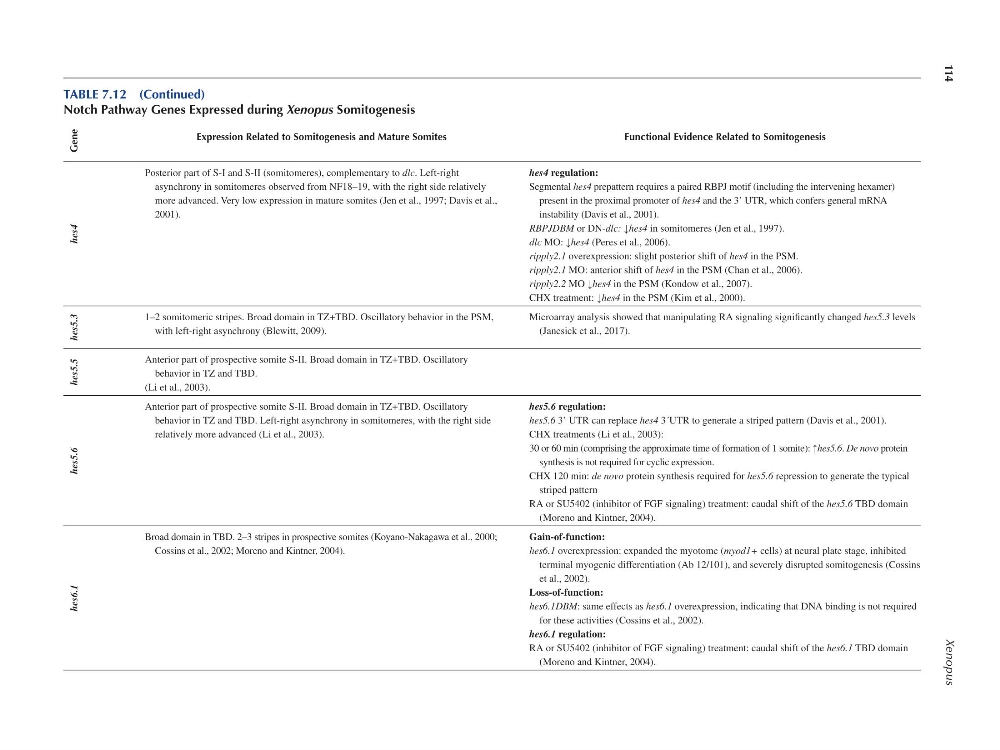
TABLE 7.12 (Continued)
Notch Pathway Genes Expressed during Xenopus Somitogenesis
Expression Related to Somitogenesis and Mature Somites
Functional Evidence Related to Somitogenesis
hes6.1
hes5.6
hes5.5
hes5.3
hes4
Gene
Posterior part of S-I and S-II (somitomeres), complementary to dlc. Left-right
asynchrony in somitomeres observed from NF18–19, with the right side relatively
more advanced. Very low expression in mature somites ( Jen et al., 1997 ; Davis et al.,
2001 ).
hes4 regulation:
Segmental hes4 prepattern requires a paired RBPJ motif (including the intervening hexamer)
present in the proximal promoter of hes4 and the 3’ UTR, which confers general mRNA
instability ( Davis et al., 2001 ).
RBPJ DBM or DN-dlc: ↓hes4 in somitomeres ( Jen et al., 1997 ).
dlc MO : ↓hes4 ( Peres et al., 2006 ).
ripply2.1 overexpression : slight posterior shift of hes4 in the PSM.
ripply2.1 MO : anterior shift of hes4 in the PSM ( Chan et al., 2006 ).
ripply2.2 MO ↓hes4 in the PSM ( Kondow et al., 2007 ).
CHX treatment : ↓hes4 in the PSM ( Kim et al., 2000 ).
1–2 somitomeric stripes. Broad domain in TZ+TBD. Oscillatory behavior in the PSM,
Microarray analysis showed that manipulating RA signaling signif cantly changed hes5.3 levels
with left-right asynchrony ( Blewitt, 2009 ).
( Janesick et al., 2017 ).
Anterior part of prospective somite S-II. Broad domain in TZ+TBD. Oscillatory
behavior in TZ and TBD.
( Li et al., 2003 ).
Anterior part of prospective somite S-II. Broad domain in TZ+TBD. Oscillatory
behavior in TZ and TBD. Left-right asynchrony in somitomeres, with the right side
relatively more advanced ( Li et al., 2003 ).
hes5.6 regulation:
hes5.6 3’ UTR can replace hes4 3´UTR to generate a striped pattern ( Davis et al., 2001 ).
CHX treatments ( Li et al., 2003 ):
30 or 60 min (comprising the approximate time of formation of 1 somite): ↑hes5.6. De novo protein
synthesis is not required for cyclic expression.
CHX 120 min: de novo protein synthesis required for hes5.6 repression to generate the typical
striped pattern
RA or SU5402 (inhibitor of FGF signaling) treatment : caudal shift of the hes5.6 TBD domain
( Moreno and Kintner, 2004 ).
Broad domain in TBD. 2–3 stripes in prospective somites ( Koyano-Nakagawa et al., 2000 ;
Cossins et al., 2002 ; Moreno and Kintner, 2004 ).
Gain-of-function:
hes6.1 overexpression : expanded the myotome ( myod1+ cells) at neural plate stage, inhibited
terminal myogenic differentiation (Ab 12/101), and severely disrupted somitogenesis ( Cossins
et al., 2002 ).
Loss-of-function:
hes6.1 DBM: same effects as hes6.1 overexpression, indicating that DNA binding is not required
for these activities ( Cossins et al., 2002 ).
hes6.1 regulation:
RA or SU5402 (inhibitor of FGF signaling) treatment: caudal shift of the hes6.1 TBD domain
( Moreno and Kintner, 2004 ).
114
Xenopus
Notch Pathway Genes Expressed during Xenopus Somitogenesis
Expression Related to Somitogenesis and Mature Somites
Functional Evidence Related to Somitogenesis
hes6.1
hes5.6
hes5.5
hes5.3
hes4
Gene
Posterior part of S-I and S-II (somitomeres), complementary to dlc. Left-right
asynchrony in somitomeres observed from NF18–19, with the right side relatively
more advanced. Very low expression in mature somites ( Jen et al., 1997 ; Davis et al.,
2001 ).
hes4 regulation:
Segmental hes4 prepattern requires a paired RBPJ motif (including the intervening hexamer)
present in the proximal promoter of hes4 and the 3’ UTR, which confers general mRNA
instability ( Davis et al., 2001 ).
RBPJ DBM or DN-dlc: ↓hes4 in somitomeres ( Jen et al., 1997 ).
dlc MO : ↓hes4 ( Peres et al., 2006 ).
ripply2.1 overexpression : slight posterior shift of hes4 in the PSM.
ripply2.1 MO : anterior shift of hes4 in the PSM ( Chan et al., 2006 ).
ripply2.2 MO ↓hes4 in the PSM ( Kondow et al., 2007 ).
CHX treatment : ↓hes4 in the PSM ( Kim et al., 2000 ).
1–2 somitomeric stripes. Broad domain in TZ+TBD. Oscillatory behavior in the PSM,
Microarray analysis showed that manipulating RA signaling signif cantly changed hes5.3 levels
with left-right asynchrony ( Blewitt, 2009 ).
( Janesick et al., 2017 ).
Anterior part of prospective somite S-II. Broad domain in TZ+TBD. Oscillatory
behavior in TZ and TBD.
( Li et al., 2003 ).
Anterior part of prospective somite S-II. Broad domain in TZ+TBD. Oscillatory
behavior in TZ and TBD. Left-right asynchrony in somitomeres, with the right side
relatively more advanced ( Li et al., 2003 ).
hes5.6 regulation:
hes5.6 3’ UTR can replace hes4 3´UTR to generate a striped pattern ( Davis et al., 2001 ).
CHX treatments ( Li et al., 2003 ):
30 or 60 min (comprising the approximate time of formation of 1 somite): ↑hes5.6. De novo protein
synthesis is not required for cyclic expression.
CHX 120 min: de novo protein synthesis required for hes5.6 repression to generate the typical
striped pattern
RA or SU5402 (inhibitor of FGF signaling) treatment : caudal shift of the hes5.6 TBD domain
( Moreno and Kintner, 2004 ).
Broad domain in TBD. 2–3 stripes in prospective somites ( Koyano-Nakagawa et al., 2000 ;
Cossins et al., 2002 ; Moreno and Kintner, 2004 ).
Gain-of-function:
hes6.1 overexpression : expanded the myotome ( myod1+ cells) at neural plate stage, inhibited
terminal myogenic differentiation (Ab 12/101), and severely disrupted somitogenesis ( Cossins
et al., 2002 ).
Loss-of-function:
hes6.1 DBM: same effects as hes6.1 overexpression, indicating that DNA binding is not required
for these activities ( Cossins et al., 2002 ).
hes6.1 regulation:
RA or SU5402 (inhibitor of FGF signaling) treatment: caudal shift of the hes6.1 TBD domain
( Moreno and Kintner, 2004 ).
114
Xenopus