

Analytica Chimica Acta, accepted, 07/07/2015. This is the accepted version without proofing
corrections. DOI: 10.1016/j.aca.2015.06.011
.
Page 20 of 26
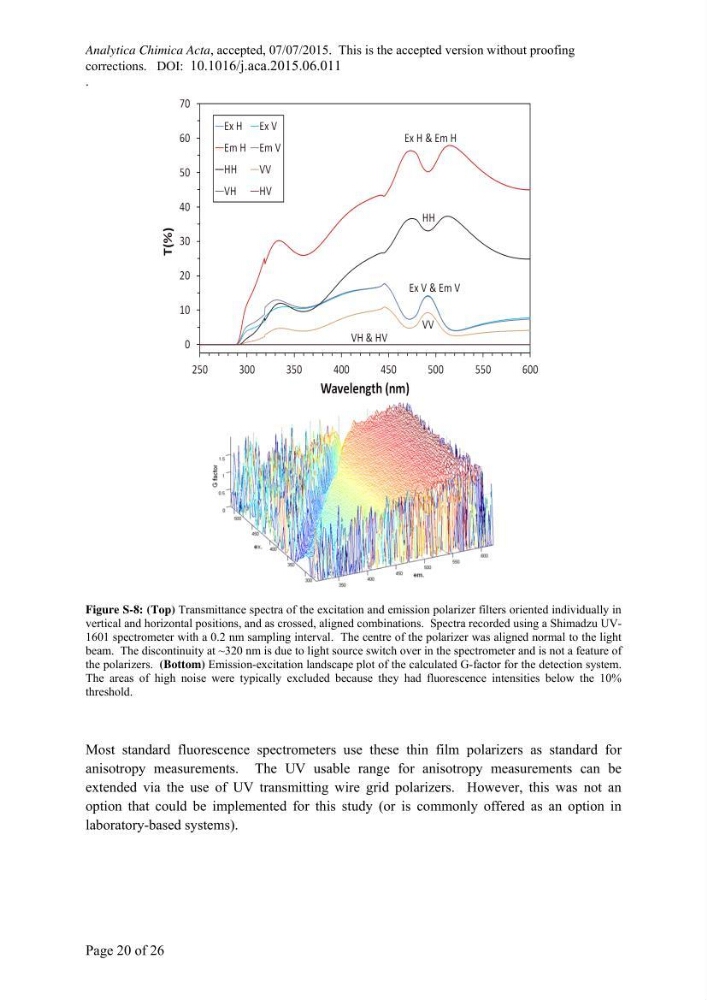
Figure S-8: (Top) Transmittance spectra of the excitation and emission polarizer filters oriented individually in
vertical and horizontal positions, and as crossed, aligned combinations. Spectra recorded using a Shimadzu UV1601 spectrometer with a 0.2 nm sampling interval. The centre of the polarizer was aligned normal to the light
beam. The discontinuity at ~320 nm is due to light source switch over in the spectrometer and is not a feature of
the polarizers. (Bottom) Emission-excitation landscape plot of the calculated G-factor for the detection system.
The areas of high noise were typically excluded because they had fluorescence intensities below the 10%
threshold.
Most standard fluorescence spectrometers use these thin film polarizers as standard for
anisotropy measurements. The UV usable range for anisotropy measurements can be
extended via the use of UV transmitting wire grid polarizers. However, this was not an
option that could be implemented for this study (or is commonly offered as an option in
laboratory-based systems).
corrections. DOI: 10.1016/j.aca.2015.06.011
.
Page 20 of 26
Figure S-8: (Top) Transmittance spectra of the excitation and emission polarizer filters oriented individually in
vertical and horizontal positions, and as crossed, aligned combinations. Spectra recorded using a Shimadzu UV1601 spectrometer with a 0.2 nm sampling interval. The centre of the polarizer was aligned normal to the light
beam. The discontinuity at ~320 nm is due to light source switch over in the spectrometer and is not a feature of
the polarizers. (Bottom) Emission-excitation landscape plot of the calculated G-factor for the detection system.
The areas of high noise were typically excluded because they had fluorescence intensities below the 10%
threshold.
Most standard fluorescence spectrometers use these thin film polarizers as standard for
anisotropy measurements. The UV usable range for anisotropy measurements can be
extended via the use of UV transmitting wire grid polarizers. However, this was not an
option that could be implemented for this study (or is commonly offered as an option in
laboratory-based systems).