

ANALYSIS OF OILS USING FLUORESCENCE.
21
0
10
20
30
40
50
0
2
4
6
8
10
A
540nm, r=0.93
y=a+b*ln(x)
average lifetime[ns]
polars[%]
0
10
20
30
40
50
0
2
4
6
8
10
B
540nm, r=0.90
y=a+b*ln(x)
average lifetime[ns]
corrected polars[%]
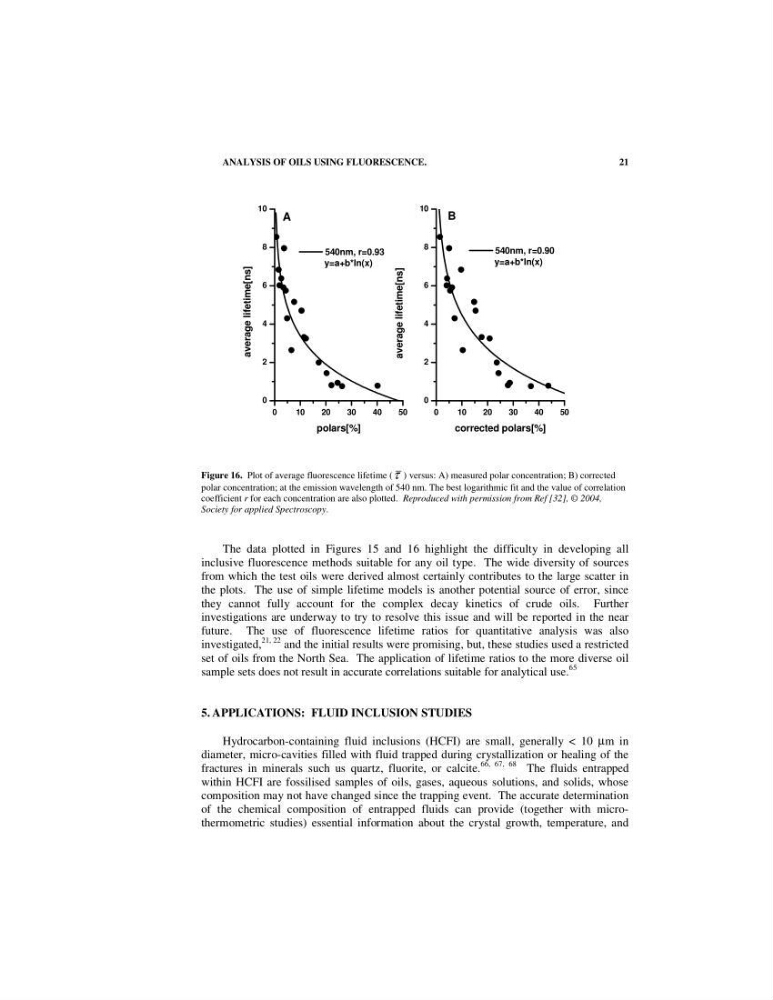
Figure 16. Plot of average fluorescence lifetime (τ ) versus: A) measured polar concentration; B) corrected
polar concentration; at the emission wavelength of 540 nm. The best logarithmic fit and the value of correlation
coefficient r for each concentration are also plotted. Reproduced with permission from Ref [32], © 2004,
Society for applied Spectroscopy.
The data plotted in Figures 15 and 16 highlight the difficulty in developing all
inclusive fluorescence methods suitable for any oil type. The wide diversity of sources
from which the test oils were derived almost certainly contributes to the large scatter in
the plots. The use of simple lifetime models is another potential source of error, since
they cannot fully account for the complex decay kinetics of crude oils. Further
investigations are underway to try to resolve this issue and will be reported in the near
future. The use of fluorescence lifetime ratios for quantitative analysis was also
investigated,
21, 22 and the initial results were promising, but, these studies used a restricted
set of oils from the North Sea. The application of lifetime ratios to the more diverse oil
sample sets does not result in accurate correlations suitable for analytical use.
65
5. APPLICATIONS: FLUID INCLUSION STUDIES
Hydrocarbon-containing fluid inclusions (HCFI) are small, generally < 10 µm in
diameter, micro-cavities filled with fluid trapped during crystallization or healing of the
fractures in minerals such us quartz, fluorite, or calcite.
66, 67, 68 The fluids entrapped
within HCFI are fossilised samples of oils, gases, aqueous solutions, and solids, whose
composition may not have changed since the trapping event. The accurate determination
of the chemical composition of entrapped fluids can provide (together with microthermometric studies) essential information about the crystal growth, temperature, and
21
0
10
20
30
40
50
0
2
4
6
8
10
A
540nm, r=0.93
y=a+b*ln(x)
average lifetime[ns]
polars[%]
0
10
20
30
40
50
0
2
4
6
8
10
B
540nm, r=0.90
y=a+b*ln(x)
average lifetime[ns]
corrected polars[%]
Figure 16. Plot of average fluorescence lifetime (τ ) versus: A) measured polar concentration; B) corrected
polar concentration; at the emission wavelength of 540 nm. The best logarithmic fit and the value of correlation
coefficient r for each concentration are also plotted. Reproduced with permission from Ref [32], © 2004,
Society for applied Spectroscopy.
The data plotted in Figures 15 and 16 highlight the difficulty in developing all
inclusive fluorescence methods suitable for any oil type. The wide diversity of sources
from which the test oils were derived almost certainly contributes to the large scatter in
the plots. The use of simple lifetime models is another potential source of error, since
they cannot fully account for the complex decay kinetics of crude oils. Further
investigations are underway to try to resolve this issue and will be reported in the near
future. The use of fluorescence lifetime ratios for quantitative analysis was also
investigated,
21, 22 and the initial results were promising, but, these studies used a restricted
set of oils from the North Sea. The application of lifetime ratios to the more diverse oil
sample sets does not result in accurate correlations suitable for analytical use.
65
5. APPLICATIONS: FLUID INCLUSION STUDIES
Hydrocarbon-containing fluid inclusions (HCFI) are small, generally < 10 µm in
diameter, micro-cavities filled with fluid trapped during crystallization or healing of the
fractures in minerals such us quartz, fluorite, or calcite.
66, 67, 68 The fluids entrapped
within HCFI are fossilised samples of oils, gases, aqueous solutions, and solids, whose
composition may not have changed since the trapping event. The accurate determination
of the chemical composition of entrapped fluids can provide (together with microthermometric studies) essential information about the crystal growth, temperature, and