

3.3. HYDRAULIC SIMILITUDE
65
leads to
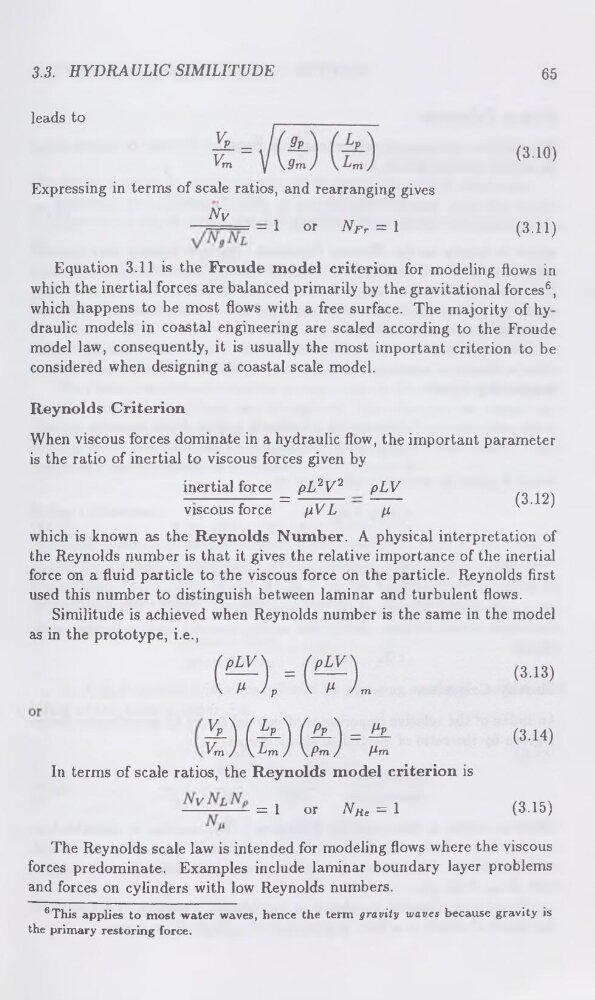
Expressing in terms of scale ratios, and rearranging gives
Nv
— 1
or Npr = 1
(3.10)
(3.11)
Equation 3.11 is the Froude model criterion for modeling flows in
which the inertial forces are balanced primarily by the gravitational forces6,
which happens to be most flows with a free surface. The majority of hydraulic models in coastal engineering are scaled according to the Froude
model law, consequently, it is usually the most important criterion to be
considered when designing a coastal scale model.
6This applies to most water waves, hence the term gravity waves because gravity is
the primary restoring force.
Reynolds Criterion
When viscous forces dominate in a hydraulic flow, the important parameter
is the ratio of inertial to viscous forces given by
inertial force pL2V2
pLV
----------7-----=
- ---(3.12)
viscous force----pVL
p
which is known as the Reynolds Number. A physical interpretation of
the Reynolds number is that it gives the relative importance of the inertial
force on a fluid particle to the viscous force on the particle. Reynolds first
used this number to distinguish between laminar and turbulent flows.
Similitude is achieved when Reynolds number is the same in the model
as in the prototype, i.e.,
In terms of scale ratios, the Reynolds model criterion is
= 1 or Nr. = 1
(3.15)
The Reynolds scale law is intended for modeling flows where the viscous
forces predominate. Examples include laminar boundary layer problems
and forces on cylinders with low Reynolds numbers.
65
leads to
Expressing in terms of scale ratios, and rearranging gives
Nv
— 1
or Npr = 1
(3.10)
(3.11)
Equation 3.11 is the Froude model criterion for modeling flows in
which the inertial forces are balanced primarily by the gravitational forces6,
which happens to be most flows with a free surface. The majority of hydraulic models in coastal engineering are scaled according to the Froude
model law, consequently, it is usually the most important criterion to be
considered when designing a coastal scale model.
6This applies to most water waves, hence the term gravity waves because gravity is
the primary restoring force.
Reynolds Criterion
When viscous forces dominate in a hydraulic flow, the important parameter
is the ratio of inertial to viscous forces given by
inertial force pL2V2
pLV
----------7-----=
- ---(3.12)
viscous force----pVL
p
which is known as the Reynolds Number. A physical interpretation of
the Reynolds number is that it gives the relative importance of the inertial
force on a fluid particle to the viscous force on the particle. Reynolds first
used this number to distinguish between laminar and turbulent flows.
Similitude is achieved when Reynolds number is the same in the model
as in the prototype, i.e.,
In terms of scale ratios, the Reynolds model criterion is
= 1 or Nr. = 1
(3.15)
The Reynolds scale law is intended for modeling flows where the viscous
forces predominate. Examples include laminar boundary layer problems
and forces on cylinders with low Reynolds numbers.