

64
CHAPTER 3. PRINCIPLES OF SIMILITUDE
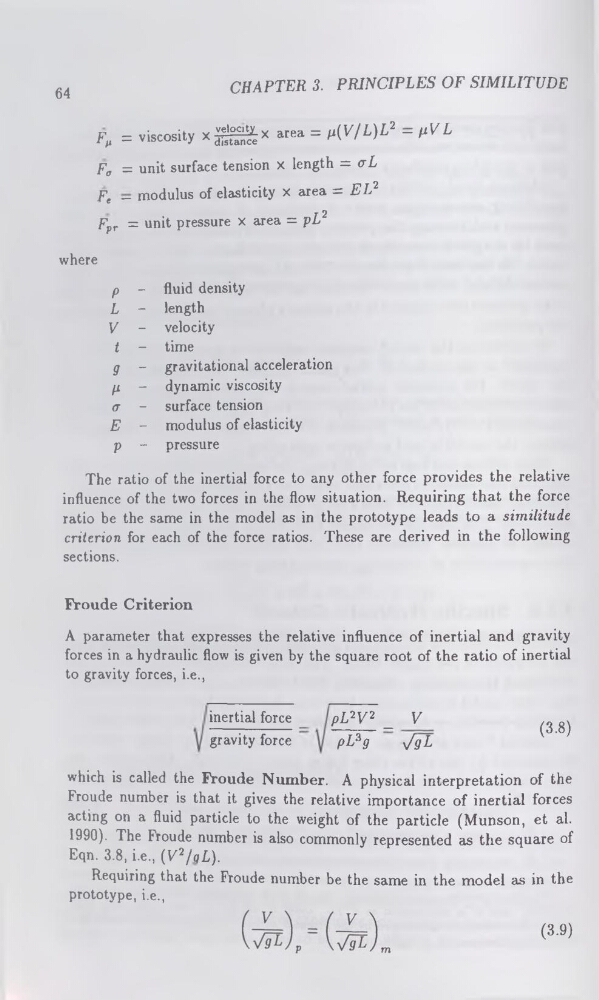
F„ = viscosity xggjx area = p(V/L)L2 - pVL
Fa = unit surface tension x length = aL
Fe - modulus of elasticity x area = EL2
Fpr = unit pressure x area = pL2
where
p - fluid density
L - length
V - velocity
t - time
g - gravitational acceleration
p - dynamic viscosity
a - surface tension
E - modulus of elasticity
p - pressure
The ratio of the inertial force to any other force provides the relative
influence of the two forces in the flow situation. Requiring that the force
ratio be the same in the model as in the prototype leads to a similitude
criterion for each of the force ratios. These are derived in the following
sections.
Froude Criterion
A parameter that expresses the relative influence of inertial and gravity
forces in a hydraulic flow is given by the square root of the ratio of inertial
to gravity forces, i.e.,
inertial force
gravity force
pL2V2 _ V
pL3g
x/gL
(3-8)
which is called the Froude Number. A physical interpretation of the
Froude number is that it gives the relative importance of inertial forces
acting on a fluid particle to the weight of the particle (Munson, et al.
1990). The Froude number is also commonly represented as the square of
Eqn. 3.8, i.e., (V2/t/L).
Requiring that the Froude number be the same in the model as in the
prototype, i.e.,
(3-9)
CHAPTER 3. PRINCIPLES OF SIMILITUDE
F„ = viscosity xggjx area = p(V/L)L2 - pVL
Fa = unit surface tension x length = aL
Fe - modulus of elasticity x area = EL2
Fpr = unit pressure x area = pL2
where
p - fluid density
L - length
V - velocity
t - time
g - gravitational acceleration
p - dynamic viscosity
a - surface tension
E - modulus of elasticity
p - pressure
The ratio of the inertial force to any other force provides the relative
influence of the two forces in the flow situation. Requiring that the force
ratio be the same in the model as in the prototype leads to a similitude
criterion for each of the force ratios. These are derived in the following
sections.
Froude Criterion
A parameter that expresses the relative influence of inertial and gravity
forces in a hydraulic flow is given by the square root of the ratio of inertial
to gravity forces, i.e.,
inertial force
gravity force
pL2V2 _ V
pL3g
x/gL
(3-8)
which is called the Froude Number. A physical interpretation of the
Froude number is that it gives the relative importance of inertial forces
acting on a fluid particle to the weight of the particle (Munson, et al.
1990). The Froude number is also commonly represented as the square of
Eqn. 3.8, i.e., (V2/t/L).
Requiring that the Froude number be the same in the model as in the
prototype, i.e.,
(3-9)