

66
CHAPTER 3. PRINCIPLES OF SIMILITUDE
Weber Criterion
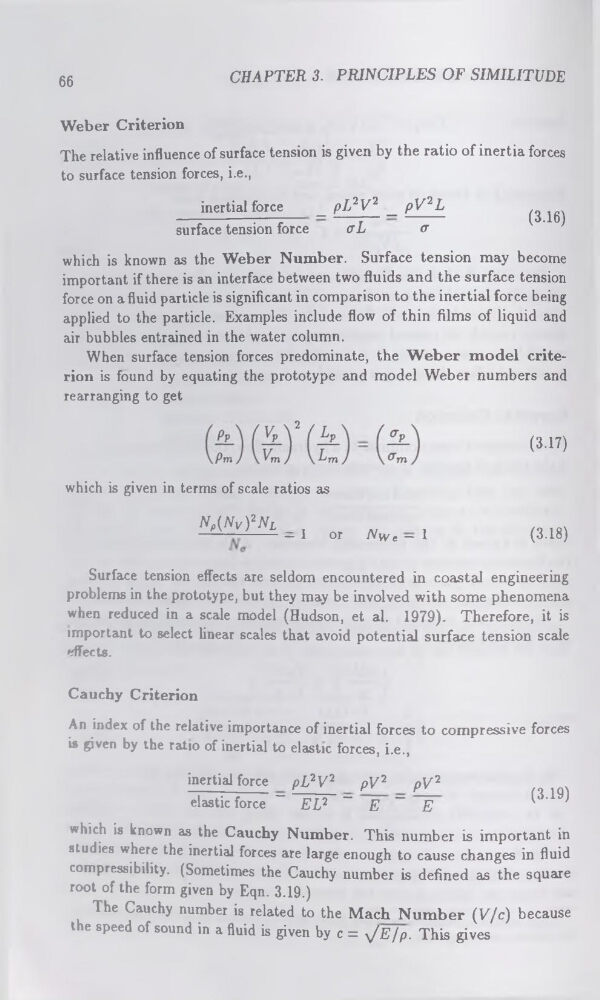
The relative influence of surface tension is given by the ratio of inertia forces
to surface tension forces, i.e.,
inertial force
_ pL2V2 _ pV2L
surface tension force
which is known as the Weber Number. Surface tension may become
important if there is an interface between two fluids and the surface tension
force on a fluid particle is significant in comparison to the inertial force being
applied to the particle. Examples include flow of thin films of liquid and
air bubbles entrained in the water column.
When surface tension forces predominate, the Weber model criterion is found by equating the prototype and model Weber numbers and
rearranging to get
(3.17)
which is given in terms of scale ratios as
N,(Nv)2NL
----- —---------- 1 or Nwe — 1
(3.18)
Surface tension effects are seldom encountered in coastal engineering
problems in the prototype, but they may be involved with some phenomena
when reduced in a scale model (Hudson, et al. 1979). Therefore, it is
important to select linear scales that avoid potential surface tension scale
effects.
Cauchy Criterion
An index of the relative importance of inertial forces to compressive forces
is given by the ratio of inertial to elastic forces, i.e.,
inertial force p£2V2
pV2
pV2
elastic force ~ EL2 ~ E ~ E
(3.19)
which is known as the Cauchy Number. This number is important in
studies where the inertial forces are large enough to cause changes in fluid
compressibility. (Sometimes the Cauchy number is defined as the square
root of the form given by Eqn. 3.19.)
The Cauchy number is related to the Mach Number (V/c) because
the speed of sound in a fluid is given by c = yjE/p. This gives
CHAPTER 3. PRINCIPLES OF SIMILITUDE
Weber Criterion
The relative influence of surface tension is given by the ratio of inertia forces
to surface tension forces, i.e.,
inertial force
_ pL2V2 _ pV2L
surface tension force
which is known as the Weber Number. Surface tension may become
important if there is an interface between two fluids and the surface tension
force on a fluid particle is significant in comparison to the inertial force being
applied to the particle. Examples include flow of thin films of liquid and
air bubbles entrained in the water column.
When surface tension forces predominate, the Weber model criterion is found by equating the prototype and model Weber numbers and
rearranging to get
(3.17)
which is given in terms of scale ratios as
N,(Nv)2NL
----- —---------- 1 or Nwe — 1
(3.18)
Surface tension effects are seldom encountered in coastal engineering
problems in the prototype, but they may be involved with some phenomena
when reduced in a scale model (Hudson, et al. 1979). Therefore, it is
important to select linear scales that avoid potential surface tension scale
effects.
Cauchy Criterion
An index of the relative importance of inertial forces to compressive forces
is given by the ratio of inertial to elastic forces, i.e.,
inertial force p£2V2
pV2
pV2
elastic force ~ EL2 ~ E ~ E
(3.19)
which is known as the Cauchy Number. This number is important in
studies where the inertial forces are large enough to cause changes in fluid
compressibility. (Sometimes the Cauchy number is defined as the square
root of the form given by Eqn. 3.19.)
The Cauchy number is related to the Mach Number (V/c) because
the speed of sound in a fluid is given by c = yjE/p. This gives