

432
CHAPTER 7. LABORATORY WAVE GENERATION
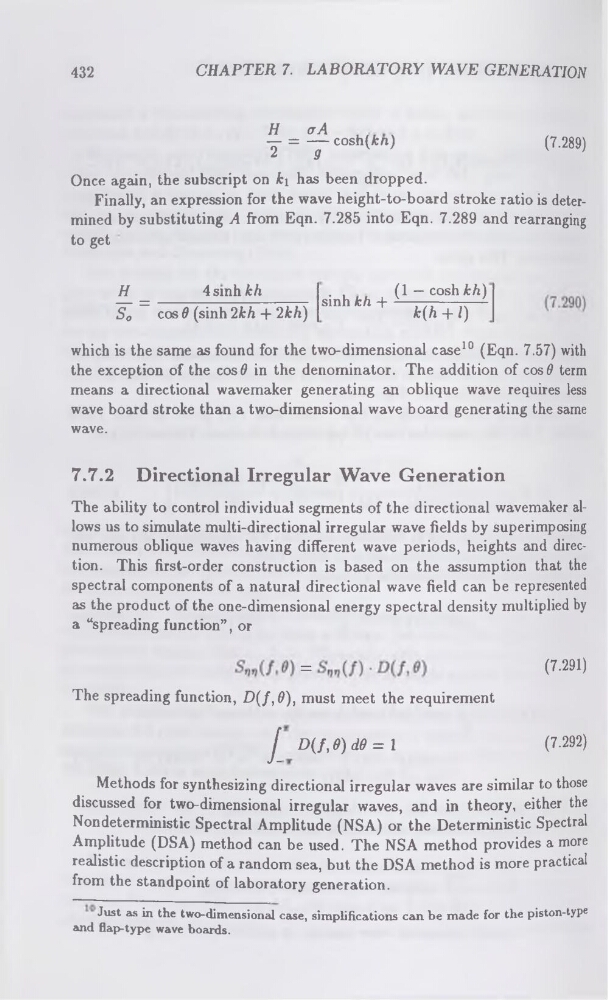
H
aA
— = — cosh(fcn)
2
g
(7.289)
Once again, the subscript on k\ has been dropped.
Finally, an expression for the wave height-to-board stroke ratio is determined by substituting A from Eqn. 7.285 into Eqn. 7.289 and rearranging
to get
H
4smhfc/i
. ,
(1 —coshfc/i)
— = ---- „ , . ,——---- ■, sinh kh d-------- —----- - —
So
cos 0 (smh 2kh + 2kh)
k(h + /)
which is the same as found for the two-dimensional case10 (Eqn. 7.57) with
the exception of the cos 0 in the denominator. The addition of cos 0 term
means a directional wavemaker generating an oblique wave requires less
wave board stroke than a two-dimensional wave board generating the same
wave.
7.7.2 Directional Irregular Wave Generation
The ability to control individual segments of the directional wavemaker allows us to simulate multi-directional irregular wave fields by superimposing
numerous oblique waves having different wave periods, heights and direction. This first-order construction is based on the assumption that the
spectral components of a natural directional wave field can be represented
as the product of the one-dimensional energy spectral density multiplied by
a “spreading function”, or
=
(7.291)
The spreading function, D(f,0), must meet the requirement
y D(f,0)d0=l
(7.292)
Methods for synthesizing directional irregular waves are similar to those
discussed for two-dimensional irregular waves, and in theory, either the
Non deterministic Spectral Amplitude (NS A) or the Deterministic Spectral
Amplitude (DS A) method can be used. The NS A method provides a more
realistic description of a random sea, but the DSA method is more practical
from the standpoint of laboratory generation.
Just as in the two-dimensional case, simplifications can be made for the piston-type
and flap-type wave boards.
CHAPTER 7. LABORATORY WAVE GENERATION
H
aA
— = — cosh(fcn)
2
g
(7.289)
Once again, the subscript on k\ has been dropped.
Finally, an expression for the wave height-to-board stroke ratio is determined by substituting A from Eqn. 7.285 into Eqn. 7.289 and rearranging
to get
H
4smhfc/i
. ,
(1 —coshfc/i)
— = ---- „ , . ,——---- ■, sinh kh d-------- —----- - —
So
cos 0 (smh 2kh + 2kh)
k(h + /)
which is the same as found for the two-dimensional case10 (Eqn. 7.57) with
the exception of the cos 0 in the denominator. The addition of cos 0 term
means a directional wavemaker generating an oblique wave requires less
wave board stroke than a two-dimensional wave board generating the same
wave.
7.7.2 Directional Irregular Wave Generation
The ability to control individual segments of the directional wavemaker allows us to simulate multi-directional irregular wave fields by superimposing
numerous oblique waves having different wave periods, heights and direction. This first-order construction is based on the assumption that the
spectral components of a natural directional wave field can be represented
as the product of the one-dimensional energy spectral density multiplied by
a “spreading function”, or
=
(7.291)
The spreading function, D(f,0), must meet the requirement
y D(f,0)d0=l
(7.292)
Methods for synthesizing directional irregular waves are similar to those
discussed for two-dimensional irregular waves, and in theory, either the
Non deterministic Spectral Amplitude (NS A) or the Deterministic Spectral
Amplitude (DS A) method can be used. The NS A method provides a more
realistic description of a random sea, but the DSA method is more practical
from the standpoint of laboratory generation.
Just as in the two-dimensional case, simplifications can be made for the piston-type
and flap-type wave boards.