

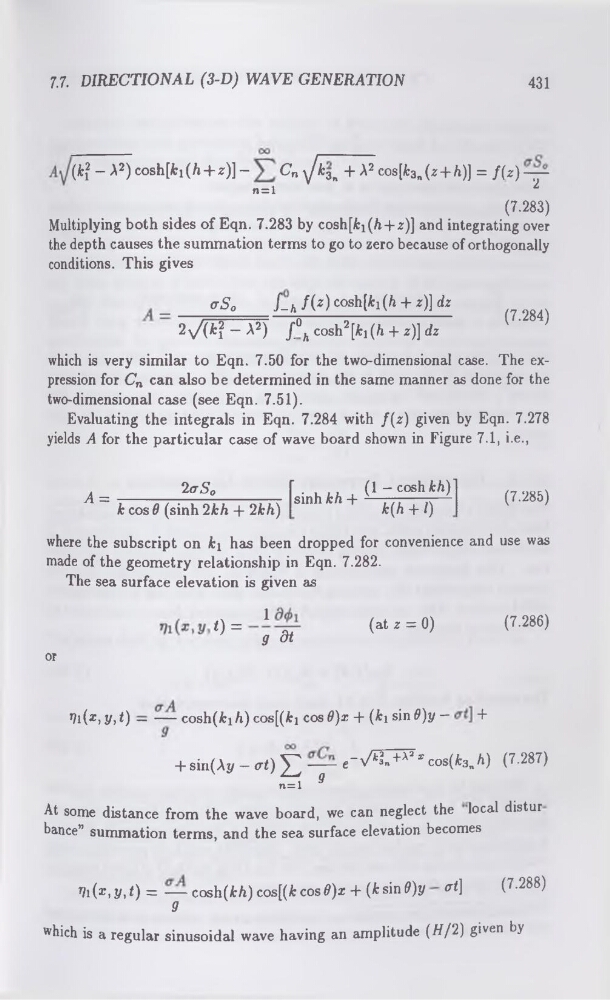
7.7. DIRECTIONAL (3-D) WAVE GENERATION
431
(Arf - A2) cosh[fci(/i + * )] -
C” \[k3n + A2 cos[fc3n (z + /i)] = f(z)-~n=l
2
(7.283)
Multiplying both sides of Eqn. 7.283 by coshfAr^/i-l-z)] and integrating over
the depth causes the summation terms to go to zero because of orthogonally
conditions. This gives
_
aS0
f-hf(z) cosh[&i(/i + z)] dz
2\/(kl — A2) f°h cosh2[Ari (/i 4- z)] dz
(7.284)
which is very similar to Eqn. 7.50 for the two-dimensional case. The expression for Cn can also be determined in the same manner as done for the
two-dimensional case (see Eqn. 7.51).
Evaluating the integrals in Eqn. 7.284 with /(z) given by Eqn. 7.278
yields A for the particular case of wave board shown in Figure 7.1, i.e.,
A
2aS°
f, (1 ~ COshfc/l)l
.
.
A = ---------■ . ,——---- ----7 smhAr/i-|------777------- T?—
(7.285)
k cos 0 (sinh 2kh + 2kk)
k(h + /)
where the subscript on k± has been dropped for convenience and use was
made of the geometry relationship in Eqn. 7.282.
The sea surface elevation is given as
t) =
i
g dt
(at z = 0)
(7.286)
or
’h(x> y,t) — ----cosh(fci/i) cos[(&i cos0)ar + (Ari sin#)j/ —
+
+ sin(Ay-ai)£ — e-V^+^ * cos( * 3.A)
(7.287)
n=l 9
At some distance from the wave board, we can neglect the local distur
bance” summation terms, and the sea surface elevation becomes
*h(x> y, 0 = —— cosh(ArA) cos[(Ar cos 0)x + (Ar sin (T)y
g
which is a regular sinusoidal wave having an amplitude (T//2) given by
431
(Arf - A2) cosh[fci(/i + * )] -
C” \[k3n + A2 cos[fc3n (z + /i)] = f(z)-~n=l
2
(7.283)
Multiplying both sides of Eqn. 7.283 by coshfAr^/i-l-z)] and integrating over
the depth causes the summation terms to go to zero because of orthogonally
conditions. This gives
_
aS0
f-hf(z) cosh[&i(/i + z)] dz
2\/(kl — A2) f°h cosh2[Ari (/i 4- z)] dz
(7.284)
which is very similar to Eqn. 7.50 for the two-dimensional case. The expression for Cn can also be determined in the same manner as done for the
two-dimensional case (see Eqn. 7.51).
Evaluating the integrals in Eqn. 7.284 with /(z) given by Eqn. 7.278
yields A for the particular case of wave board shown in Figure 7.1, i.e.,
A
2aS°
f, (1 ~ COshfc/l)l
.
.
A = ---------■ . ,——---- ----7 smhAr/i-|------777------- T?—
(7.285)
k cos 0 (sinh 2kh + 2kk)
k(h + /)
where the subscript on k± has been dropped for convenience and use was
made of the geometry relationship in Eqn. 7.282.
The sea surface elevation is given as
t) =
i
g dt
(at z = 0)
(7.286)
or
’h(x> y,t) — ----cosh(fci/i) cos[(&i cos0)ar + (Ari sin#)j/ —
+
+ sin(Ay-ai)£ — e-V^+^ * cos( * 3.A)
(7.287)
n=l 9
At some distance from the wave board, we can neglect the local distur
bance” summation terms, and the sea surface elevation becomes
*h(x> y, 0 = —— cosh(ArA) cos[(Ar cos 0)x + (Ar sin (T)y
g
which is a regular sinusoidal wave having an amplitude (T//2) given by