

7.7. DIRECTIONAL (3-D) WAVE GENERATION
433
Detailed discussions on the subject of first-order directional irregular
wave synthesis and generation have been given by Sand and Mynett (1987)
and by Takayama and Hiraishi (1987).
7.7.3
Practical Aspects of Directional Wavemakers
In the real world we should expect to see some decrease in our ability to
generate perfect oblique waves due to the finite restrictions of the laboratory
and other sources of error that can alter the quality of the generated wave.
The first-order theory for generation of oblique waves assumes an infinitely long wave generator comprised of segments having an infinitely
small width. In practice the wave generator has finite length and segment
widths, and the sinusoidal variation of the wavemaker along the y-axis becomes a discrete curve with discontinuities between wave board segments.
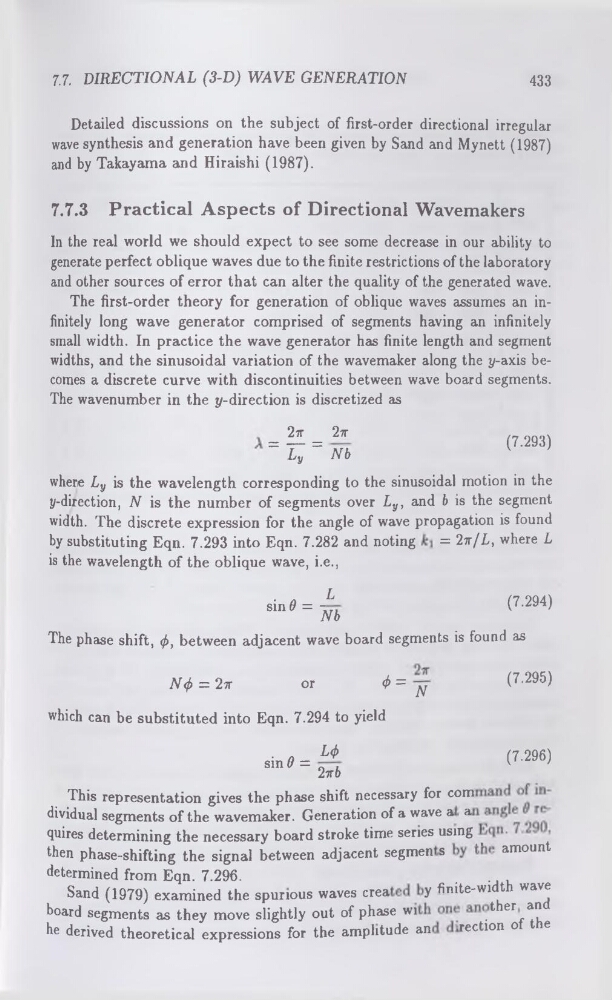
The wavenumber in the ^/-direction is discretized as
2tt
2tt
= Ty = Nb
(7.293)
where Ly is the wavelength corresponding to the sinusoidal motion in the
^-direction, N is the number of segments over Ly, and b is the segment
width. The discrete expression for the angle of wave propagation is found
by substituting Eqn. 7.293 into Eqn. 7.282 and noting
= 2%/L, where L
is the wavelength of the oblique wave, i.e.,
• n
L
(7.294)
slnS=j«
The phase shift, 0, between adjacent wave board segments is found as
jl _
(7.295)
N = 27T
or
k
which can be substituted into Eqn. 7.294 to yield
. n
L
(7.296)
sin^=2%&
This representation gives the phase shift necessary for com
dividual segments of the wavemaker. Generation of a wave a a
quires determining the necessary board stroke time serieS USæ®.. amOunt
then phase-shifting the signal between adjacent segmen s
determined from Eqn. 7.296.
finite-width wave
Sand (1979) examined the spurious waves créa
y
ther and
board segments as they move slightly out of phase wi
. rection of the
he derived theoretical expressions for the amplitude an
433
Detailed discussions on the subject of first-order directional irregular
wave synthesis and generation have been given by Sand and Mynett (1987)
and by Takayama and Hiraishi (1987).
7.7.3
Practical Aspects of Directional Wavemakers
In the real world we should expect to see some decrease in our ability to
generate perfect oblique waves due to the finite restrictions of the laboratory
and other sources of error that can alter the quality of the generated wave.
The first-order theory for generation of oblique waves assumes an infinitely long wave generator comprised of segments having an infinitely
small width. In practice the wave generator has finite length and segment
widths, and the sinusoidal variation of the wavemaker along the y-axis becomes a discrete curve with discontinuities between wave board segments.
The wavenumber in the ^/-direction is discretized as
2tt
2tt
= Ty = Nb
(7.293)
where Ly is the wavelength corresponding to the sinusoidal motion in the
^-direction, N is the number of segments over Ly, and b is the segment
width. The discrete expression for the angle of wave propagation is found
by substituting Eqn. 7.293 into Eqn. 7.282 and noting
= 2%/L, where L
is the wavelength of the oblique wave, i.e.,
• n
L
(7.294)
slnS=j«
The phase shift, 0, between adjacent wave board segments is found as
jl _
(7.295)
N = 27T
or
k
which can be substituted into Eqn. 7.294 to yield
. n
L
(7.296)
sin^=2%&
This representation gives the phase shift necessary for com
dividual segments of the wavemaker. Generation of a wave a a
quires determining the necessary board stroke time serieS USæ®.. amOunt
then phase-shifting the signal between adjacent segmen s
determined from Eqn. 7.296.
finite-width wave
Sand (1979) examined the spurious waves créa
y
ther and
board segments as they move slightly out of phase wi
. rection of the
he derived theoretical expressions for the amplitude an