

7.4. NONLINEAR WAVE GENERATION
381
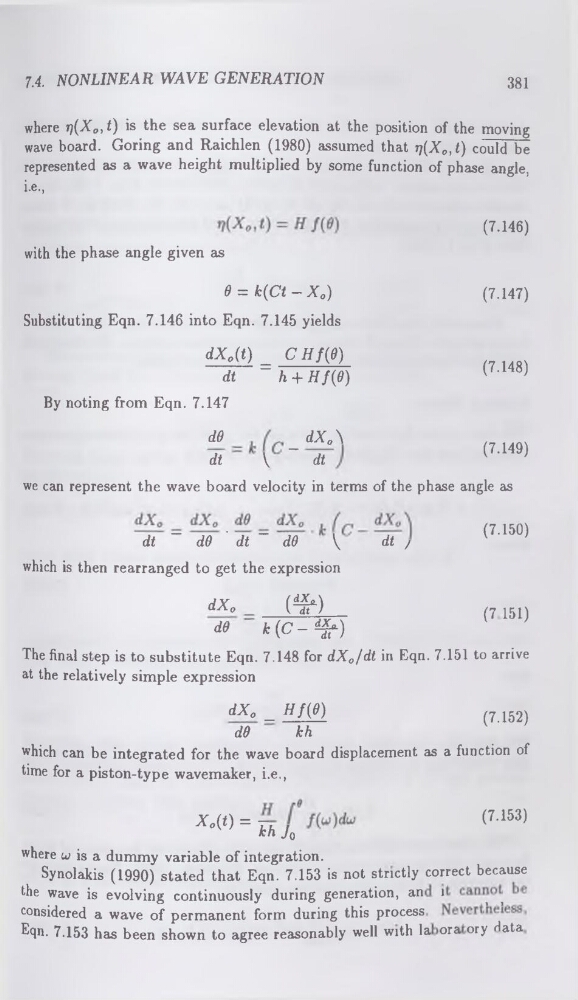
where 7/(X0,f) is the sea surface elevation at the position of the moving
wave board. Goring and Raichlen (1980) assumed that T](XO)t) could be
represented as a wave height multiplied by some function of phase angle,
i.e.,
we can represent the wave board velocity in terms of the phase angle as
with the phase angle given as
(7.146)
e = k(ct - x0}
(7.147)
Substituting Eqn. 7.146 into Eqn. 7.145 yields
dX0(t) _ CHf(0)
dt
~ h + Hf(e)
(7.148)
By noting from Eqn. 7.147
M
_ dXo\
dt
\
dt
(7.149)
(7.150)
(7151)
dt ~ dO ’ dt ~ dd
V
dt /
which is then rearranged to get the expression
dX,
(ffi)
de kfc-fy)
The final step is to substitute Eqn. 7.148 for dXoldl in Eqn. 7.151 to arrive
at the relatively simple expression
dXo _ Hf{e)
(7.152)
de
kh
which can be integrated for the wave board displacement as a function of
time for a piston-type wavemaker, i.e.,
Xo(t) = Th
kh J g
(7.153)
where w is a dummy variable of integration.
kA(-aii«?e
Synolakis (1990) stated that Eqn. 7.153 is not stnctly correcl. because
the wave is evolving continuously during generation, an 1
, .
considered a wave of permanent form during this process
.
data
Eqn. 7.153 has been shown to agree reasonably well with la ora ory
381
where 7/(X0,f) is the sea surface elevation at the position of the moving
wave board. Goring and Raichlen (1980) assumed that T](XO)t) could be
represented as a wave height multiplied by some function of phase angle,
i.e.,
we can represent the wave board velocity in terms of the phase angle as
with the phase angle given as
(7.146)
e = k(ct - x0}
(7.147)
Substituting Eqn. 7.146 into Eqn. 7.145 yields
dX0(t) _ CHf(0)
dt
~ h + Hf(e)
(7.148)
By noting from Eqn. 7.147
M
_ dXo\
dt
\
dt
(7.149)
(7.150)
(7151)
dt ~ dO ’ dt ~ dd
V
dt /
which is then rearranged to get the expression
dX,
(ffi)
de kfc-fy)
The final step is to substitute Eqn. 7.148 for dXoldl in Eqn. 7.151 to arrive
at the relatively simple expression
dXo _ Hf{e)
(7.152)
de
kh
which can be integrated for the wave board displacement as a function of
time for a piston-type wavemaker, i.e.,
Xo(t) = Th
kh J g
(7.153)
where w is a dummy variable of integration.
kA(-aii«?e
Synolakis (1990) stated that Eqn. 7.153 is not stnctly correcl. because
the wave is evolving continuously during generation, an 1
, .
considered a wave of permanent form during this process
.
data
Eqn. 7.153 has been shown to agree reasonably well with la ora ory