

380
CHAPTER 7. LABORATORY WAVE GENERATION
General Wavemaker Equation
Goring (1979) studied tsunami waves propagating across a shelf, and he
used solitary and cnoidal waves to represent the tsunami theoretically and
experimentally in the laboratory. Generation of solitary waves by positive
displacement of water volume was not satisfactory for Goring’s experiments
because the trailing oscillatory waves would have interfered with measurements of the reflected solitary wave. The need to generate waves without
the residual oscillatory tail resulted in development of a wavemaker theory for producing acceptable profiles of solitary and cnoidal waves using a
piston-type wave board.
The basis of the shallow water wavemaker theory is "... to match the
velocities of the wave board and the water particles of the desired wave
as the board moves” (Goring and Raichlen 1980). Svendsen (1985) noted
that including the wave board motion in the formulation of the theory
eliminated one source of free secondary harmonic waves.
The wave board displacement for a piston-type wavemaker is denoted
as Xo(t), and the wave board velocity is given as dX0/dt. Beneath long
waves, it is reasonable to assume that the horizontal velocities are nearly
constant over the depth, or u(z,z,/) ~ ü(z, Z). Equating the wave board
speed to the depth-averaged particle velocity on the face of the board gives
the expression
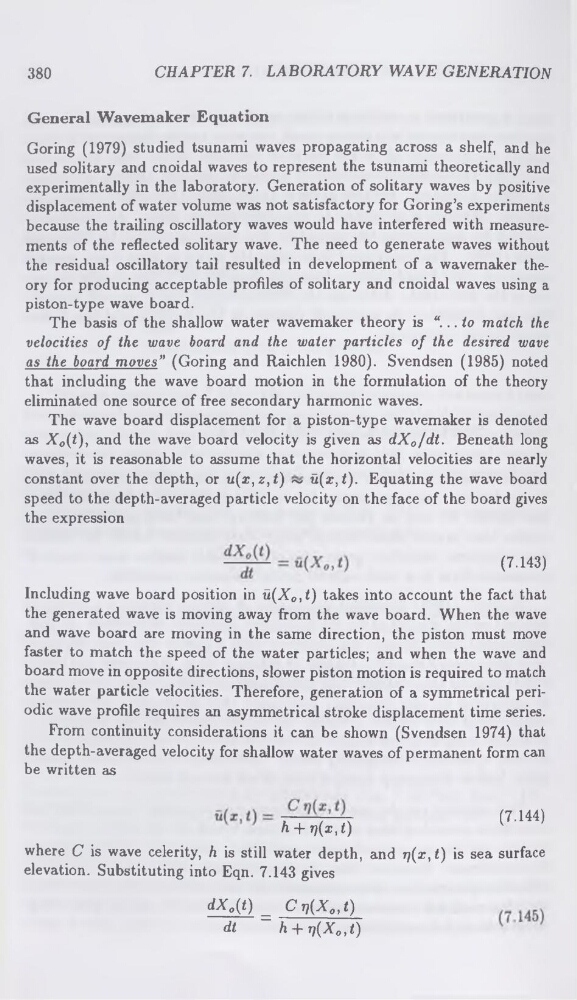
(7.143)
Including wave board position in ü(X0,Z) takes into account the fact that
the generated wave is moving away from the wave board. When the wave
and wave board are moving in the same direction, the piston must move
faster to match the speed of the water particles; and when the wave and
board move in opposite directions, slower piston motion is required to match
the water particle velocities. Therefore, generation of a symmetrical periodic wave profile requires an asymmetrical stroke displacement time series.
From continuity considerations it can be shown (Svendsen 1974) that
the depth-averaged velocity for shallow water waves of permanent form can
be written as
(7.144)
h + T)(x,t)
where C is wave celerity, h is still water depth, and rj(x,t) is sea surface
elevation. Substituting into Eqn. 7.143 gives
dX
h + i](Xo,t)
CHAPTER 7. LABORATORY WAVE GENERATION
General Wavemaker Equation
Goring (1979) studied tsunami waves propagating across a shelf, and he
used solitary and cnoidal waves to represent the tsunami theoretically and
experimentally in the laboratory. Generation of solitary waves by positive
displacement of water volume was not satisfactory for Goring’s experiments
because the trailing oscillatory waves would have interfered with measurements of the reflected solitary wave. The need to generate waves without
the residual oscillatory tail resulted in development of a wavemaker theory for producing acceptable profiles of solitary and cnoidal waves using a
piston-type wave board.
The basis of the shallow water wavemaker theory is "... to match the
velocities of the wave board and the water particles of the desired wave
as the board moves” (Goring and Raichlen 1980). Svendsen (1985) noted
that including the wave board motion in the formulation of the theory
eliminated one source of free secondary harmonic waves.
The wave board displacement for a piston-type wavemaker is denoted
as Xo(t), and the wave board velocity is given as dX0/dt. Beneath long
waves, it is reasonable to assume that the horizontal velocities are nearly
constant over the depth, or u(z,z,/) ~ ü(z, Z). Equating the wave board
speed to the depth-averaged particle velocity on the face of the board gives
the expression
(7.143)
Including wave board position in ü(X0,Z) takes into account the fact that
the generated wave is moving away from the wave board. When the wave
and wave board are moving in the same direction, the piston must move
faster to match the speed of the water particles; and when the wave and
board move in opposite directions, slower piston motion is required to match
the water particle velocities. Therefore, generation of a symmetrical periodic wave profile requires an asymmetrical stroke displacement time series.
From continuity considerations it can be shown (Svendsen 1974) that
the depth-averaged velocity for shallow water waves of permanent form can
be written as
(7.144)
h + T)(x,t)
where C is wave celerity, h is still water depth, and rj(x,t) is sea surface
elevation. Substituting into Eqn. 7.143 gives
dX
h + i](Xo,t)