

374
CHAPTER 7. LABORATORY WAVE GENERATION
The circular frequency is
From Eqn. 7.134 as/- *
oo, the term mi is found for a piston-type wavemaker to be
2 191
mi = 2 297^°'548 ~ °’268) = °’267
and from Eqn. 7.139 with 1 = 0, the flap-type wave board displacement is given as
4sinh2Ui
_
4sinh2(0.524)
_ 1.201
~ sinh 2kh + 2kh ~ sinh 2(0.524) + 2(0.524) ” 2.297
0.523
and from Eqn. 7.139 with I -+ oo, the piston-type wave board displacement is given
as
v x
H .
H2
xo(() = _SI„,(+_ 3 cosh kh
sinh3 kh
2 \ . n
------- sin 2at
mi /
_ 6 cm .
(6 cm)2 /3cosh(0.524)
2 \ .
“ 2(0.523) Sin,r + 32(25 cm) y sinh3(0.524) ~ (0.523) J S1“ *
Xo(t) = (5.74 cm) sin irt + (0.76 cm) sin 2%t
From the criterion given by Eqn. 7.140 we see that this particular wave is slightly
above the limit recommended by Madsen (1971), i.e.,
HL2 _ (6 cm)(300 cm)2 _
8?r2
h3
(25 cm)3
> 3
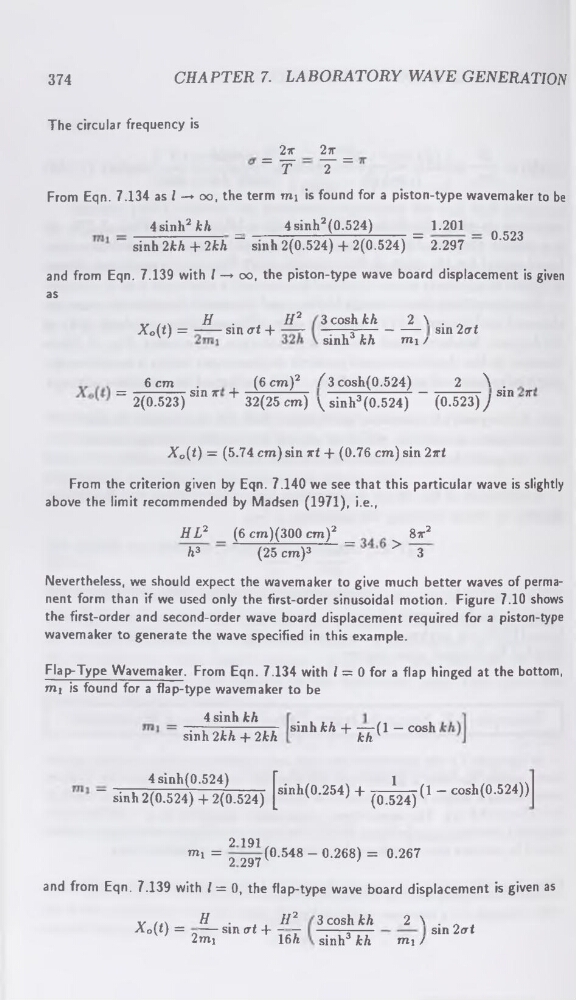
Nevertheless, we should expect the wavemaker to give much better waves of permanent form than if we used only the first-order sinusoidal motion. Figure 7.10 shows
the first-order and second-order wave board displacement required for a piston-type
wavemaker to generate the wave specified in this example.
Flap-Type Wavemaker. From Eqn. 7.134 with I = 0 for a flap hinged at the bottom,
mi is found for a flap-type wavemaker to be
4 sinh kh
sinh 2kh + 2kh
sinh kh + —(1 — cosh
kh
_ 27r
= T
2?T _
T “
4sinh(0.524)
F . , .
.
1
, .
~ sinh 2(0.524) +2(0.524) [sinh(0’254) + (0.524)^ “ cosh(0-524»
Y (n
H .
,
H2
X“W=2^’S",,7<+Ï6Î
3 cosh kh
sinh3 kh
2 \
mi /
sin 2at
CHAPTER 7. LABORATORY WAVE GENERATION
The circular frequency is
From Eqn. 7.134 as/- *
oo, the term mi is found for a piston-type wavemaker to be
2 191
mi = 2 297^°'548 ~ °’268) = °’267
and from Eqn. 7.139 with 1 = 0, the flap-type wave board displacement is given as
4sinh2Ui
_
4sinh2(0.524)
_ 1.201
~ sinh 2kh + 2kh ~ sinh 2(0.524) + 2(0.524) ” 2.297
0.523
and from Eqn. 7.139 with I -+ oo, the piston-type wave board displacement is given
as
v x
H .
H2
xo(() = _SI„,(+_ 3 cosh kh
sinh3 kh
2 \ . n
------- sin 2at
mi /
_ 6 cm .
(6 cm)2 /3cosh(0.524)
2 \ .
“ 2(0.523) Sin,r + 32(25 cm) y sinh3(0.524) ~ (0.523) J S1“ *
Xo(t) = (5.74 cm) sin irt + (0.76 cm) sin 2%t
From the criterion given by Eqn. 7.140 we see that this particular wave is slightly
above the limit recommended by Madsen (1971), i.e.,
HL2 _ (6 cm)(300 cm)2 _
8?r2
h3
(25 cm)3
> 3
Nevertheless, we should expect the wavemaker to give much better waves of permanent form than if we used only the first-order sinusoidal motion. Figure 7.10 shows
the first-order and second-order wave board displacement required for a piston-type
wavemaker to generate the wave specified in this example.
Flap-Type Wavemaker. From Eqn. 7.134 with I = 0 for a flap hinged at the bottom,
mi is found for a flap-type wavemaker to be
4 sinh kh
sinh 2kh + 2kh
sinh kh + —(1 — cosh
kh
_ 27r
= T
2?T _
T “
4sinh(0.524)
F . , .
.
1
, .
~ sinh 2(0.524) +2(0.524) [sinh(0’254) + (0.524)^ “ cosh(0-524»
Y (n
H .
,
H2
X“W=2^’S",,7<+Ï6Î
3 cosh kh
sinh3 kh
2 \
mi /
sin 2at