

7.4. NONLINEAR WAVE GENERATION
373
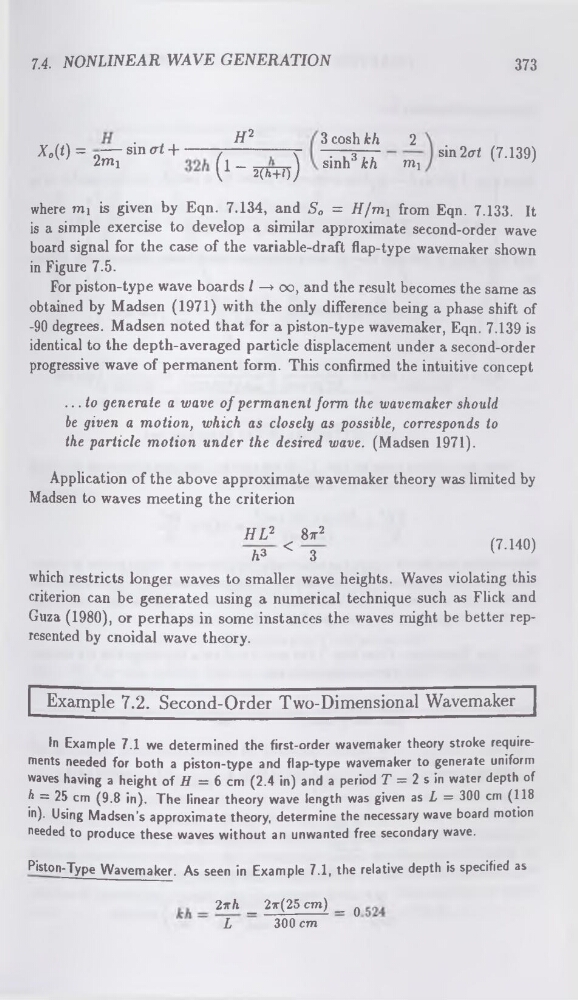
X0(f) = 9^-Sina/ +
Z7711
H2
(1 ~ 2(4+0 )
3 cosh kh
sinh3 kh
2
mj
sin2cr/ (7.139)
where mi is given by Eqn. 7.134, and So = H/mi from Eqn. 7.133. It
is a simple exercise to develop a similar approximate second-order wave
board signal for the case of the variable-draft flap-type wavemaker shown
in Figure 7.5.
For piston-type wave boards I -+ oo, and the result becomes the same as
obtained by Madsen (1971) with the only difference being a phase shift of
-90 degrees. Madsen noted that for a piston-type wavemaker, Eqn. 7.139 is
identical to the depth-averaged particle displacement under a second-order
progressive wave of permanent form. This confirmed the intuitive concept
... to generate a wave of permanent form the wavemaker should
be given a motion, which as closely as possible, corresponds to
the particle motion under the desired wave. (Madsen 1971).
Application of the above approximate wavemaker theory was limited by
Madsen to waves meeting the criterion
HL2
8tt2
h3 < 3
(7.140)
which restricts longer waves to smaller wave heights. Waves violating this
criterion can be generated using a numerical technique such as Flick and
Guza (1980), or perhaps in some instances the waves might be better represented by cnoidal wave theory.
Example 7.2. Second-Order Two-Dimensional Wavemaker
In Example 7.1 we determined the first-order wavemaker theory stroke requirements needed for both a piston-type and flap-type wavemaker to generate uniform
waves having a height of H = 6 cm (2.4 in) and a period T = 2 s in water depth of
4 = 25 cm (9.8 in). The linear theory wave length was given as L = 300 cm (118
in). Using Madsen's approximate theory, determine the necessary wave board motion
needed to produce these waves without an unwanted free secondary wave.
Piston-Type Wavemaker. As seen in Example 7.1, the relative depth is specified as
2irh _ 2tt(25 cm) _ Q
L
300 cm
373
X0(f) = 9^-Sina/ +
Z7711
H2
(1 ~ 2(4+0 )
3 cosh kh
sinh3 kh
2
mj
sin2cr/ (7.139)
where mi is given by Eqn. 7.134, and So = H/mi from Eqn. 7.133. It
is a simple exercise to develop a similar approximate second-order wave
board signal for the case of the variable-draft flap-type wavemaker shown
in Figure 7.5.
For piston-type wave boards I -+ oo, and the result becomes the same as
obtained by Madsen (1971) with the only difference being a phase shift of
-90 degrees. Madsen noted that for a piston-type wavemaker, Eqn. 7.139 is
identical to the depth-averaged particle displacement under a second-order
progressive wave of permanent form. This confirmed the intuitive concept
... to generate a wave of permanent form the wavemaker should
be given a motion, which as closely as possible, corresponds to
the particle motion under the desired wave. (Madsen 1971).
Application of the above approximate wavemaker theory was limited by
Madsen to waves meeting the criterion
HL2
8tt2
h3 < 3
(7.140)
which restricts longer waves to smaller wave heights. Waves violating this
criterion can be generated using a numerical technique such as Flick and
Guza (1980), or perhaps in some instances the waves might be better represented by cnoidal wave theory.
Example 7.2. Second-Order Two-Dimensional Wavemaker
In Example 7.1 we determined the first-order wavemaker theory stroke requirements needed for both a piston-type and flap-type wavemaker to generate uniform
waves having a height of H = 6 cm (2.4 in) and a period T = 2 s in water depth of
4 = 25 cm (9.8 in). The linear theory wave length was given as L = 300 cm (118
in). Using Madsen's approximate theory, determine the necessary wave board motion
needed to produce these waves without an unwanted free secondary wave.
Piston-Type Wavemaker. As seen in Example 7.1, the relative depth is specified as
2irh _ 2tt(25 cm) _ Q
L
300 cm