

372
CHAPTER 7. LABORATORY WAVE GENERATION
making
4 sinh kh
sinh 2kh 4- 2kh
' . , ,
(1 — cosh kh)
smhH1+ * (/. + <)
(7.134)
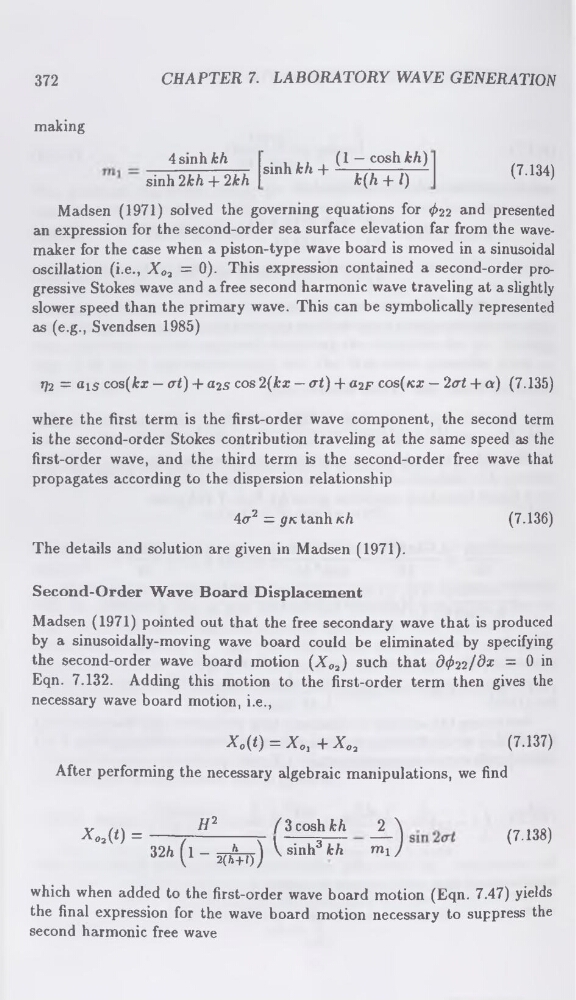
Madsen (1971) solved the governing equations for 22 and presented
an expression for the second-order sea surface elevation far from the wavemaker for the case when a piston-type wave board is moved in a sinusoidal
oscillation (i.e., XO2 = 0). This expression contained a second-order progressive Stokes wave and a free second harmonic wave traveling at a slightly
slower speed than the primary wave. This can be symbolically represented
as (e.g., Svendsen 1985)
Tj2 = ais cos(fcz — at) 4- a2S cos 2(kx — at) 4- û2f cos(kx — 2at 4- a) (7.135)
where the first term is the first-order wave component, the second term
is the second-order Stokes contribution traveling at the same speed as the
first-order wave, and the third term is the second-order free wave that
propagates according to the dispersion relationship
4a2 = gn tanh K.h
(7.136)
The details and solution are given in Madsen (1971).
Second-Order Wave Board Displacement
Madsen (1971) pointed out that the free secondary wave that is produced
by a sinusoidally-moving wave board could be eliminated by specifying
the second-order wave board motion (XO2) such that dfai/dx = 0 in
Eqn. 7.132. Adding this motion to the first-order term then gives the
necessary wave board motion, i.e.,
Xo(t) = XOi +XO2
(7.137)
After performing the necessary algebraic manipulations, we find
XO3(t) = 32/1 (>-5(rây) Vsinh3W
H2
f 3 cosh kh
(7.138)
which when added to the first-order wave board motion (Eqn. 7.47) yields
the final expression for the wave board motion necessary to suppress the
second harmonic free wave
CHAPTER 7. LABORATORY WAVE GENERATION
making
4 sinh kh
sinh 2kh 4- 2kh
' . , ,
(1 — cosh kh)
smhH1+ * (/. + <)
(7.134)
Madsen (1971) solved the governing equations for 22 and presented
an expression for the second-order sea surface elevation far from the wavemaker for the case when a piston-type wave board is moved in a sinusoidal
oscillation (i.e., XO2 = 0). This expression contained a second-order progressive Stokes wave and a free second harmonic wave traveling at a slightly
slower speed than the primary wave. This can be symbolically represented
as (e.g., Svendsen 1985)
Tj2 = ais cos(fcz — at) 4- a2S cos 2(kx — at) 4- û2f cos(kx — 2at 4- a) (7.135)
where the first term is the first-order wave component, the second term
is the second-order Stokes contribution traveling at the same speed as the
first-order wave, and the third term is the second-order free wave that
propagates according to the dispersion relationship
4a2 = gn tanh K.h
(7.136)
The details and solution are given in Madsen (1971).
Second-Order Wave Board Displacement
Madsen (1971) pointed out that the free secondary wave that is produced
by a sinusoidally-moving wave board could be eliminated by specifying
the second-order wave board motion (XO2) such that dfai/dx = 0 in
Eqn. 7.132. Adding this motion to the first-order term then gives the
necessary wave board motion, i.e.,
Xo(t) = XOi +XO2
(7.137)
After performing the necessary algebraic manipulations, we find
XO3(t) = 32/1 (>-5(rây) Vsinh3W
H2
f 3 cosh kh
(7.138)
which when added to the first-order wave board motion (Eqn. 7.47) yields
the final expression for the wave board motion necessary to suppress the
second harmonic free wave