

7.4. NONLINEAR WAVE GENERATION
375
0.0
0.4
0.8
1.2
1.6
2.0
2.4
2.8
3.2
8.6
4.0
Time - Seconds
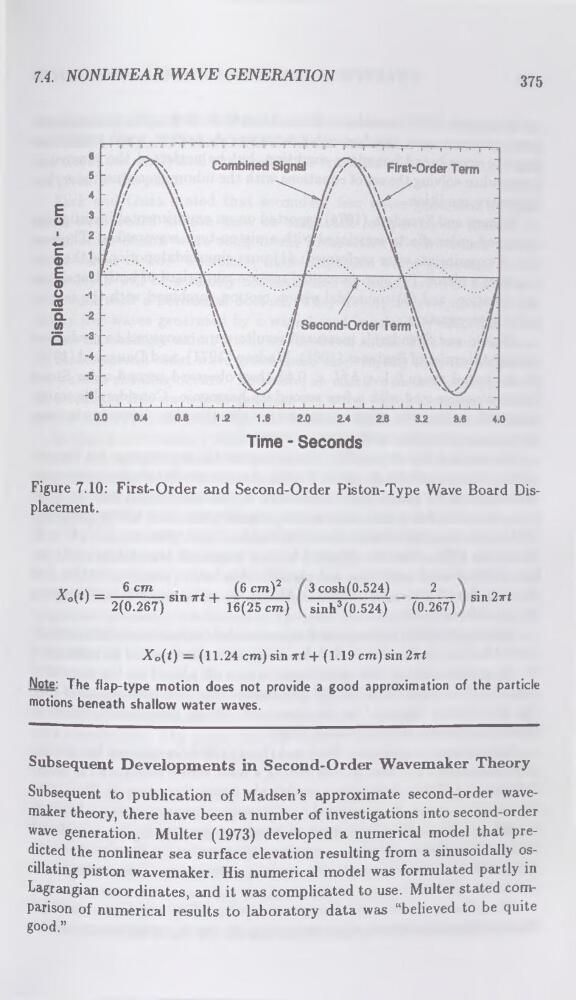
Figure 7.10: First-Order and Second-Order Piston-Type Wave Board Displacement.
Xo(<) =
6 cm sin irt +
2(0.267)
(6 cm)2
16(25 cm)
3cosh(0.524)
sinh3(0.524)
2
(0.267)
sin 2irt
Xo(t) - (11.24 cm)sin?rt + (1.19 cm)sin27rt
Note: The flap-type motion does not provide a good approximation of the particle
motions beneath shallow water waves.
Subsequent Developments in Second-Order Wavemaker Theory
Subsequent to publication of Madsen’s approximate second-order wavemaker theory, there have been a number of investigations into second-order
wave generation. Multer (1973) developed a numerical model that predicted the nonlinear sea surface elevation resulting from a sinusoidally oscillating piston wavemaker. His numerical model was formulated partly in
Lagrangian coordinates, and it was complicated to use. Multer stated comparison of numerical results to laboratory data was “believed to be quite
good.”
375
0.0
0.4
0.8
1.2
1.6
2.0
2.4
2.8
3.2
8.6
4.0
Time - Seconds
Figure 7.10: First-Order and Second-Order Piston-Type Wave Board Displacement.
Xo(<) =
6 cm sin irt +
2(0.267)
(6 cm)2
16(25 cm)
3cosh(0.524)
sinh3(0.524)
2
(0.267)
sin 2irt
Xo(t) - (11.24 cm)sin?rt + (1.19 cm)sin27rt
Note: The flap-type motion does not provide a good approximation of the particle
motions beneath shallow water waves.
Subsequent Developments in Second-Order Wavemaker Theory
Subsequent to publication of Madsen’s approximate second-order wavemaker theory, there have been a number of investigations into second-order
wave generation. Multer (1973) developed a numerical model that predicted the nonlinear sea surface elevation resulting from a sinusoidally oscillating piston wavemaker. His numerical model was formulated partly in
Lagrangian coordinates, and it was complicated to use. Multer stated comparison of numerical results to laboratory data was “believed to be quite
good.”