

7.3. FIRST-ORDER WAVE GENERATION
349
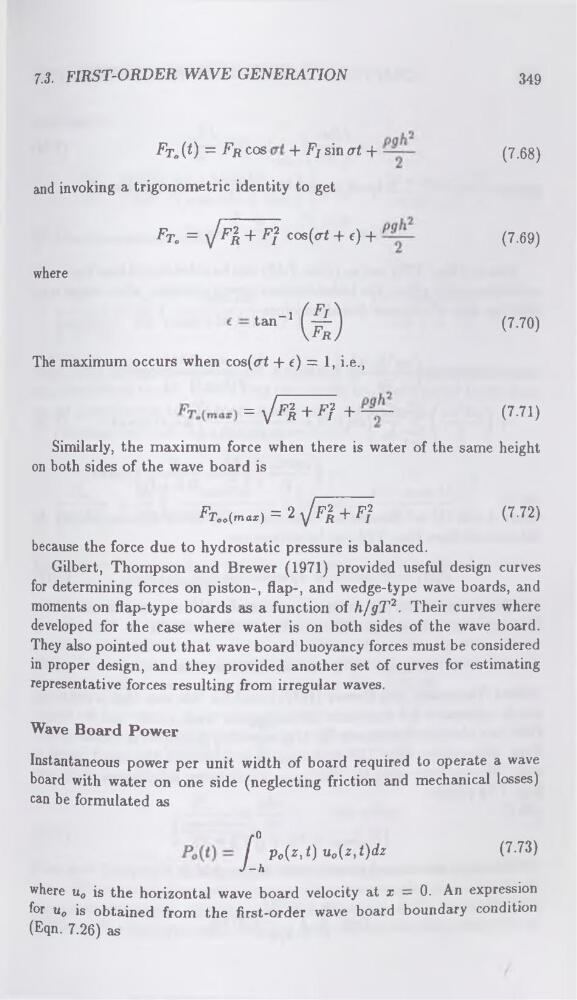
Fro (0 = ?R cos + Fj sin at + —
(7.68)
and invoking a trigonometric identity to get
Fto = yjFk + Fj cos (at 4- c) +
(7.69)
where
(7.70)
The maximum occurs when cos(at + e) = 1, i.e.,
= y/n + Fj + “
(7.71)
Similarly, the maximum force when there is water of the same height
on both sides of the wave board is
^(^, = 274+^
(7.72)
because the force due to hydrostatic pressure is balanced.
Gilbert, Thompson and Brewer (1971) provided useful design curves
for determining forces on piston-, flap-, and wedge-type wave boards, and
moments on flap-type boards cis a function of h/gT2. Their curves where
developed for the case where water is on both sides of the wave board.
They also pointed out that wave board buoyancy forces must be considered
in proper design, and they provided another set of curves for estimating
representative forces resulting from irregular waves.
Wave Board Power
Instantaneous power per unit width of board required to operate a wave
board with water on one side (neglecting friction and mechanical losses)
can be formulated as
/
o
p0(z,t) u0(z,t)dz
■h
(7.73)
where u0 is the horizontal wave board velocity at x — 0. An expression
for u0 is obtained from the first-order wave board boundary condition
(Eqn. 7.26) as
349
Fro (0 = ?R cos + Fj sin at + —
(7.68)
and invoking a trigonometric identity to get
Fto = yjFk + Fj cos (at 4- c) +
(7.69)
where
(7.70)
The maximum occurs when cos(at + e) = 1, i.e.,
= y/n + Fj + “
(7.71)
Similarly, the maximum force when there is water of the same height
on both sides of the wave board is
^(^, = 274+^
(7.72)
because the force due to hydrostatic pressure is balanced.
Gilbert, Thompson and Brewer (1971) provided useful design curves
for determining forces on piston-, flap-, and wedge-type wave boards, and
moments on flap-type boards cis a function of h/gT2. Their curves where
developed for the case where water is on both sides of the wave board.
They also pointed out that wave board buoyancy forces must be considered
in proper design, and they provided another set of curves for estimating
representative forces resulting from irregular waves.
Wave Board Power
Instantaneous power per unit width of board required to operate a wave
board with water on one side (neglecting friction and mechanical losses)
can be formulated as
/
o
p0(z,t) u0(z,t)dz
■h
(7.73)
where u0 is the horizontal wave board velocity at x — 0. An expression
for u0 is obtained from the first-order wave board boundary condition
(Eqn. 7.26) as