

348
CHAPTER 7. LABORATORY WAVE GENERATION
The pressure distribution on a wave board that has water of the same
depth on both sides of the board is found by adding the contribution that
comes from a wavemaker velocity potential for waves propagating in the
negative-r direction (evaluated at x = 0). This results in a doubling of
the dynamic pressure contribution. The hydrostatic pressures on opposite
sides of the wave board exactly balance, so there is no net contribution due
to hydrostatic pressure. Therefore, the instantaneous pressure distribution
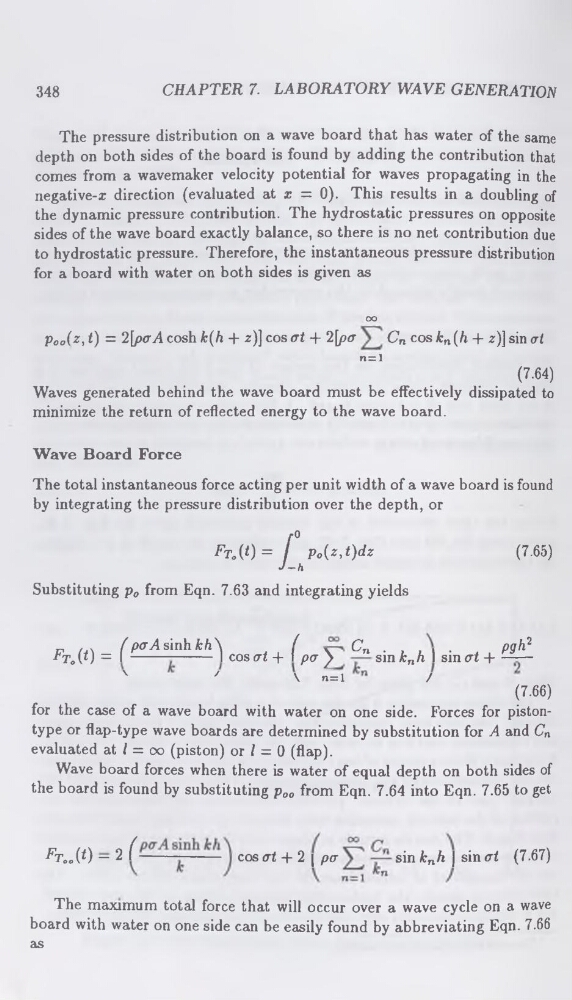
for a board with water on both sides is given as
oo
poo(z, t) = 2 [pa A cosh k(h 4- z)] cos at 4- 2 [per
Cn cos kn (h + z)] sin at
n=l
(7-64)
Waves generated behind the wave board must be effectively dissipated to
minimize the return of reflected energy to the wave board.
Wave Board Force
The total instantaneous force acting per unit width of a wave board is found
by integrating the pressure distribution over the depth, or
rO
7?to(/)= / po(z,t)dz
J-h
(7-65)
Substituting po from Eqn. 7.63 and integrating yields
„
(PaA sinh kh\
t f
Cn . ,
.
pffh2
Tro(t) = I --------------- I cos at 4- I pa y
sin knh I sin at 4---- —
'
'
\ n=l
/
(7.66)
for the case of a wave board with water on one side. Forces for pistontype or flap-type wave boards are determined by substitution for A and Cn
evaluated at I = oo (piston) or I = 0 (flap).
Wave board forces when there is water of equal depth on both sides of
the board is found by substituting p00 from Eqn. 7.64 into Eqn. 7.65 to get
Ftoo(/) — 2 f - ----- --------cos at 4- 2 | pa
sin knh ) sin at (7.67)
The maximum total force that will occur over a wave cycle on a wave
board with water on one side can be easily found by abbreviating Eqn. 7.66
as
CHAPTER 7. LABORATORY WAVE GENERATION
The pressure distribution on a wave board that has water of the same
depth on both sides of the board is found by adding the contribution that
comes from a wavemaker velocity potential for waves propagating in the
negative-r direction (evaluated at x = 0). This results in a doubling of
the dynamic pressure contribution. The hydrostatic pressures on opposite
sides of the wave board exactly balance, so there is no net contribution due
to hydrostatic pressure. Therefore, the instantaneous pressure distribution
for a board with water on both sides is given as
oo
poo(z, t) = 2 [pa A cosh k(h 4- z)] cos at 4- 2 [per
Cn cos kn (h + z)] sin at
n=l
(7-64)
Waves generated behind the wave board must be effectively dissipated to
minimize the return of reflected energy to the wave board.
Wave Board Force
The total instantaneous force acting per unit width of a wave board is found
by integrating the pressure distribution over the depth, or
rO
7?to(/)= / po(z,t)dz
J-h
(7-65)
Substituting po from Eqn. 7.63 and integrating yields
„
(PaA sinh kh\
t f
Cn . ,
.
pffh2
Tro(t) = I --------------- I cos at 4- I pa y
sin knh I sin at 4---- —
'
'
\ n=l
/
(7.66)
for the case of a wave board with water on one side. Forces for pistontype or flap-type wave boards are determined by substitution for A and Cn
evaluated at I = oo (piston) or I = 0 (flap).
Wave board forces when there is water of equal depth on both sides of
the board is found by substituting p00 from Eqn. 7.64 into Eqn. 7.65 to get
Ftoo(/) — 2 f - ----- --------cos at 4- 2 | pa
sin knh ) sin at (7.67)
The maximum total force that will occur over a wave cycle on a wave
board with water on one side can be easily found by abbreviating Eqn. 7.66
as