

7.3. FIRST-ORDER WAVE GENERATION
347
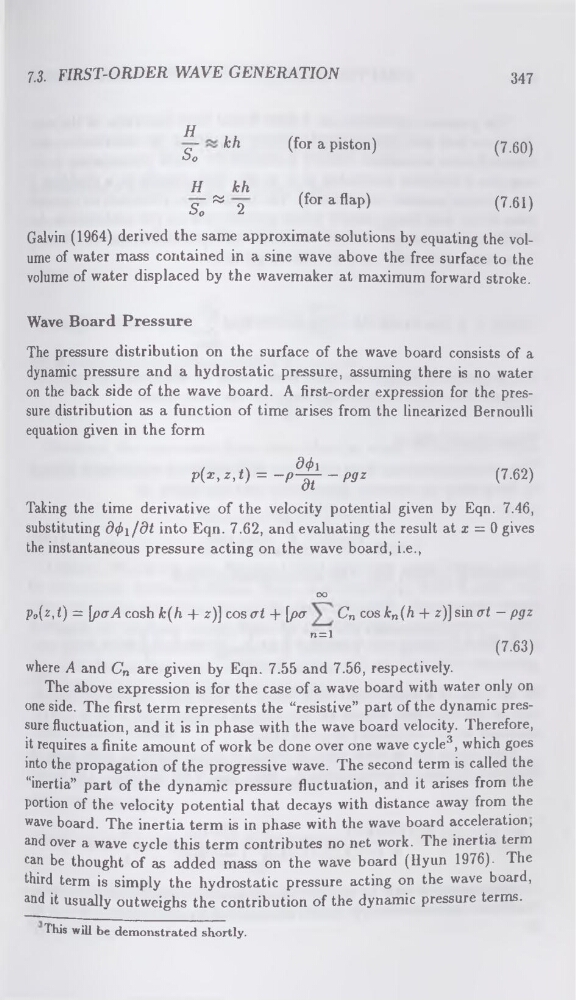
H
S~o
kh
(for a piston)
H_~ kh
So~ 2
(for a flap)
(7.60)
(7.61)
Galvin (1964) derived the same approximate solutions by equating the volume of water mass contained in a sine wave above the free surface to the
volume of water displaced by the wavemaker at maximum forward stroke.
Wave Board Pressure
The pressure distribution on the surface of the wave board consists of a
dynamic pressure and a hydrostatic pressure, assuming there is no water
on the back side of the wave board. A first-order expression for the pressure distribution as a function of time arises from the linearized Bernoulli
equation given in the form
p(x,z,t) =-p^-- pgz
(7.62)
Taking the time derivative of the velocity potential given by Eqn. 7.46,
substituting d^x/dt into Eqn. 7.62, and evaluating the result at x = 0 gives
the instantaneous pressure acting on the wave board, i.e.,
oo
p0(z, t) = [pa A cosh k(h 4- z)] cos at 4- [pa
Cn cos kn(h 4- 2)] sin at — pgz
n=l
(7.63)
where A and Cn are given by Eqn. 7.55 and 7.56, respectively.
The above expression is for the case of a wave board with water only on
one side. The first term represents the “resistive” part of the dynamic pressure fluctuation, and it is in phase with the wave board velocity. Therefore,
it requires a finite amount of work be done over one wave cycle3, which goes
into the propagation of the progressive wave. The second term is called the
“inertia” part of the dynamic pressure fluctuation, and it arises from the
portion of the velocity potential that decays with distance away from the
wave board. The inertia term is in phase with the wave board acceleration,
and over a wave cycle this term contributes no net work. The inertia term
can be thought of as added mass on the wave board (Hyun 1976). The
third term is simply the hydrostatic pressure acting on the wave board,
and it usually outweighs the contribution of the dynamic pressure terms.
This will be demonstrated shortly.
347
H
S~o
kh
(for a piston)
H_~ kh
So~ 2
(for a flap)
(7.60)
(7.61)
Galvin (1964) derived the same approximate solutions by equating the volume of water mass contained in a sine wave above the free surface to the
volume of water displaced by the wavemaker at maximum forward stroke.
Wave Board Pressure
The pressure distribution on the surface of the wave board consists of a
dynamic pressure and a hydrostatic pressure, assuming there is no water
on the back side of the wave board. A first-order expression for the pressure distribution as a function of time arises from the linearized Bernoulli
equation given in the form
p(x,z,t) =-p^-- pgz
(7.62)
Taking the time derivative of the velocity potential given by Eqn. 7.46,
substituting d^x/dt into Eqn. 7.62, and evaluating the result at x = 0 gives
the instantaneous pressure acting on the wave board, i.e.,
oo
p0(z, t) = [pa A cosh k(h 4- z)] cos at 4- [pa
Cn cos kn(h 4- 2)] sin at — pgz
n=l
(7.63)
where A and Cn are given by Eqn. 7.55 and 7.56, respectively.
The above expression is for the case of a wave board with water only on
one side. The first term represents the “resistive” part of the dynamic pressure fluctuation, and it is in phase with the wave board velocity. Therefore,
it requires a finite amount of work be done over one wave cycle3, which goes
into the propagation of the progressive wave. The second term is called the
“inertia” part of the dynamic pressure fluctuation, and it arises from the
portion of the velocity potential that decays with distance away from the
wave board. The inertia term is in phase with the wave board acceleration,
and over a wave cycle this term contributes no net work. The inertia term
can be thought of as added mass on the wave board (Hyun 1976). The
third term is simply the hydrostatic pressure acting on the wave board,
and it usually outweighs the contribution of the dynamic pressure terms.
This will be demonstrated shortly.