

350
CHAPTER 7. LABORATORY WAVE GENERATION
r ( \
ol
f^-dF
(7.74)
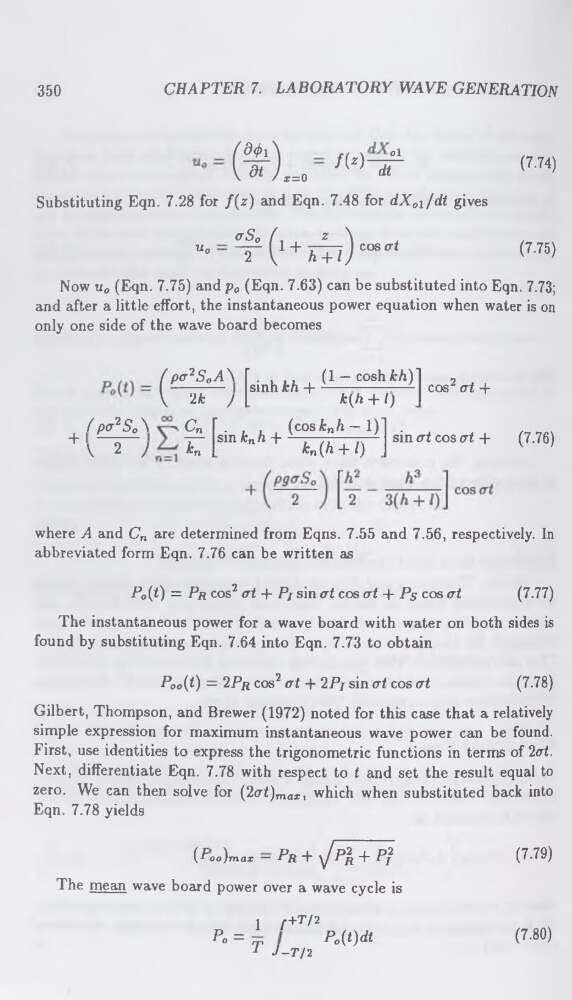
Substituting Eqn. 7.28 for /(z) and Eqn. 7.48 for dX^/dt gives
(tSo
U° ~ “1“
cos at
(7-75)
Now u0 (Eqn. 7.75) and p0 (Eqn. 7.63) can be substituted into Eqn. 7.73;
and after a little effort, the instantaneous power equation when water is on
only one side of the wave board becomes
(
pa2S0A\ f. .
(1 — cosh kh\\
——— sinh kh +
2 cos2 at +
2k /
k(h 4-1)
/pa2S0\
Cn F. , ,
(cosknh — 1)1 .
4-—-—
7“ smÂ?wh+ v
.
sin at cos at 4(7.76)
\ 2 J
kn
kn(h + l)
where A and Cn are determined from Eqns. 7.55 and 7.56, respectively. In
abbreviated form Eqn. 7.76 can be written as
Po(f) = Pr cos2 at 4- Pj sin at cos at 4- P$ cos at
(7.77)
The instantaneous power for a wave board with water on both sides is
found by substituting Eqn. 7.64 into Eqn. 7.73 to obtain
Poo(t) — %Pr cos2 at 4- 2Pj sin at cos at
(7.78)
Gilbert, Thompson, and Brewer (1972) noted for this case that a relatively
simple expression for maximum instantaneous wave power can be found.
First, use identities to express the trigonometric functions in terms of 2at.
Next, differentiate Eqn. 7.78 with respect to t and set the result equal to
zero. We can then solve for (2af)ma;r, which when substituted back into
Eqn. 7.78 yields
(f«o)max — Pr 4- y/p2 R 4- P]
The mean wave board power over a wave cycle is
1 /‘+T/2
P°=v
P°^dt
1 J—T/2
(7.79)
(7.80)
CHAPTER 7. LABORATORY WAVE GENERATION
r ( \
ol
f^-dF
(7.74)
Substituting Eqn. 7.28 for /(z) and Eqn. 7.48 for dX^/dt gives
(tSo
U° ~ “1“
cos at
(7-75)
Now u0 (Eqn. 7.75) and p0 (Eqn. 7.63) can be substituted into Eqn. 7.73;
and after a little effort, the instantaneous power equation when water is on
only one side of the wave board becomes
(
pa2S0A\ f. .
(1 — cosh kh\\
——— sinh kh +
2 cos2 at +
2k /
k(h 4-1)
/pa2S0\
Cn F. , ,
(cosknh — 1)1 .
4-—-—
7“ smÂ?wh+ v
.
sin at cos at 4(7.76)
\ 2 J
kn
kn(h + l)
where A and Cn are determined from Eqns. 7.55 and 7.56, respectively. In
abbreviated form Eqn. 7.76 can be written as
Po(f) = Pr cos2 at 4- Pj sin at cos at 4- P$ cos at
(7.77)
The instantaneous power for a wave board with water on both sides is
found by substituting Eqn. 7.64 into Eqn. 7.73 to obtain
Poo(t) — %Pr cos2 at 4- 2Pj sin at cos at
(7.78)
Gilbert, Thompson, and Brewer (1972) noted for this case that a relatively
simple expression for maximum instantaneous wave power can be found.
First, use identities to express the trigonometric functions in terms of 2at.
Next, differentiate Eqn. 7.78 with respect to t and set the result equal to
zero. We can then solve for (2af)ma;r, which when substituted back into
Eqn. 7.78 yields
(f«o)max — Pr 4- y/p2 R 4- P]
The mean wave board power over a wave cycle is
1 /‘+T/2
P°=v
P°^dt
1 J—T/2
(7.79)
(7.80)