

7.3. FIRST-ORDER WAVE GENERATION
343
can be no flow through the wave board, B can be set to zero. Furthermore,
the constant, D, is arbitrary, so let D = 0 for convenience.
It is also necessary that crj =
(7.45)
For a given value of a there is one solution for ki, but an infinite number of
solutions for fc3; therefore, it is necessary to sum all the possible solutions
for (f>k3- The constant phase shifts, 71 and a3n, are also arbitrary, so set
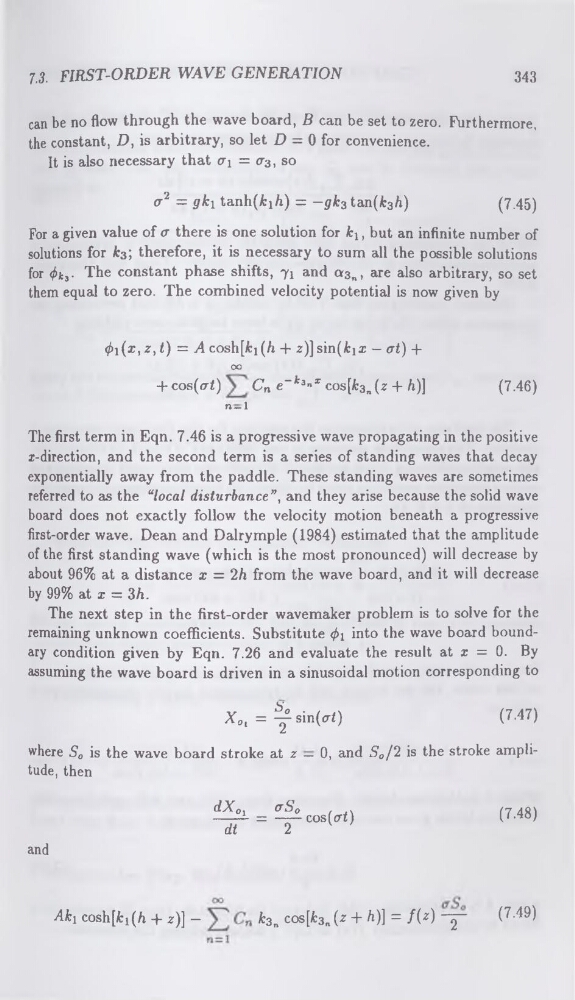
them equal to zero. The combined velocity potential is now given by
i(r, z, Z) = A cosh[&i(/i + z)]sin(Arix — at) +
00
4-cos(crt)
Cn e~k3nX cos[A:3n(z + h)]
(7.46)
n— 1
The first term in Eqn. 7.46 is a progressive wave propagating in the positive
^-direction, and the second term is a series of standing waves that decay
exponentially away from the paddle. These standing waves are sometimes
referred to as the “local disturbance”, and they arise because the solid wave
board does not exactly follow the velocity motion beneath a progressive
first-order wave. Dean and Dalrymple (1984) estimated that the amplitude
of the first standing wave (which is the most pronounced) will decrease by
about 96% at a distance x = 2h from the wave board, and it will decrease
by 99% at x = 3/i.
The next step in the first-order wavemaker problem is to solve for the
remaining unknown coefficients. Substitutei into the wave board boundary condition given by Eqn. 7.26 and evaluate the result at x = 0. By
assuming the wave board is driven in a sinusoidal motion corresponding to
Xai = ^sin(at)
(7.47)
where So is the wave board stroke at z — 0, and So/2 is the stroke amplitude, then
^L = ^cos(rt)
(7.48)
M
2
'
and
Aki coshffc^h + z)] -
^3n cosl^3n (z + fi)] = f(z) y
(7-49)
343
can be no flow through the wave board, B can be set to zero. Furthermore,
the constant, D, is arbitrary, so let D = 0 for convenience.
It is also necessary that crj =
(7.45)
For a given value of a there is one solution for ki, but an infinite number of
solutions for fc3; therefore, it is necessary to sum all the possible solutions
for (f>k3- The constant phase shifts, 71 and a3n, are also arbitrary, so set
them equal to zero. The combined velocity potential is now given by
i(r, z, Z) = A cosh[&i(/i + z)]sin(Arix — at) +
00
4-cos(crt)
Cn e~k3nX cos[A:3n(z + h)]
(7.46)
n— 1
The first term in Eqn. 7.46 is a progressive wave propagating in the positive
^-direction, and the second term is a series of standing waves that decay
exponentially away from the paddle. These standing waves are sometimes
referred to as the “local disturbance”, and they arise because the solid wave
board does not exactly follow the velocity motion beneath a progressive
first-order wave. Dean and Dalrymple (1984) estimated that the amplitude
of the first standing wave (which is the most pronounced) will decrease by
about 96% at a distance x = 2h from the wave board, and it will decrease
by 99% at x = 3/i.
The next step in the first-order wavemaker problem is to solve for the
remaining unknown coefficients. Substitute
assuming the wave board is driven in a sinusoidal motion corresponding to
Xai = ^sin(at)
(7.47)
where So is the wave board stroke at z — 0, and So/2 is the stroke amplitude, then
^L = ^cos(rt)
(7.48)
M
2
'
and
Aki coshffc^h + z)] -
^3n cosl^3n (z + fi)] = f(z) y
(7-49)