

342
CHAPTER 7. LABORATORY WAVE GENERATION
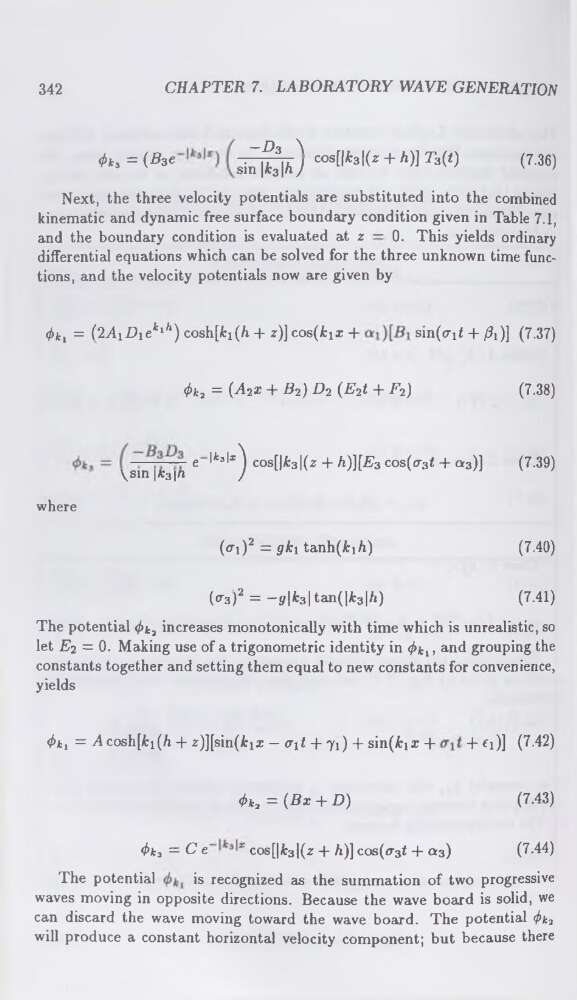
k3 = (^36
-P3 \
sin |fc3 |/i J
cos[|fc3|(z + A)] T3(Z)
(7.36)
Next, the three velocity potentials are substituted into the combined
kinematic and dynamic free surface boundary condition given in Table 7.1,
and the boundary condition is evaluated at z — 0. This yields ordinary
differential equations which can be solved for the three unknown time functions, and the velocity potentials now are given by
kl = (2AiDieklh) coshffc^/i 4- z)] cos(fcix 4sin(aif 4- Z?i)] (7.37)
k2 = (^2æ 4- B2) D2 (E2t 4- F2)
(7.38)
e |fc3|îÙ cos[|fc3|(z 4- h)]^ cos(cr3/ 4- «3)]
(7.39)
y sin |fc31 n.
j
where
(
(c'a)2 = -9|fc3|tan([t3|/>)
(7.41)
The potential k2 increases monotonically with time which is unrealistic, so
let E2 = 0. Making use of a trigonometric identity in (f>k1, and grouping the
constants together and setting them equal to new constants for convenience,
yields
ki = Acoshffc^/i 4-z)][sin(&ix — (Tif 4-7i) 4-sin(£iz 4-4-€1)] (7.42)
(7-43)
(f>k3 = C e
cos[|fc3|(z 4- h)] cos(a3Z 4- 03)
(7-44)
The potential
is recognized as the summation of two progressive
waves moving in opposite directions. Because the wave board is solid, we
can discard the wave moving toward the wave board. The potentialk2
will produce a constant horizontal velocity component; but because there
CHAPTER 7. LABORATORY WAVE GENERATION
k3 = (^36
-P3 \
sin |fc3 |/i J
cos[|fc3|(z + A)] T3(Z)
(7.36)
Next, the three velocity potentials are substituted into the combined
kinematic and dynamic free surface boundary condition given in Table 7.1,
and the boundary condition is evaluated at z — 0. This yields ordinary
differential equations which can be solved for the three unknown time functions, and the velocity potentials now are given by
kl = (2AiDieklh) coshffc^/i 4- z)] cos(fcix 4sin(aif 4- Z?i)] (7.37)
(7.38)
e |fc3|îÙ cos[|fc3|(z 4- h)]^ cos(cr3/ 4- «3)]
(7.39)
y sin |fc31 n.
j
where
(
(c'a)2 = -9|fc3|tan([t3|/>)
(7.41)
The potential k2 increases monotonically with time which is unrealistic, so
let E2 = 0. Making use of a trigonometric identity in (f>k1, and grouping the
constants together and setting them equal to new constants for convenience,
yields
(7-43)
(f>k3 = C e
cos[|fc3|(z 4- h)] cos(a3Z 4- 03)
(7-44)
The potential
is recognized as the summation of two progressive
waves moving in opposite directions. Because the wave board is solid, we
can discard the wave moving toward the wave board. The potential
will produce a constant horizontal velocity component; but because there