

344
CHAPTER 7. LABORATORY WAVE GENERATION
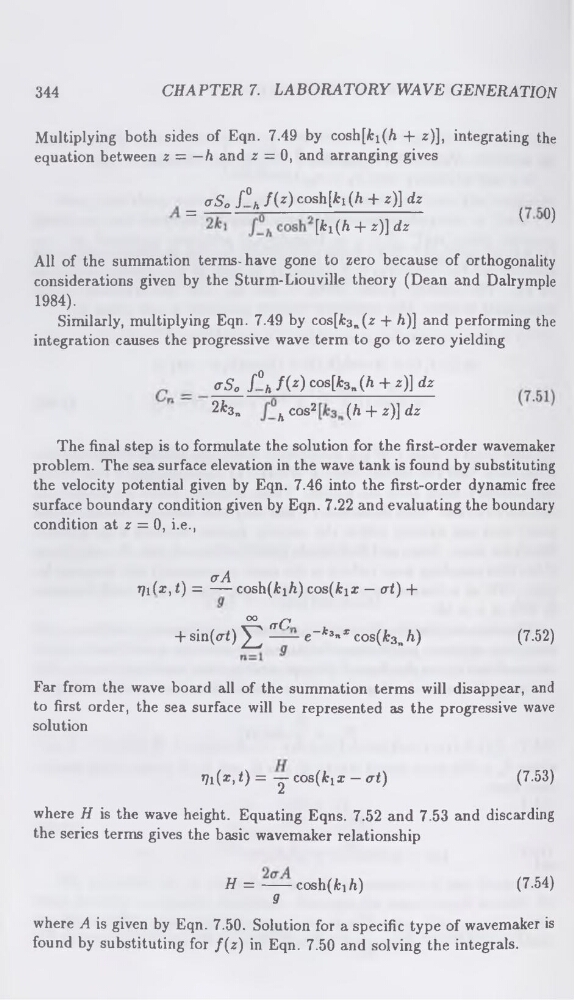
Multiplying both sides of Eqn. 7.49 by coshffc^/i + z)], integrating the
equation between z = -h and z = 0, and arranging gives
_ aSo f°h f(z) cosh[fci(h + z)] dz
~
\k^h + z)]dz
( 0)
All of the summation terms-have gone to zero because of orthogonality
considerations given by the Sturm-Liouville theory (Dean and Dalrymple
1984).
Similarly, multiplying Eqn. 7.49 by cos[À:3n(z + /i)] and performing the
integration causes the progressive wave term to go to zero yielding
aS0 f°h f(z) cos[fc3n(/i + z)] dz
2^3n
h cos2(^ + * )] ^Z
The final step is to formulate the solution for the first-order wavemaker
problem. The sea surface elevation in the wave tank is found by substituting
the velocity potential given by Eqn. 7.46 into the first-order dynamic free
surface boundary condition given by Eqn. 7.22 and evaluating the boundary
condition at z = 0, i.e.,
aA
t]i(x, t) = — cosh(^iA) cos(fcix — at) +
00 aC
+ sin(crt)^2 —~ e~k*nX cos(fc3n/i)
(7-52)
Far from the wave board all of the summation terms will disappear, and
to first order, the sea surface will be represented as the progressive wave
solution
Th(x, 0 = y cos(fcjx - at)
(7.53)
where H is the wave height. Equating Eqns. 7.52 and 7.53 and discarding
the series terms gives the basic wavemaker relationship
H =----- cosh(fc1h)
(7.54)
9
where A is given by Eqn. 7.50. Solution for a specific type of wavemaker is
found by substituting for /(z) in Eqn. 7.50 and solving the integrals.
CHAPTER 7. LABORATORY WAVE GENERATION
Multiplying both sides of Eqn. 7.49 by coshffc^/i + z)], integrating the
equation between z = -h and z = 0, and arranging gives
_ aSo f°h f(z) cosh[fci(h + z)] dz
~
\k^h + z)]dz
( 0)
All of the summation terms-have gone to zero because of orthogonality
considerations given by the Sturm-Liouville theory (Dean and Dalrymple
1984).
Similarly, multiplying Eqn. 7.49 by cos[À:3n(z + /i)] and performing the
integration causes the progressive wave term to go to zero yielding
aS0 f°h f(z) cos[fc3n(/i + z)] dz
2^3n
h cos2(^ + * )] ^Z
The final step is to formulate the solution for the first-order wavemaker
problem. The sea surface elevation in the wave tank is found by substituting
the velocity potential given by Eqn. 7.46 into the first-order dynamic free
surface boundary condition given by Eqn. 7.22 and evaluating the boundary
condition at z = 0, i.e.,
aA
t]i(x, t) = — cosh(^iA) cos(fcix — at) +
00 aC
+ sin(crt)^2 —~ e~k*nX cos(fc3n/i)
(7-52)
Far from the wave board all of the summation terms will disappear, and
to first order, the sea surface will be represented as the progressive wave
solution
Th(x, 0 = y cos(fcjx - at)
(7.53)
where H is the wave height. Equating Eqns. 7.52 and 7.53 and discarding
the series terms gives the basic wavemaker relationship
H =----- cosh(fc1h)
(7.54)
9
where A is given by Eqn. 7.50. Solution for a specific type of wavemaker is
found by substituting for /(z) in Eqn. 7.50 and solving the integrals.