

338
CHAPTER 7. LABORATORY WAVE GENERATION
Bottom Boundary Condition (at z = —h)
0(e):
di
dz
(7-17)
0(?): ^ = 0
dz
(7.18)
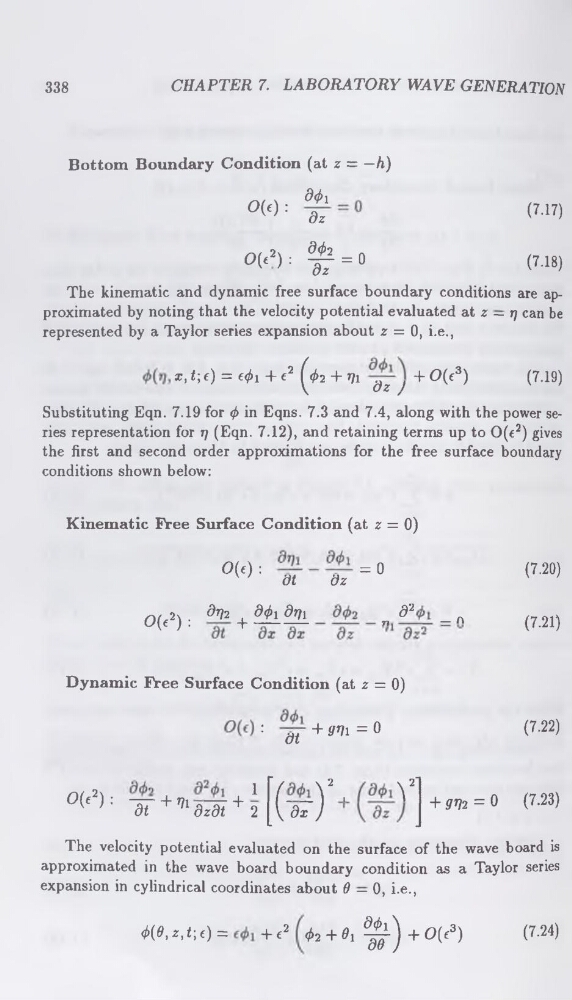
The kinematic and dynamic free surface boundary conditions are approximated by noting that the velocity potential evaluated at z — rj can be
represented by a Taylor series expansion about z = 0, i.e.,
x, t; e) = 6(/>i 4- c2
f^2 + rji
+ ^(f3)
\
dz J
(7-19)
Substituting Eqn. 7.19 for in Eqns. 7.3 and 7.4, along with the power series representation for tj (Eqn. 7.12), and retaining terms up to O(e2) gives
the first and second order approximations for the free surface boundary
conditions shown below:
Kinematic Free Surface Condition (at z = 0)
O(f) :
= 0
(7.20)
dt
dz
o(f2} ■ dr>2 + dl dr*
r, d?- n
(7 911
0(f)'
+
(7'21)
Dynamic Free Surface Condition (at z = 0)
:
+ 9m = 0
dt
(7.22)
Olr2V
I n
. 1 17V .
V] .
n
,7 911
0(e)- -âr + md^+2[{-d7)
]+»% = »
<7-23)
The velocity potential evaluated on the surface of the wave board is
approximated in the wave board boundary condition as a Taylor series
expansion in cylindrical coordinates about 0 — 0, i.e.,
0(0, M;e) = 4-e2
»+O(ô
(7.24)
02 + @1
CHAPTER 7. LABORATORY WAVE GENERATION
Bottom Boundary Condition (at z = —h)
0(e):
di
dz
(7-17)
0(?): ^ = 0
dz
(7.18)
The kinematic and dynamic free surface boundary conditions are approximated by noting that the velocity potential evaluated at z — rj can be
represented by a Taylor series expansion about z = 0, i.e.,
x, t; e) = 6(/>i 4- c2
f^2 + rji
+ ^(f3)
\
dz J
(7-19)
Substituting Eqn. 7.19 for in Eqns. 7.3 and 7.4, along with the power series representation for tj (Eqn. 7.12), and retaining terms up to O(e2) gives
the first and second order approximations for the free surface boundary
conditions shown below:
Kinematic Free Surface Condition (at z = 0)
O(f) :
= 0
(7.20)
dt
dz
o(f2} ■ dr>2 + d
r, d?- n
(7 911
0(f)'
+
(7'21)
Dynamic Free Surface Condition (at z = 0)
:
+ 9m = 0
dt
(7.22)
Olr2V
I n
. 1 17V .
V] .
n
,7 911
0(e)- -âr + md^+2[{-d7)
]+»% = »
<7-23)
The velocity potential evaluated on the surface of the wave board is
approximated in the wave board boundary condition as a Taylor series
expansion in cylindrical coordinates about 0 — 0, i.e.,
0(0, M;e) = 4-e2
»+O(ô
(7.24)
02 + @1