

7.2. TWO-DIMENSIONAL GOVERNING EQUATIONS
337
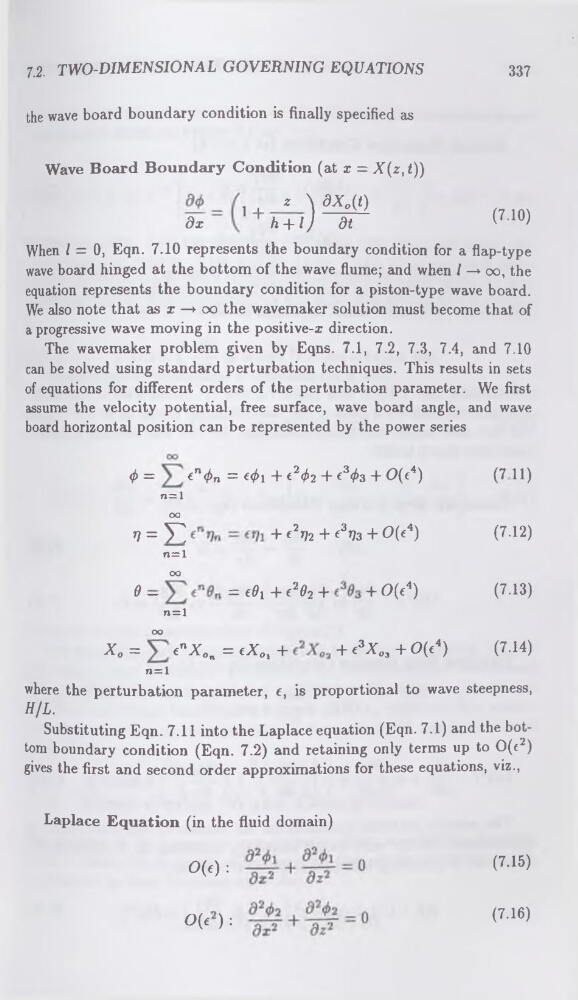
the wave board boundary condition is finally specified as
Wave Board Boundary Condition (at x = X(z,f))
dx
} , z } ox0(t)
h +I ) dt
(710)
When I = 0, Eqn. 7.10 represents the boundary condition for a flap-type
wave board hinged at the bottom of the wave flume; and when I —♦ oo, the
equation represents the boundary condition for a piston-type wave board.
We also note that as x —> oo the wavemaker solution must become that of
a progressive wave moving in the positive-x direction.
The wavemaker problem given by Eqns. 7.1, 7.2, 7.3, 7.4, and 7.10
can be solved using standard perturbation techniques. This results in sets
of equations for different orders of the perturbation parameter. We first
assume the velocity potential, free surface, wave board angle, and wave
board horizontal position can be represented by the power series
=
Cnn = «01 + «202 + «303 + û(e4)
(711)
n=l
oo
Î? = 5"^
+ C27/2 + 6% + o(e4)
(7.12)
n=l
oo
0 —
= «#1 + C2^2 +
+ <9(c4)
(7-13)
n=l
oo
Xo =
enXOn = eX01 +
+ C3XO3 + O(e4)
(7.14)
n=l
where the perturbation parameter, c, is proportional to wave steepness,
H/L.
Substituting Eqn. 7.11 into the Laplace equation (Eqn. 7.1) and the bottom boundary condition (Eqn. 7.2) and retaining only terms up to O(c2)
gives the first and second order approximations for these equations, viz.,
Laplace Equation (in the fluid domain)
o(e):
0(e):
(7.15)
(7.16)
337
the wave board boundary condition is finally specified as
Wave Board Boundary Condition (at x = X(z,f))
dx
} , z } ox0(t)
h +I ) dt
(710)
When I = 0, Eqn. 7.10 represents the boundary condition for a flap-type
wave board hinged at the bottom of the wave flume; and when I —♦ oo, the
equation represents the boundary condition for a piston-type wave board.
We also note that as x —> oo the wavemaker solution must become that of
a progressive wave moving in the positive-x direction.
The wavemaker problem given by Eqns. 7.1, 7.2, 7.3, 7.4, and 7.10
can be solved using standard perturbation techniques. This results in sets
of equations for different orders of the perturbation parameter. We first
assume the velocity potential, free surface, wave board angle, and wave
board horizontal position can be represented by the power series
=
Cnn = «01 + «202 + «303 + û(e4)
(711)
n=l
oo
Î? = 5"^
+ C27/2 + 6% + o(e4)
(7.12)
n=l
oo
0 —
= «#1 + C2^2 +
+ <9(c4)
(7-13)
n=l
oo
Xo =
enXOn = eX01 +
+ C3XO3 + O(e4)
(7.14)
n=l
where the perturbation parameter, c, is proportional to wave steepness,
H/L.
Substituting Eqn. 7.11 into the Laplace equation (Eqn. 7.1) and the bottom boundary condition (Eqn. 7.2) and retaining only terms up to O(c2)
gives the first and second order approximations for these equations, viz.,
Laplace Equation (in the fluid domain)
o(e):
0(e):
(7.15)
(7.16)