

336
CHAPTER 7. LABORATORY WAVE GENERATION
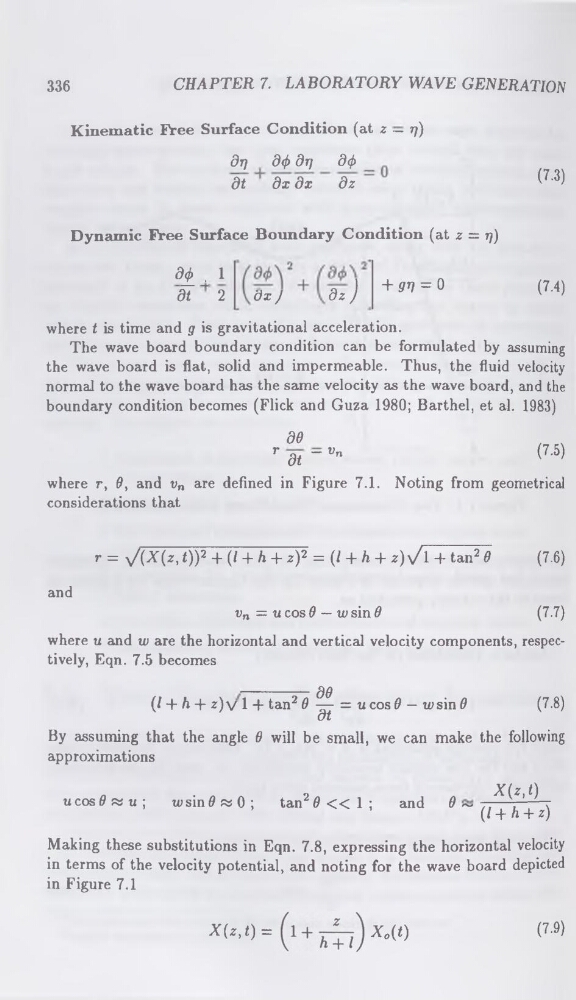
Kinematic Free Surface Condition (at z — rj)
dr)
d<}> dr)
d(f>
dt
dx dx
dz
(7-3)
Dynamic Free Surface Boundary Condition (at z = r))
d± . 1
dt
2
+ gi) = 0
(7-4)
where t is time and g is gravitational acceleration.
The wave board boundary condition can be formulated by assuming
the wave board is flat, solid and impermeable. Thus, the fluid velocity
normal to the wave board has the same velocity as the wave board, and the
boundary condition becomes (Flick and Guza 1980; Barthel, et al. 1983)
dO
r dt~Vn
(7.5)
where r, 0, and vn are defined in Figure 7.1. Noting from geometrical
considerations that
r = y/(X(z,t\)2 + (/ + /i + z)2 = (I + h + z)\/l + tan2#
(7.6)
and
vn = u cos 0 — w sin 0
(7-7)
dx )
dz )
where u and w are the horizontal and vertical velocity components, respectively, Eqn. 7.5 becomes
_ ________ Qg
(/ + /i + z) V 1 + tan2 0 — = u cos 0 — w sin 0
(7.8)
dt
By assuming that the angle 0 will be small, we can make the following
approximations
ucos#«u;
wsin#«0;
tan2#<
(Z + A + z)
and
0 ~
Making these substitutions in Eqn. 7.8, expressing the horizontal velocity
in terms of the velocity potential, and noting for the wave board depicted
in Figure 7.1
X(z,/) =
xo(0
(7.9)
CHAPTER 7. LABORATORY WAVE GENERATION
Kinematic Free Surface Condition (at z — rj)
dr)
d<}> dr)
d(f>
dt
dx dx
dz
(7-3)
Dynamic Free Surface Boundary Condition (at z = r))
d± . 1
dt
2
+ gi) = 0
(7-4)
where t is time and g is gravitational acceleration.
The wave board boundary condition can be formulated by assuming
the wave board is flat, solid and impermeable. Thus, the fluid velocity
normal to the wave board has the same velocity as the wave board, and the
boundary condition becomes (Flick and Guza 1980; Barthel, et al. 1983)
dO
r dt~Vn
(7.5)
where r, 0, and vn are defined in Figure 7.1. Noting from geometrical
considerations that
r = y/(X(z,t\)2 + (/ + /i + z)2 = (I + h + z)\/l + tan2#
(7.6)
and
vn = u cos 0 — w sin 0
(7-7)
dx )
dz )
where u and w are the horizontal and vertical velocity components, respectively, Eqn. 7.5 becomes
_ ________ Qg
(/ + /i + z) V 1 + tan2 0 — = u cos 0 — w sin 0
(7.8)
dt
By assuming that the angle 0 will be small, we can make the following
approximations
ucos#«u;
wsin#«0;
tan2#<
(Z + A + z)
and
0 ~
Making these substitutions in Eqn. 7.8, expressing the horizontal velocity
in terms of the velocity potential, and noting for the wave board depicted
in Figure 7.1
X(z,/) =
xo(0
(7.9)