

6.4. SUSPENSION-DOMINATED MODELS
303
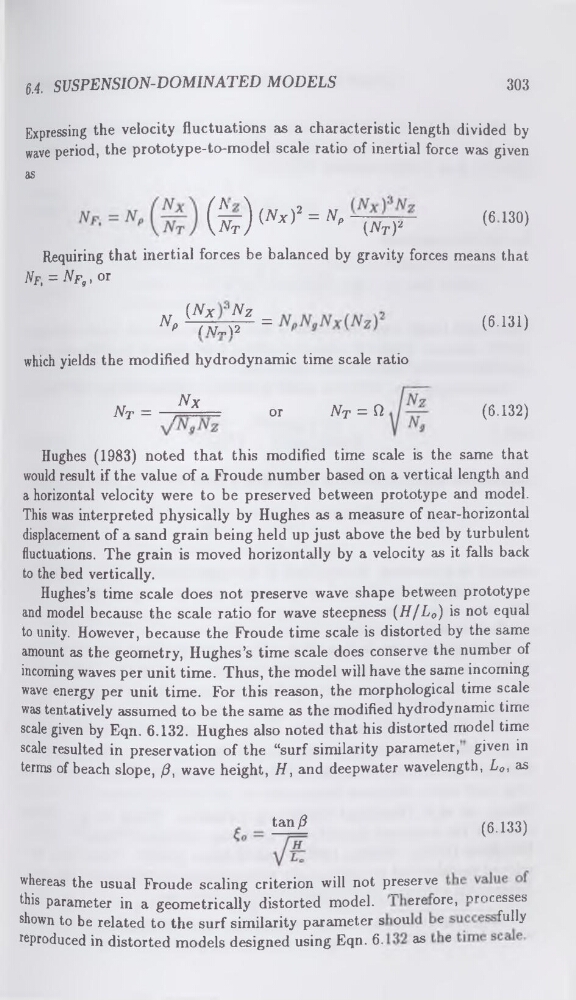
Expressing the velocity fluctuations as a characteristic length divided by
wave period, the prototype-to-model scale ratio of inertial force was given
as
fir)
(613«)
\^t /
(Nr)2
Requiring that inertial forces be balanced by gravity forces means that
Nf, = NFg, or
N” ( -^r^ =
(6.131)
which yields the modified hydrodynamic time scale ratio
Nt = ,Nx
or
Nt = ft
(6.132)
Hughes (1983) noted that this modified time scale is the same that
would result if the value of a Froude number based on a vertical length and
a horizontal velocity were to be preserved between prototype and model.
This was interpreted physically by Hughes as a measure of near-horizontal
displacement of a sand grain being held up just above the bed by turbulent
fluctuations. The grain is moved horizontally by a velocity as it falls back
to the bed vertically.
Hughes’s time scale does not preserve wave shape between prototype
and model because the scale ratio for wave steepness {H/Lo) is not equal
to unity. However, because the Froude time scale is distorted by the same
amount as the geometry, Hughes’s time scale does conserve the number of
incoming waves per unit time. Thus, the model will have the same incoming
wave energy per unit time. For this reason, the morphological time scale
was tentatively assumed to be the same as the modified hydrodynamic time
scale given by Eqn. 6.132. Hughes also noted that his distorted model time
scale resulted in preservation of the “surf similarity parameter, given in
terms of beach slope, /?, wave height, H, and deepwater wavelength, Lo, as
tan/?
(6.133)
whereas the usual Froude scaling criterion will not P£®serve
nrnresses
this parameter in a geometrically distorted model.
e * e°re’
fully
shown to be related to the surf similarity parameter s ou
e
reproduced in distorted models designed using Eqn. 6.
as e
303
Expressing the velocity fluctuations as a characteristic length divided by
wave period, the prototype-to-model scale ratio of inertial force was given
as
fir)
(613«)
\^t /
(Nr)2
Requiring that inertial forces be balanced by gravity forces means that
Nf, = NFg, or
N” ( -^r^ =
(6.131)
which yields the modified hydrodynamic time scale ratio
Nt = ,Nx
or
Nt = ft
(6.132)
Hughes (1983) noted that this modified time scale is the same that
would result if the value of a Froude number based on a vertical length and
a horizontal velocity were to be preserved between prototype and model.
This was interpreted physically by Hughes as a measure of near-horizontal
displacement of a sand grain being held up just above the bed by turbulent
fluctuations. The grain is moved horizontally by a velocity as it falls back
to the bed vertically.
Hughes’s time scale does not preserve wave shape between prototype
and model because the scale ratio for wave steepness {H/Lo) is not equal
to unity. However, because the Froude time scale is distorted by the same
amount as the geometry, Hughes’s time scale does conserve the number of
incoming waves per unit time. Thus, the model will have the same incoming
wave energy per unit time. For this reason, the morphological time scale
was tentatively assumed to be the same as the modified hydrodynamic time
scale given by Eqn. 6.132. Hughes also noted that his distorted model time
scale resulted in preservation of the “surf similarity parameter, given in
terms of beach slope, /?, wave height, H, and deepwater wavelength, Lo, as
tan/?
(6.133)
whereas the usual Froude scaling criterion will not P£®serve
nrnresses
this parameter in a geometrically distorted model.
e * e°re’
fully
shown to be related to the surf similarity parameter s ou
e
reproduced in distorted models designed using Eqn. 6.
as e