

304
CHAPTER 6. SEDIMENT TRANSPORT MODELS
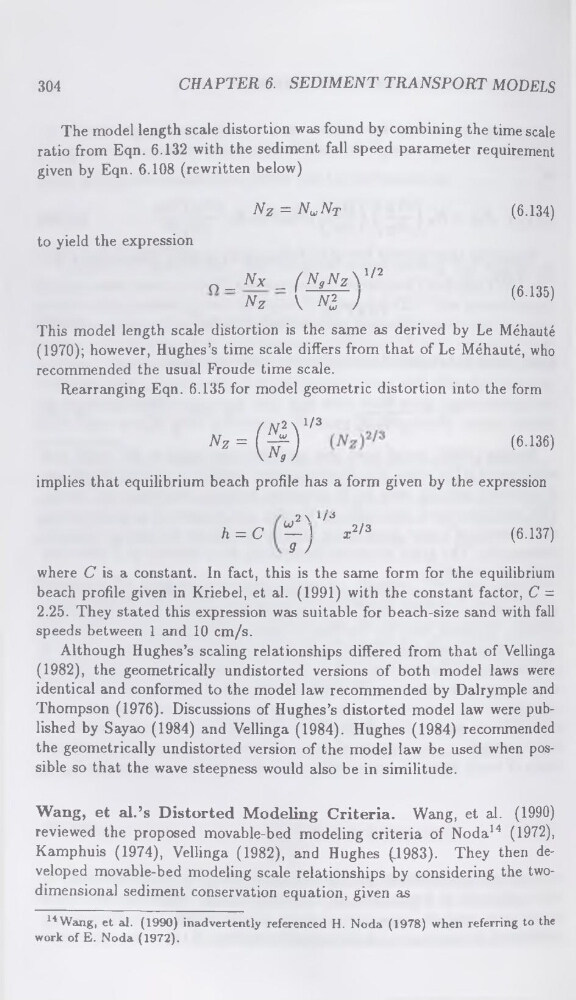
The model length scale distortion was found by combining the time scale
ratio from Eqn. 6.132 with the sediment fall speed parameter requirement
given by Eqn. 6.108 (rewritten below)
Nz = N^Nt
to yield the expression
o_ Nx _ (NgNz\'/2
Nz
\ N£ J
(6.134)
(6.135)
This model length scale distortion is the same as derived by Le Méhauté
(1970); however, Hughes’s time scale differs from that of Le Méhauté, who
recommended the usual Froude time scale.
Rearranging Eqn. 6.135 for model geometric distortion into the form
Nz =
/7V2\1/3
(<)
(6.136)
implies that equilibrium beach profile has a form given by the expression
h = C
, ,2\ V-i
u I
^2/3
-----X '
9 J
(6.137)
where C is a constant. In fact, this is the same form for the equilibrium
beach profile given in Kriebel, et al. (1991) with the constant factor, C =
2.25. They stated this expression was suitable for beach-size sand with fall
speeds between 1 and 10 cm/s.
Although Hughes’s scaling relationships differed from that of Vellinga
(1982), the geometrically undistorted versions of both model laws were
identical and conformed to the model law recommended by Dalrymple and
Thompson (1976). Discussions of Hughes’s distorted model law were published by Sayao (1984) and Vellinga (1984). Hughes (1984) recommended
the geometrically undistorted version of the model law be used when possible so that the wave steepness would also be in similitude.
Wang, et al.’s Distorted Modeling Criteria. Wang, et al. (1990)
reviewed the proposed movable-bed modeling criteria of Noda14 (1972),
Kamphuis (1974), Vellinga (1982), and Hughes (.1983). They then developed movable-bed modeling scale relationships by considering the twodimensional sediment conservation equation, given as
14 Wang, et al. (1990) inadvertently referenced H. Noda (1978) when referring to the
work of E. Noda (1972).
CHAPTER 6. SEDIMENT TRANSPORT MODELS
The model length scale distortion was found by combining the time scale
ratio from Eqn. 6.132 with the sediment fall speed parameter requirement
given by Eqn. 6.108 (rewritten below)
Nz = N^Nt
to yield the expression
o_ Nx _ (NgNz\'/2
Nz
\ N£ J
(6.134)
(6.135)
This model length scale distortion is the same as derived by Le Méhauté
(1970); however, Hughes’s time scale differs from that of Le Méhauté, who
recommended the usual Froude time scale.
Rearranging Eqn. 6.135 for model geometric distortion into the form
Nz =
/7V2\1/3
(<)
(6.136)
implies that equilibrium beach profile has a form given by the expression
h = C
, ,2\ V-i
u I
^2/3
-----X '
9 J
(6.137)
where C is a constant. In fact, this is the same form for the equilibrium
beach profile given in Kriebel, et al. (1991) with the constant factor, C =
2.25. They stated this expression was suitable for beach-size sand with fall
speeds between 1 and 10 cm/s.
Although Hughes’s scaling relationships differed from that of Vellinga
(1982), the geometrically undistorted versions of both model laws were
identical and conformed to the model law recommended by Dalrymple and
Thompson (1976). Discussions of Hughes’s distorted model law were published by Sayao (1984) and Vellinga (1984). Hughes (1984) recommended
the geometrically undistorted version of the model law be used when possible so that the wave steepness would also be in similitude.
Wang, et al.’s Distorted Modeling Criteria. Wang, et al. (1990)
reviewed the proposed movable-bed modeling criteria of Noda14 (1972),
Kamphuis (1974), Vellinga (1982), and Hughes (.1983). They then developed movable-bed modeling scale relationships by considering the twodimensional sediment conservation equation, given as
14 Wang, et al. (1990) inadvertently referenced H. Noda (1978) when referring to the
work of E. Noda (1972).