

302
CHAPTER 6. SEDIMENT TRANSPORT MODELS
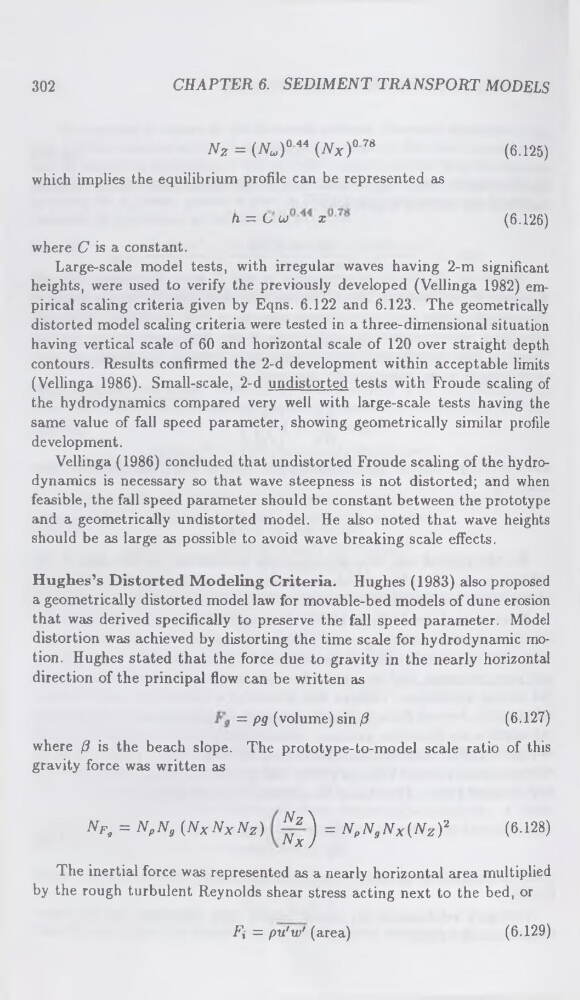
Nz = (N^0 44 (Nx)07s
(6.125)
which implies the equilibrium profile can be represented as
h = G a)
x
(6.126)
where C is a constant.
Large-scale model tests, with irregular waves having 2-m significant
heights, were used to verify the previously developed (Vellinga 1982) empirical scaling criteria given by Eqns. 6.122 and 6.123. The geometrically
distorted model scaling criteria were tested in a three-dimensional situation
having vertical scale of 60 and horizontal scale of 120 over straight depth
contours. Results confirmed the 2-d development within acceptable limits
(Vellinga 1986). Small-scale, 2-d undistorted tests with Froude scaling of
the hydrodynamics compared very well with large-scale tests having the
same value of fall speed parameter, showing geometrically similar profile
development.
Vellinga (1986) concluded that undistorted Froude scaling of the hydrodynamics is necessary so that wave steepness is not distorted; and when
feasible, the fall speed parameter should be constant between the prototype
and a geometrically undistorted model. He also noted that wave heights
should be as large as possible to avoid wave breaking scale effects.
Hughes’s Distorted Modeling Criteria. Hughes (1983) also proposed
a geometrically distorted model law for movable-bed models of dune erosion
that was derived specifically to preserve the fall speed parameter. Model
distortion was achieved by distorting the time scale for hydrodynamic motion. Hughes stated that the force due to gravity in the nearly horizontal
direction of the principal flow can be written as
= pg (volume) sin (3
(6.127)
where (3 is the beach slope. The prototype-to-model scale ratio of this
gravity force was written as
NFg = NpNg (NXNXNZ) Nz\
Nx) = NpN,Nx(NzŸ
(6.128)
The inertial force was represented as a nearly horizontal area multiplied
by the rough turbulent Reynolds shear stress acting next to the bed, or
Fi = pu'w' (area)
(6.129)
CHAPTER 6. SEDIMENT TRANSPORT MODELS
Nz = (N^0 44 (Nx)07s
(6.125)
which implies the equilibrium profile can be represented as
h = G a)
x
(6.126)
where C is a constant.
Large-scale model tests, with irregular waves having 2-m significant
heights, were used to verify the previously developed (Vellinga 1982) empirical scaling criteria given by Eqns. 6.122 and 6.123. The geometrically
distorted model scaling criteria were tested in a three-dimensional situation
having vertical scale of 60 and horizontal scale of 120 over straight depth
contours. Results confirmed the 2-d development within acceptable limits
(Vellinga 1986). Small-scale, 2-d undistorted tests with Froude scaling of
the hydrodynamics compared very well with large-scale tests having the
same value of fall speed parameter, showing geometrically similar profile
development.
Vellinga (1986) concluded that undistorted Froude scaling of the hydrodynamics is necessary so that wave steepness is not distorted; and when
feasible, the fall speed parameter should be constant between the prototype
and a geometrically undistorted model. He also noted that wave heights
should be as large as possible to avoid wave breaking scale effects.
Hughes’s Distorted Modeling Criteria. Hughes (1983) also proposed
a geometrically distorted model law for movable-bed models of dune erosion
that was derived specifically to preserve the fall speed parameter. Model
distortion was achieved by distorting the time scale for hydrodynamic motion. Hughes stated that the force due to gravity in the nearly horizontal
direction of the principal flow can be written as
= pg (volume) sin (3
(6.127)
where (3 is the beach slope. The prototype-to-model scale ratio of this
gravity force was written as
NFg = NpNg (NXNXNZ) Nz\
Nx) = NpN,Nx(NzŸ
(6.128)
The inertial force was represented as a nearly horizontal area multiplied
by the rough turbulent Reynolds shear stress acting next to the bed, or
Fi = pu'w' (area)
(6.129)