

6.4. SUSPENSION-DOMINATED MODELS
301
Ntm = {NzY
(6.120)
Hydrodynamics were scaled according to the undistorted Froude criterion
based on the vertical length scale, i.e.,
Nt — \/Nz
(6.121)
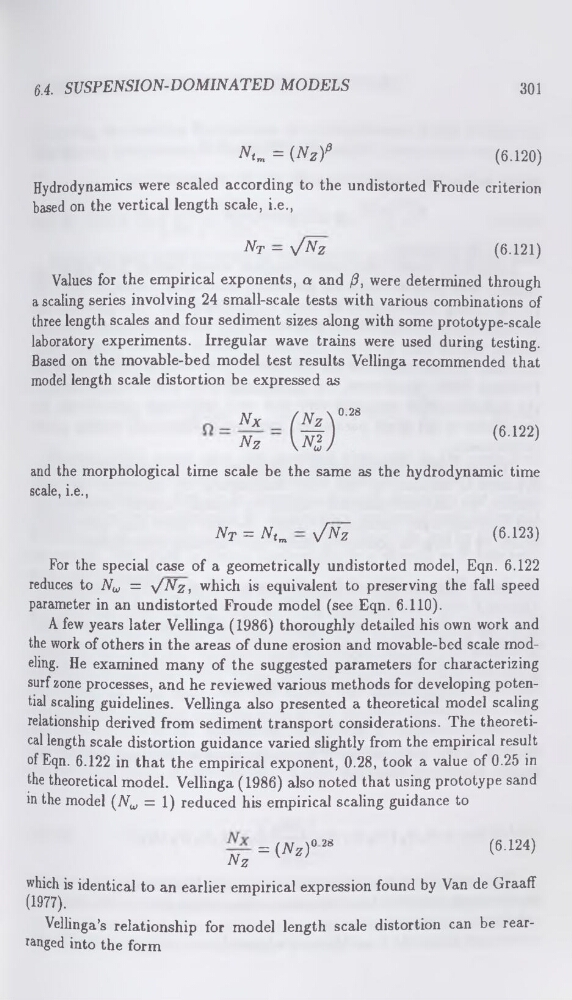
Values for the empirical exponents, a and /?, were determined through
a scaling series involving 24 small-scale tests with various combinations of
three length scales and four sediment sizes along with some prototype-scale
laboratory experiments. Irregular wave trains were used during testing.
Based on the movable-bed model test results Vellinga recommended that
model length scale distortion be expressed as
Nx
Nz
(6.122)
and the morphological time scale be the same as the hydrodynamic time
scale, i.e.,
y/N^
7VT = Ntm
(6.123)
For the special case of a geometrically undistorted model, Eqn. 6.122
reduces to Nu = y/Nz, which is equivalent to preserving the fall speed
parameter in an undistorted Froude model (see Eqn. 6.110).
A few years later Vellinga (1986) thoroughly detailed his own work and
the work of others in the areas of dune erosion and movable-bed scale modeling. He examined many of the suggested parameters for characterizing
surf zone processes, and he reviewed various methods for developing potential scaling guidelines. Vellinga also presented a theoretical model scaling
relationship derived from sediment transport considerations. The theoretical length scale distortion guidance varied slightly from the empirical result
of Eqn. 6.122 in that the empirical exponent, 0.28, took a value of 0.25 in
the theoretical model. Vellinga ( 1986) also noted that using prototype sand
in the model (Vw = 1) reduced his empirical scaling guidance to
= (Nz)0 28
( 6.124)
Nz
which is identical to an earlier empirical expression found by Van de Graaff
(1977).
Vellinga’s relationship for model length scale distortion can be rearranged into the form
301
Ntm = {NzY
(6.120)
Hydrodynamics were scaled according to the undistorted Froude criterion
based on the vertical length scale, i.e.,
Nt — \/Nz
(6.121)
Values for the empirical exponents, a and /?, were determined through
a scaling series involving 24 small-scale tests with various combinations of
three length scales and four sediment sizes along with some prototype-scale
laboratory experiments. Irregular wave trains were used during testing.
Based on the movable-bed model test results Vellinga recommended that
model length scale distortion be expressed as
Nx
Nz
(6.122)
and the morphological time scale be the same as the hydrodynamic time
scale, i.e.,
y/N^
7VT = Ntm
(6.123)
For the special case of a geometrically undistorted model, Eqn. 6.122
reduces to Nu = y/Nz, which is equivalent to preserving the fall speed
parameter in an undistorted Froude model (see Eqn. 6.110).
A few years later Vellinga (1986) thoroughly detailed his own work and
the work of others in the areas of dune erosion and movable-bed scale modeling. He examined many of the suggested parameters for characterizing
surf zone processes, and he reviewed various methods for developing potential scaling guidelines. Vellinga also presented a theoretical model scaling
relationship derived from sediment transport considerations. The theoretical length scale distortion guidance varied slightly from the empirical result
of Eqn. 6.122 in that the empirical exponent, 0.28, took a value of 0.25 in
the theoretical model. Vellinga ( 1986) also noted that using prototype sand
in the model (Vw = 1) reduced his empirical scaling guidance to
= (Nz)0 28
( 6.124)
Nz
which is identical to an earlier empirical expression found by Van de Graaff
(1977).
Vellinga’s relationship for model length scale distortion can be rearranged into the form