

300
CHAPTER 6. SEDIMENT TRANSPORT MODELS
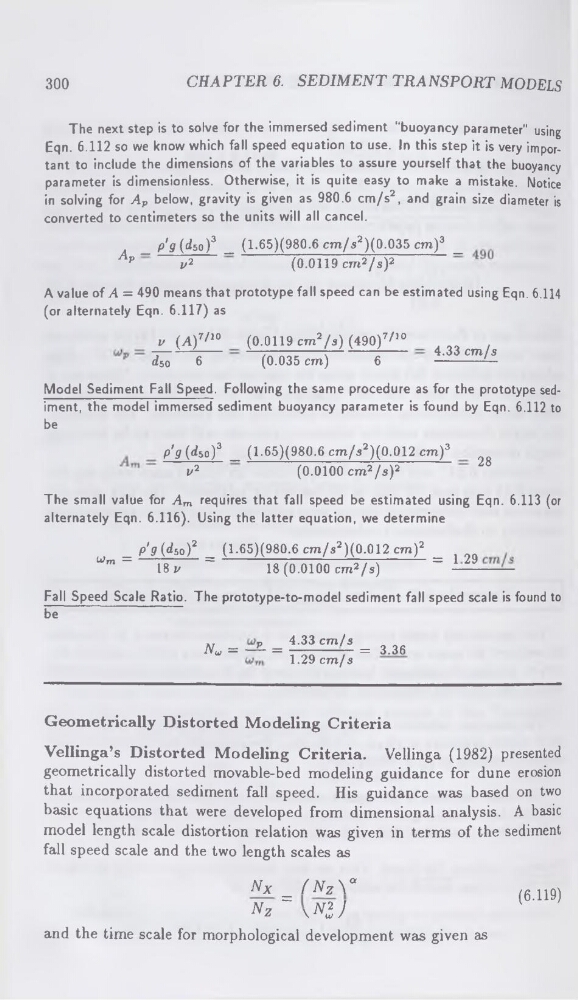
The next step is to solve for the immersed sediment ‘‘buoyancy parameter" using
Eqn. 6.112 so we know which fall speed equation to use. In this step it is very important to include the dimensions of the variables to assure yourself that the buoyancy
parameter is dimensionless. Otherwise, it is quite easy to make a mistake. Notice
in solving for Ap below, gravity is given as 980.6 cm/s2, and grain size diameter is
converted to centimeters so the units will all cancel.
_ p'g (< * 50 )3 _ (1.65)(980.6 cm/s2)(0.035 cm)3 _
Ap
v2
(0.0119 cm2/s)2
A value of A = 490 means that prototype fall speed can be estimated using Eqn. 6.114
(or alternately Eqn. 6.117) as
v (A)7/10
dso
6
(0.0119 cm2/s) (490)7/1°
(0.035 cm)
6
4.33 cm/s
Model Sediment Fall Speed. Following the same procedure as for the prototype sediment, the model immersed sediment buoyancy parameter is found by Eqn. 6.112 to
be
pzf/(dio)3 _ (1.65)(980.6 cm/s2)(0.012 cm)3
i/2
(0.0100 cm2/s)2
28
The small value for Am requires that fall speed be estimated using Eqn. 6.113 (or
alternately Eqn. 6.116). Using the latter equation, we determine
p'gÇdso)2
(1.65)(980.6 cm/s2)(0.012 cm)2
"m = ~1ST- = ---------- ÏS(0.5ÏÔ0 enP/s)----------- = 129
Fall Speed Scale Ratio. The prototype-to-model sediment fall speed scale is found to
be
..
4.33 cm/s
Nu = -^ = —------ = 3.36
1.29 cm/s
Geometrically Distorted Modeling Criteria
Vellinga’s Distorted Modeling Criteria. Vellinga (1982) presented
geometrically distorted movable-bed modeling guidance for dune erosion
that incorporated sediment fall speed. His guidance was based on two
basic equations that were developed from dimensional analysis. A basic
model length scale distortion relation was given in terms of the sediment
fall speed scale and the two length scales as
Nx = (Nz\a
Hz
\N^J
and the time scale for morphological development was given as
(6.119)
CHAPTER 6. SEDIMENT TRANSPORT MODELS
The next step is to solve for the immersed sediment ‘‘buoyancy parameter" using
Eqn. 6.112 so we know which fall speed equation to use. In this step it is very important to include the dimensions of the variables to assure yourself that the buoyancy
parameter is dimensionless. Otherwise, it is quite easy to make a mistake. Notice
in solving for Ap below, gravity is given as 980.6 cm/s2, and grain size diameter is
converted to centimeters so the units will all cancel.
_ p'g (< * 50 )3 _ (1.65)(980.6 cm/s2)(0.035 cm)3 _
Ap
v2
(0.0119 cm2/s)2
A value of A = 490 means that prototype fall speed can be estimated using Eqn. 6.114
(or alternately Eqn. 6.117) as
v (A)7/10
dso
6
(0.0119 cm2/s) (490)7/1°
(0.035 cm)
6
4.33 cm/s
Model Sediment Fall Speed. Following the same procedure as for the prototype sediment, the model immersed sediment buoyancy parameter is found by Eqn. 6.112 to
be
pzf/(dio)3 _ (1.65)(980.6 cm/s2)(0.012 cm)3
i/2
(0.0100 cm2/s)2
28
The small value for Am requires that fall speed be estimated using Eqn. 6.113 (or
alternately Eqn. 6.116). Using the latter equation, we determine
p'gÇdso)2
(1.65)(980.6 cm/s2)(0.012 cm)2
"m = ~1ST- = ---------- ÏS(0.5ÏÔ0 enP/s)----------- = 129
Fall Speed Scale Ratio. The prototype-to-model sediment fall speed scale is found to
be
..
4.33 cm/s
Nu = -^ = —------ = 3.36
1.29 cm/s
Geometrically Distorted Modeling Criteria
Vellinga’s Distorted Modeling Criteria. Vellinga (1982) presented
geometrically distorted movable-bed modeling guidance for dune erosion
that incorporated sediment fall speed. His guidance was based on two
basic equations that were developed from dimensional analysis. A basic
model length scale distortion relation was given in terms of the sediment
fall speed scale and the two length scales as
Nx = (Nz\a
Hz
\N^J
and the time scale for morphological development was given as
(6.119)