

6.4, SUSPENSION-DOMINATED MODELS
299
_ PZg(^5o)2
w
18 V
For (A < 39)
/ I \7/l° < J
_ (P <7)
(^50)
6 (p)2/5
For (39 < A < 104)
(6.116)
(6.117)
_ (p'g)1/2 (rfso)'/2
W
0.91
For (104 < A < 3 x 10⁶)
(6.118)
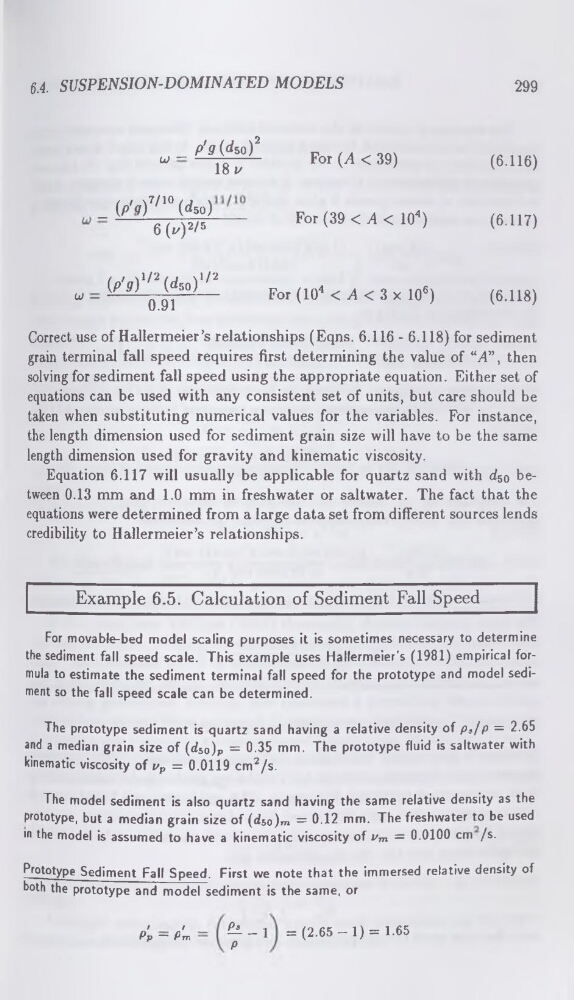
Correct use of Hallermeier’s relationships (Eqns. 6.116 - 6.118) for sediment
grain terminal fall speed requires first determining the value of “4”, then
solving for sediment fall speed using the appropriate equation. Either set of
equations can be used with any consistent set of units, but care should be
taken when substituting numerical values for the variables. For instance,
the length dimension used for sediment grain size will have to be the same
length dimension used for gravity and kinematic viscosity.
Equation 6.117 will usually be applicable for quartz sand with d50 between 0.13 mm and 1.0 mm in freshwater or saltwater. The fact that the
equations were determined from a large data set from different sources lends
credibility to Hallermeier’s relationships.
Example 6.5. Calculation of Sediment Fall Speed
For movable-bed model scaling purposes it is sometimes necessary to determine
the sediment fall speed scale. This example uses Hallermeier’s (1981) empirical formula to estimate the sediment terminal fall speed for the prototype and model sediment so the fall speed scale can be determined.
The prototype sediment is quartz sand having a relative density of ps/p = 2.65
and a median grain size of (d50)p = 0.35 mm. The prototype fluid is saltwater with
kinematic viscosity of vp = 0.0119 cm2/s.
The model sediment is also quartz sand having the same relative density as the
prototype, but a median grain size of (dso)m = 0.12 mm. The freshwater to be used
m the model is assumed to have a kinematic viscosity of vm = 0.0100 cm /s.
Prototype Sediment Fall Speed. First we note that the immersed relative density of
both the prototype and model sediment is the same, or
/
/
Pp ~~ Pm
^-1
P
= (2.65 - 1) = 1.65
299
_ PZg(^5o)2
w
18 V
For (A < 39)
/ I \7/l° < J
_ (P <7)
(^50)
6 (p)2/5
For (39 < A < 104)
(6.116)
(6.117)
_ (p'g)1/2 (rfso)'/2
W
0.91
For (104 < A < 3 x 10⁶)
(6.118)
Correct use of Hallermeier’s relationships (Eqns. 6.116 - 6.118) for sediment
grain terminal fall speed requires first determining the value of “4”, then
solving for sediment fall speed using the appropriate equation. Either set of
equations can be used with any consistent set of units, but care should be
taken when substituting numerical values for the variables. For instance,
the length dimension used for sediment grain size will have to be the same
length dimension used for gravity and kinematic viscosity.
Equation 6.117 will usually be applicable for quartz sand with d50 between 0.13 mm and 1.0 mm in freshwater or saltwater. The fact that the
equations were determined from a large data set from different sources lends
credibility to Hallermeier’s relationships.
Example 6.5. Calculation of Sediment Fall Speed
For movable-bed model scaling purposes it is sometimes necessary to determine
the sediment fall speed scale. This example uses Hallermeier’s (1981) empirical formula to estimate the sediment terminal fall speed for the prototype and model sediment so the fall speed scale can be determined.
The prototype sediment is quartz sand having a relative density of ps/p = 2.65
and a median grain size of (d50)p = 0.35 mm. The prototype fluid is saltwater with
kinematic viscosity of vp = 0.0119 cm2/s.
The model sediment is also quartz sand having the same relative density as the
prototype, but a median grain size of (dso)m = 0.12 mm. The freshwater to be used
m the model is assumed to have a kinematic viscosity of vm = 0.0100 cm /s.
Prototype Sediment Fall Speed. First we note that the immersed relative density of
both the prototype and model sediment is the same, or
/
/
Pp ~~ Pm
^-1
P
= (2.65 - 1) = 1.65