

298
CHAPTER 6. SEDIMENT TRANSPORT MODELS
grains without fluid motion provide simpler relationships for engineering
use.
A number of empirical fall speed relationships are available for use in
movable-bed modeling, and all of them should provide similar results. A
particularly useful set of relationships was presented by Hallermeier (1981).
He assembled a large data set of previously determined experimental values
of sediment terminal fall speed and associated properties of the sediment
and fluid. Hallermeier related the sediment fall speed Reynolds number to
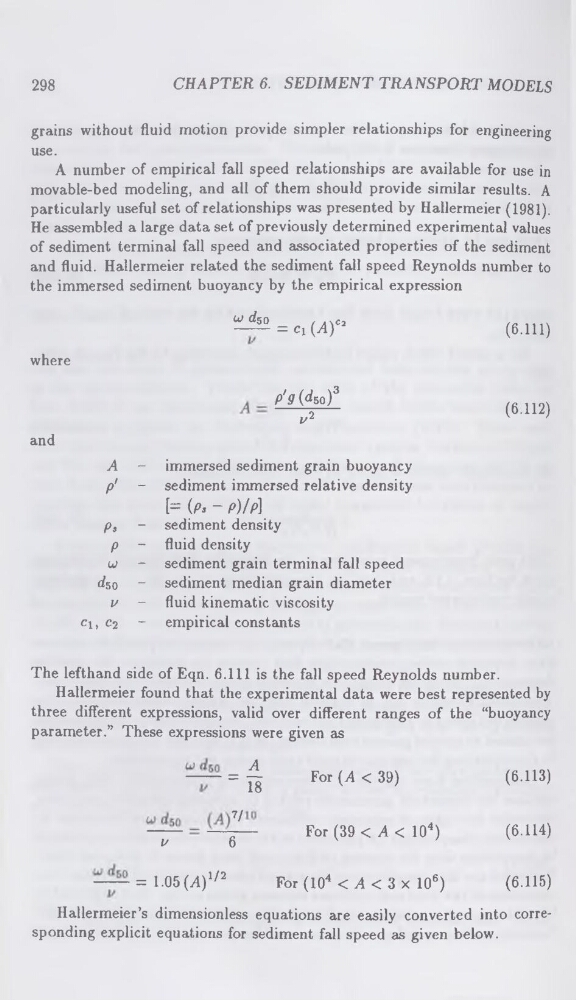
the immersed sediment buoyancy by the empirical expression
w d$o
= C! (A^
(6.111)
where
p'ff(d50)3
y2
(6.112)
and
A
-
immersed sediment grain buoyancy
p'
- sediment immersed relative density
[= (p> ~ p)/p]
ps
- sediment density
p
- fluid density
w
- sediment grain terminal fall speed
d^o
-
sediment median grain diameter
y
- fluid kinematic viscosity
ci, C2 - empirical constants
The lefthand side of Eqn. 6.111 is the fall speed Reynolds number.
Hallermeier found that the experimental data were best represented by
three different expressions, valid over different ranges of the “buoyancy
parameter.” These expressions were given as
~ = 4
For (4 < 39)
(6.113)
/
For (39 < A < IO4)
(6.114)
y
6
= 1.05 (A)1/2
For (104 < A < 3 x 10⁶)
(6.115)
Hallermeier’s dimensionless equations are easily converted into corresponding explicit equations for sediment fall speed as given below.
CHAPTER 6. SEDIMENT TRANSPORT MODELS
grains without fluid motion provide simpler relationships for engineering
use.
A number of empirical fall speed relationships are available for use in
movable-bed modeling, and all of them should provide similar results. A
particularly useful set of relationships was presented by Hallermeier (1981).
He assembled a large data set of previously determined experimental values
of sediment terminal fall speed and associated properties of the sediment
and fluid. Hallermeier related the sediment fall speed Reynolds number to
the immersed sediment buoyancy by the empirical expression
w d$o
= C! (A^
(6.111)
where
p'ff(d50)3
y2
(6.112)
and
A
-
immersed sediment grain buoyancy
p'
- sediment immersed relative density
[= (p> ~ p)/p]
ps
- sediment density
p
- fluid density
w
- sediment grain terminal fall speed
d^o
-
sediment median grain diameter
y
- fluid kinematic viscosity
ci, C2 - empirical constants
The lefthand side of Eqn. 6.111 is the fall speed Reynolds number.
Hallermeier found that the experimental data were best represented by
three different expressions, valid over different ranges of the “buoyancy
parameter.” These expressions were given as
~ = 4
For (4 < 39)
(6.113)
/
For (39 < A < IO4)
(6.114)
y
6
= 1.05 (A)1/2
For (104 < A < 3 x 10⁶)
(6.115)
Hallermeier’s dimensionless equations are easily converted into corresponding explicit equations for sediment fall speed as given below.