

Q.4. SUSPENSION-DOMINATED MODELS
297
(6.107)
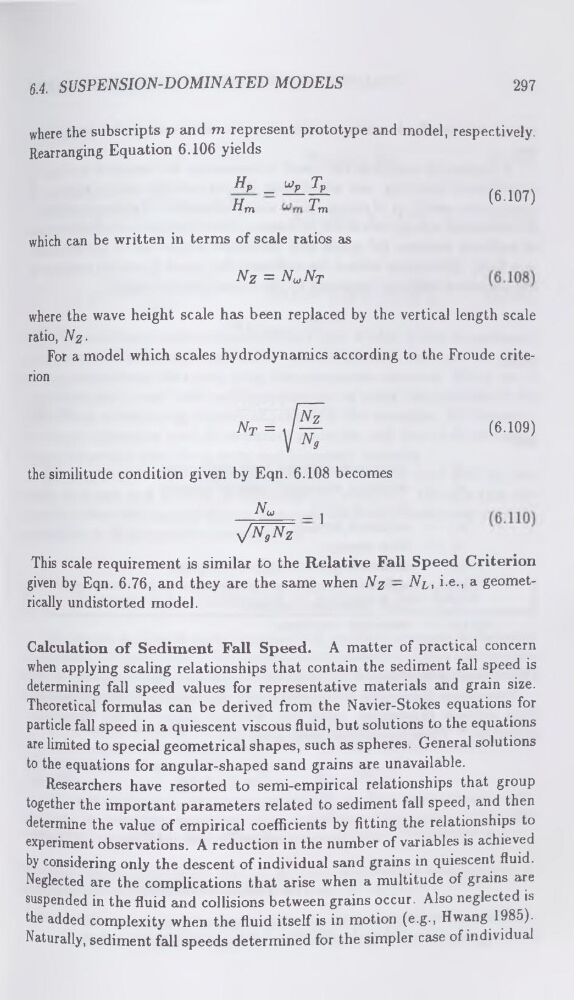
where the subscripts p and m represent prototype and model, respectively.
Rearranging Equation 6.106 yields
Up _ Wp Tp
Um
Tm
which can be written in terms of scale ratios as
Nz = NuNt
where the wave height scale has been replaced by the vertical length scale
ratio, NzFor a model which scales hydrodynamics according to the Froude criterion
(6.109)
the similitude condition given by Eqn. 6.108 becomes
N„
_ 1
y/N^z
This scale requirement is similar to the Relative Fall Speed Criterion
given by Eqn. 6.76, and they are the same when Nz — N^, i.e., a geometrically undistorted model.
Calculation of Sediment Fall Speed. A matter of practical concern
when applying scaling relationships that contain the sediment fall speed is
determining fall speed values for representative materials and grain size.
Theoretical formulas can be derived from the Navier-Stokes equations for
particle fall speed in a quiescent viscous fluid, but solutions to the equations
are limited to special geometrical shapes, such as spheres. General solutions
to the equations for angular-shaped sand grains are unavailable.
Researchers have resorted to semi-empirical relationships that group
together the important parameters related to sediment fall speed, and then
determine the value of empirical coefficients by fitting the relationships to
experiment observations. A reduction in the number of variables is achieved
by considering only the descent of individual sand grains in quiescent fluid.
Neglected are the complications that arise when a multitude of grains are
suspended in the fluid and collisions between grains occur. Also neglected is
the added complexity when the fluid itself is in motion (e.g., Hwang 1985).
Naturally, sediment fall speeds determined for the simpler case of individual
297
(6.107)
where the subscripts p and m represent prototype and model, respectively.
Rearranging Equation 6.106 yields
Up _ Wp Tp
Um
Tm
which can be written in terms of scale ratios as
Nz = NuNt
where the wave height scale has been replaced by the vertical length scale
ratio, NzFor a model which scales hydrodynamics according to the Froude criterion
(6.109)
the similitude condition given by Eqn. 6.108 becomes
N„
_ 1
y/N^z
This scale requirement is similar to the Relative Fall Speed Criterion
given by Eqn. 6.76, and they are the same when Nz — N^, i.e., a geometrically undistorted model.
Calculation of Sediment Fall Speed. A matter of practical concern
when applying scaling relationships that contain the sediment fall speed is
determining fall speed values for representative materials and grain size.
Theoretical formulas can be derived from the Navier-Stokes equations for
particle fall speed in a quiescent viscous fluid, but solutions to the equations
are limited to special geometrical shapes, such as spheres. General solutions
to the equations for angular-shaped sand grains are unavailable.
Researchers have resorted to semi-empirical relationships that group
together the important parameters related to sediment fall speed, and then
determine the value of empirical coefficients by fitting the relationships to
experiment observations. A reduction in the number of variables is achieved
by considering only the descent of individual sand grains in quiescent fluid.
Neglected are the complications that arise when a multitude of grains are
suspended in the fluid and collisions between grains occur. Also neglected is
the added complexity when the fluid itself is in motion (e.g., Hwang 1985).
Naturally, sediment fall speeds determined for the simpler case of individual