

206
CHAPTER 5. COASTAL STRUCTURE MODELS
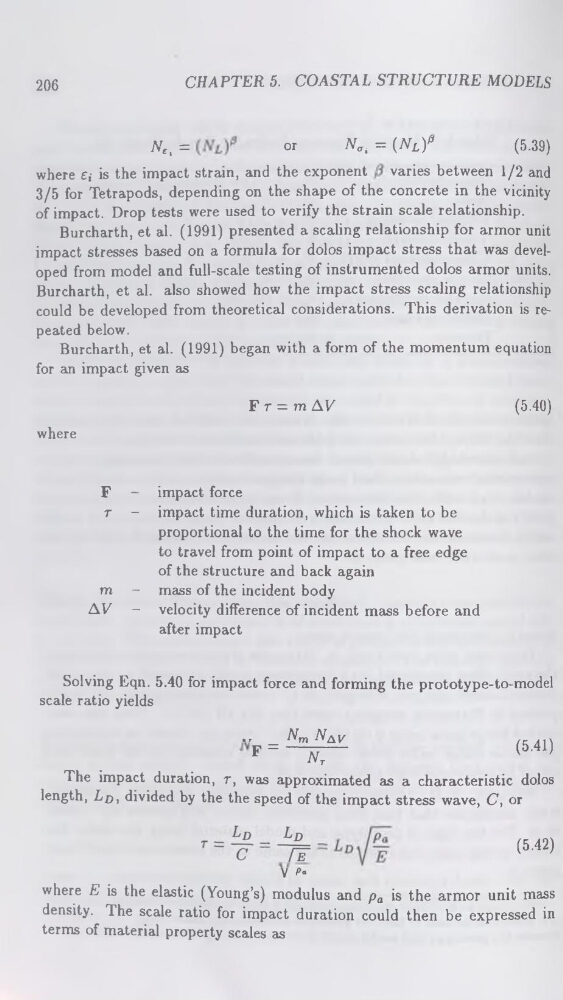
Ne, =
or
Nai = (NlY3
(5.39)
where £,• is the impact strain, and the exponent varies between 1/2 and
3/5 for Tetrapods, depending on the shape of the concrete in the vicinity
of impact. Drop tests were used to verify the strain scale relationship.
Burcharth, et al. (1991) presented a scaling relationship for armor unit
impact stresses based on a formula for dolos impact stress that was developed from model and full-scale testing of instrumented dolos armor units.
Burcharth, et al. also showed how the impact stress scaling relationship
could be developed from theoretical considerations. This derivation is repeated below.
Burcharth, et al. (1991) began with a form of the momentum equation
for an impact given as
F r = m AV
(5.40)
where
F - impact force
t - impact time duration, which is taken to be
proportional to the time for the shock wave
to travel from point of impact to a free edge
of the structure and back again
m - mass of the incident body
△V - velocity difference of incident mass before and
after impact
Solving Eqn. 5.40 for impact force and forming the prototype-to-model
scale ratio yields
„ = Nm Nav
F
Nt
(5.41)
The impact duration, r, was approximated as a characteristic dolos
length, Lp, divided by the the speed of the impact stress wave, C, or
\ Pa
(5.42)
where E is the elastic (Young’s) modulus and pa is the armor unit mass
density. The scale ratio for impact duration could then be expressed in
terms of material property scales as
CHAPTER 5. COASTAL STRUCTURE MODELS
Ne, =
or
Nai = (NlY3
(5.39)
where £,• is the impact strain, and the exponent varies between 1/2 and
3/5 for Tetrapods, depending on the shape of the concrete in the vicinity
of impact. Drop tests were used to verify the strain scale relationship.
Burcharth, et al. (1991) presented a scaling relationship for armor unit
impact stresses based on a formula for dolos impact stress that was developed from model and full-scale testing of instrumented dolos armor units.
Burcharth, et al. also showed how the impact stress scaling relationship
could be developed from theoretical considerations. This derivation is repeated below.
Burcharth, et al. (1991) began with a form of the momentum equation
for an impact given as
F r = m AV
(5.40)
where
F - impact force
t - impact time duration, which is taken to be
proportional to the time for the shock wave
to travel from point of impact to a free edge
of the structure and back again
m - mass of the incident body
△V - velocity difference of incident mass before and
after impact
Solving Eqn. 5.40 for impact force and forming the prototype-to-model
scale ratio yields
„ = Nm Nav
F
Nt
(5.41)
The impact duration, r, was approximated as a characteristic dolos
length, Lp, divided by the the speed of the impact stress wave, C, or
\ Pa
(5.42)
where E is the elastic (Young’s) modulus and pa is the armor unit mass
density. The scale ratio for impact duration could then be expressed in
terms of material property scales as