

5.2. RUBBLE-MOUND STRUCTURES
207
Nr =
V ne
(5.43)
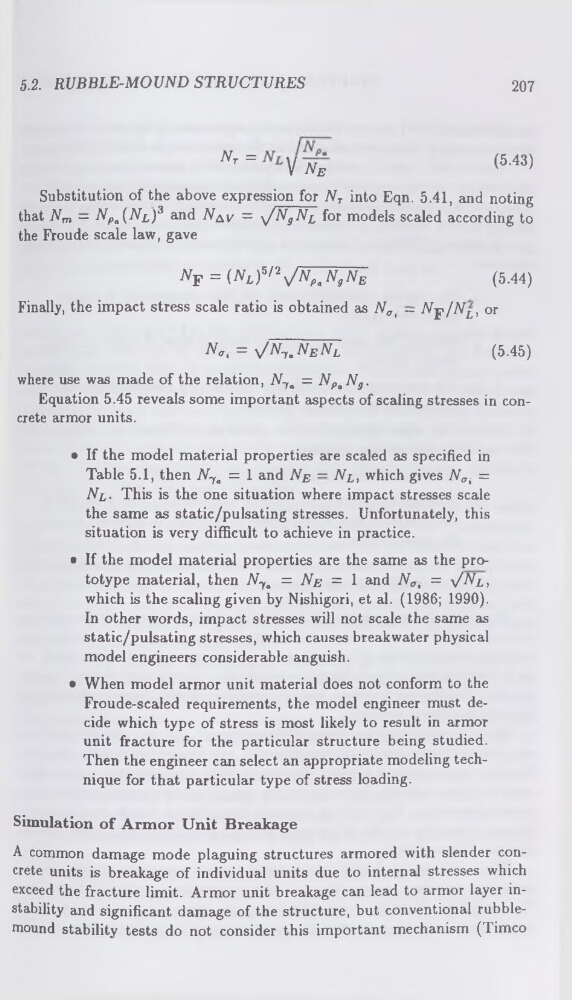
Substitution of the above expression for NT into Eqn. 5.41, and noting
that Nm — NPa(NL)3 and N&y = ^/NgN^ for models scaled according to
the Froude scale law, gave
JVF = (Wl)5/V^.'VsWe
(5.44)
Finally, the impact stress scale ratio is obtained as Nat ~ Ny/N^, or
N,, = ^Ny.NENL
(5.45)
where use was made of the relation, Nlo = NPaNg.
Equation 5.45 reveals some important aspects of scaling stresses in concrete armor units.
• If the model material properties are scaled as specified in
Table 5.1, then Nla = 1 and NE — NE, which gives Nai =
Nl- This is the one situation where impact stresses scale
the same as static/pulsating stresses. Unfortunately, this
situation is very difficult to achieve in practice.
• If the model material properties are the same as the prototype material, then Nla = NE = 1 and Na> = y/N^,
which is the scaling given by Nishigori, et al. (1986; 1990).
In other words, impact stresses will not scale the same as
static/pulsating stresses, which causes breakwater physical
model engineers considerable anguish.
• When model armor unit material does not conform to the
Froude-scaled requirements, the model engineer must decide which type of stress is most likely to result in armor
unit fracture for the particular structure being studied.
Then the engineer can select an appropriate modeling technique for that particular type of stress loading.
Simulation of Armor Unit Breakage
A common damage mode plaguing structures armored with slender concrete units is breakage of individual units due to internal stresses which
exceed the fracture limit. Armor unit breakage can lead to armor layer instability and significant damage of the structure, but conventional rubblemound stability tests do not consider this important mechanism (Timco
207
Nr =
V ne
(5.43)
Substitution of the above expression for NT into Eqn. 5.41, and noting
that Nm — NPa(NL)3 and N&y = ^/NgN^ for models scaled according to
the Froude scale law, gave
JVF = (Wl)5/V^.'VsWe
(5.44)
Finally, the impact stress scale ratio is obtained as Nat ~ Ny/N^, or
N,, = ^Ny.NENL
(5.45)
where use was made of the relation, Nlo = NPaNg.
Equation 5.45 reveals some important aspects of scaling stresses in concrete armor units.
• If the model material properties are scaled as specified in
Table 5.1, then Nla = 1 and NE — NE, which gives Nai =
Nl- This is the one situation where impact stresses scale
the same as static/pulsating stresses. Unfortunately, this
situation is very difficult to achieve in practice.
• If the model material properties are the same as the prototype material, then Nla = NE = 1 and Na> = y/N^,
which is the scaling given by Nishigori, et al. (1986; 1990).
In other words, impact stresses will not scale the same as
static/pulsating stresses, which causes breakwater physical
model engineers considerable anguish.
• When model armor unit material does not conform to the
Froude-scaled requirements, the model engineer must decide which type of stress is most likely to result in armor
unit fracture for the particular structure being studied.
Then the engineer can select an appropriate modeling technique for that particular type of stress loading.
Simulation of Armor Unit Breakage
A common damage mode plaguing structures armored with slender concrete units is breakage of individual units due to internal stresses which
exceed the fracture limit. Armor unit breakage can lead to armor layer instability and significant damage of the structure, but conventional rubblemound stability tests do not consider this important mechanism (Timco