

5.2. RUBBLE-MOUND STRUCTURES
205
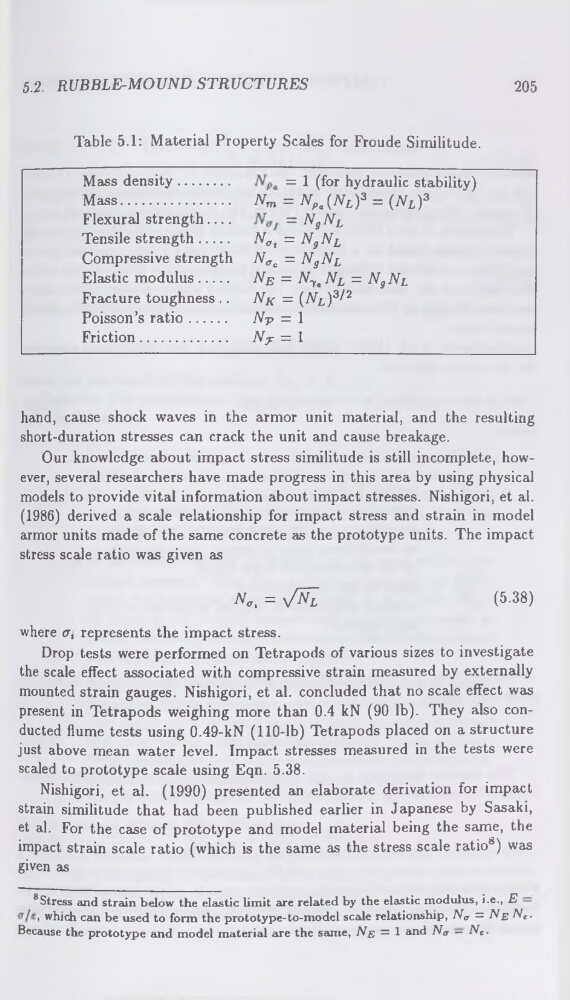
Table 5.1: Material Property Scales for Froude Similitude.
Mass density.............
= 1 (for hydraulic stability)
Mass...........................
Nm = NpANl)3 = {NlY
Flexural strength....
= n9nl
Tensile strength.......
Nat = N9Nl
Compressive strength Nac = NgNL
Elastic modulus.......
ne = NyaNL = NgNL
Fracture toughness ..
Nk = (nl)3'2
Poisson’s ratio.........
Np = 1
Friction......................
Nr = 1
8Stress and strain below the elastic limit are related by the elastic modulus, i.e., E —
which can be used to form the prototype-to-model scale relationship, Na = Ne Ne.
Because the prototype and model material are the same, Ne = 1 an<^ Na- — Nchand, cause shock waves in the armor unit material, and the resulting
short-duration stresses can crack the unit and cause breakage.
Our knowledge about impact stress similitude is still incomplete, however, several researchers have made progress in this area by using physical
models to provide vital information about impact stresses. Nishigori, et al.
(1986) derived a scale relationship for impact stress and strain in model
armor units made of the same concrete as the prototype units. The impact
stress scale ratio was given as
Na, = x/Wl
(5-38)
where a, represents the impact stress.
Drop tests were performed on Tetrapods of various sizes to investigate
the scale effect associated with compressive strain measured by externally
mounted strain gauges. Nishigori, et al. concluded that no scale effect was
present in Tetrapods weighing more than 0.4 kN (90 lb). They also conducted flume tests using 0.49-kN (110-lb) Tetrapods placed on a structure
just above mean water level. Impact stresses measured in the tests were
scaled to prototype scale using Eqn. 5.38.
Nishigori, et al. (1990) presented an elaborate derivation for impact
strain similitude that had been published earlier in Japanese by Sasaki,
et al. For the case of prototype and model material being the same, the
impact strain scale ratio (which is the same as the stress scale ratio8) was
given as
205
Table 5.1: Material Property Scales for Froude Similitude.
Mass density.............
= 1 (for hydraulic stability)
Mass...........................
Nm = NpANl)3 = {NlY
Flexural strength....
= n9nl
Tensile strength.......
Nat = N9Nl
Compressive strength Nac = NgNL
Elastic modulus.......
ne = NyaNL = NgNL
Fracture toughness ..
Nk = (nl)3'2
Poisson’s ratio.........
Np = 1
Friction......................
Nr = 1
8Stress and strain below the elastic limit are related by the elastic modulus, i.e., E —
which can be used to form the prototype-to-model scale relationship, Na = Ne Ne.
Because the prototype and model material are the same, Ne = 1 an<^ Na- — Nchand, cause shock waves in the armor unit material, and the resulting
short-duration stresses can crack the unit and cause breakage.
Our knowledge about impact stress similitude is still incomplete, however, several researchers have made progress in this area by using physical
models to provide vital information about impact stresses. Nishigori, et al.
(1986) derived a scale relationship for impact stress and strain in model
armor units made of the same concrete as the prototype units. The impact
stress scale ratio was given as
Na, = x/Wl
(5-38)
where a, represents the impact stress.
Drop tests were performed on Tetrapods of various sizes to investigate
the scale effect associated with compressive strain measured by externally
mounted strain gauges. Nishigori, et al. concluded that no scale effect was
present in Tetrapods weighing more than 0.4 kN (90 lb). They also conducted flume tests using 0.49-kN (110-lb) Tetrapods placed on a structure
just above mean water level. Impact stresses measured in the tests were
scaled to prototype scale using Eqn. 5.38.
Nishigori, et al. (1990) presented an elaborate derivation for impact
strain similitude that had been published earlier in Japanese by Sasaki,
et al. For the case of prototype and model material being the same, the
impact strain scale ratio (which is the same as the stress scale ratio8) was
given as